

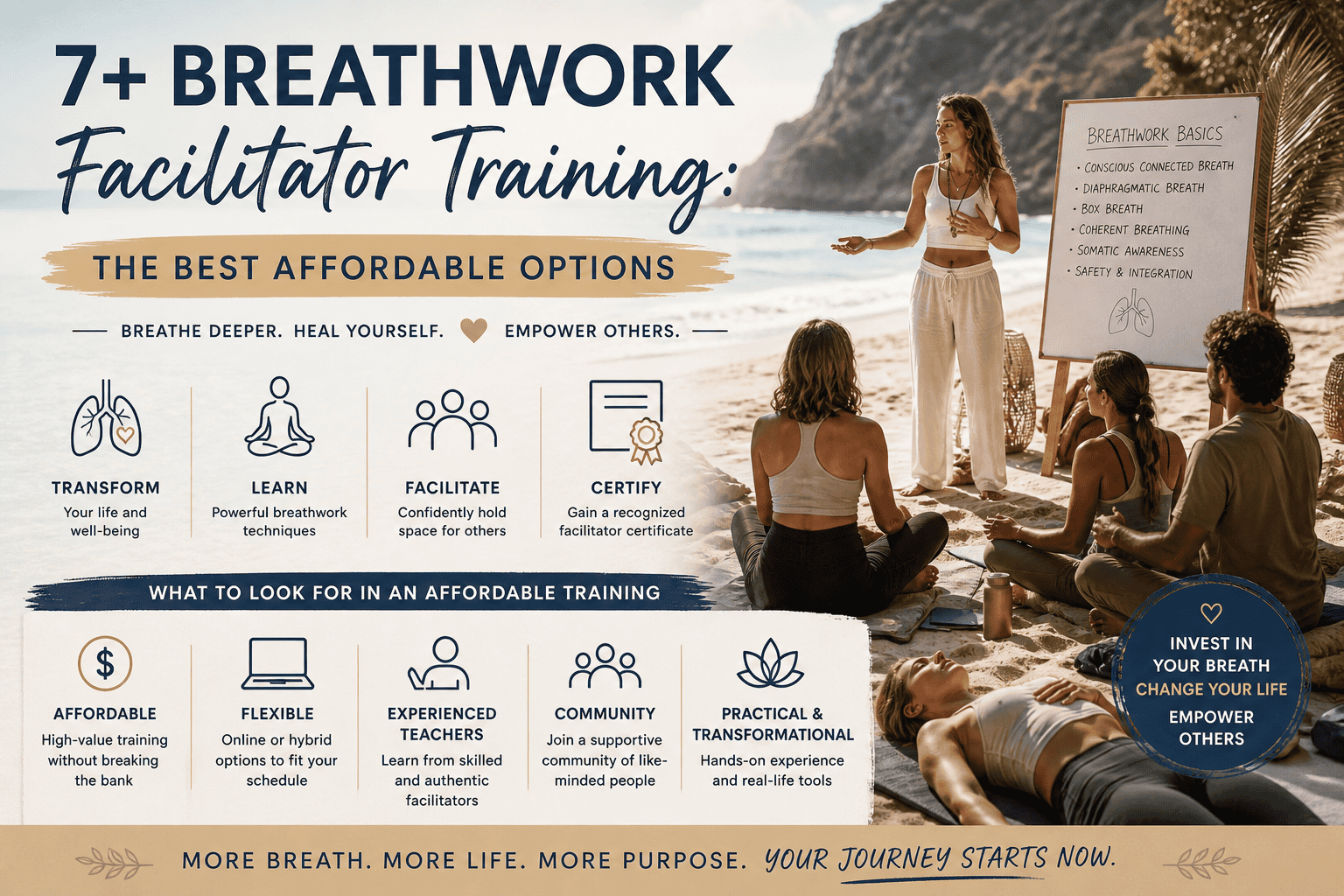
Breathwork facilitator training teaches aspiring practitioners how to safely guide individuals and groups through conscious breathing practices for wellbeing, emotional healing, and personal growth. The best programs in 2026 blend evidence-based breathwork methods, trauma-informed skills, practical teaching experience, and professional certification—creating a foundation for meaningful facilitation and sustainable careers.
What Is Breathwork Facilitator Training?
Breathwork facilitator training is the process of learning how to lead others through breath-based techniques that support emotional balance, stress release, and deeper self-awareness. Unlike a casual workshop, professional facilitator training goes far beyond simply learning breathing patterns or following scripts. It focuses on the science of the breath, principles of body-mind regulation, and most crucially, how to hold safe and ethical space for diverse participants, including those carrying trauma or heightened emotion.
Most people picture breathwork as an intensely personal practice—eyes closed, music playing, maybe a few tissues nearby. Fast-forward to today, and breathwork is much bigger than that stereotype. Modern facilitator breathwork training builds technical expertise alongside communication skills: not only knowing what to do, but also how to respond when a participant suddenly begins to cry or relives a difficult memory. Safety, adaptability, and understanding the nervous system aren’t abstract principles; they’re daily realities for working facilitators.
Courses often include anatomy and physiology, nervous system literacy, psychological safety, and guided practicum sessions. Some trainings gravitate toward spiritual approaches, while others stay firmly grounded in somatic psychology or trauma studies. What ties them together is the responsibility placed on facilitators—not to “fix” or “heal” clients, but to walk beside them as they engage in their own breath-led transformation.
Why Get Certified as a Breathwork Facilitator?
While breathwork as a field is famous for its accessibility—anyone with a set of lungs can participate—professional facilitation is a different story. Certification establishes a standard of knowledge and practice. In 2026, breathwork has become mainstream enough that communities expect certified facilitators, just as they would a yoga instructor or meditation teacher.
Certification in breathwork facilitator training signals your competence to clients, venues, and collaborators. It demonstrates that you’ve covered essential topics: contraindications (who shouldn’t join certain types of breathwork), informed consent, trauma sensitivity, emergency protocols, and professional ethics. Although breathwork isn’t heavily regulated legally in the United States, the market is increasingly self-policing: clients, insurance companies, and professional networks want to see credentials—not just charisma.
Getting certified also brings tangible benefits. Many training programs act as ongoing communities, where new facilitators can access mentorship, ask case-based questions, and develop their voice. This support is worth its weight in gold—ask any facilitator who remembers their first “things get weird” moment in a group session. As the field matures, certification will likely evolve further, creating pathways for advanced practice or specialized expertise in trauma-informed, somatic, or shamanic modalities.
How to Choose the Best Breathwork Facilitator Training
Key Considerations for Training Selection
Finding the right program is a bit like selecting shoes for a marathon: stylish ads only get you so far if the fit isn’t right. Every training promises deep transformation, but what actually matters for facilitators? Here are the genuine variables that make all the difference:
- Approach and Philosophy. Does the program prioritize somatic science, spiritual growth, trauma healing, performance, or a pragmatic mix? The best fit matches your values and intended client base.
- Instructor Experience. A seasoned trainer with thousands of real sessions under their belt will know how to coach you through the awkward, real-world stuff—like managing emotional intensity, group safety, and unexpected reactions.
- Trauma-Informed Curriculum. With trauma so common, facilitators need practical strategies for safety and containment, not just theory or buzzwords. Ask, “What do you actually do when trauma surfaces in a session?”
- Supervised Practice. In-person, online, or hybrid, does the course require you to practice under supervision, receive feedback, and demonstrate skill with real people? If not, keep looking.
- Community and Ongoing Support. Many trainings end abruptly once your certificate arrives. The strongest offer continued Q&A sessions, mentorship, and peer networking—vital for sustainable careers and confidence.
- Accreditation and Reputation. Accreditation with respected bodies (such as the Global Professional Breathwork Alliance or International Breathwork Foundation) and positive testimonials are trust signals. But beware: many breathwork brands create their own credentials, so outside verification is worth checking.
It all comes down to whether the training prepares you not just for scripted sessions, but for the unpredictable, high-stakes reality of live facilitation.
Certification Requirements and Accreditation
Certification standards vary, but most professional breathwork facilitator training programs in 2026 require:
- 200–300 hours of combined theory, practice, and integration work
- Participation in live supervised sessions (in-person or via high-quality remote platforms)
- Case study submissions, practical demonstrations, or capstone projects
- An exam (written, oral, or practical)
Some programs include advanced tracks requiring 300+ hours, while introductory workshops often land in the 50–100 hour range—but these shorter programs rarely instill the clinical or trauma-awareness needed for public facilitation. Reputable certification is less about a fancy title and more about the depth and supervision baked into the curriculum, according to experienced trainers and supervision bodies.1
Most leading programs are recognized by national or international bodies, or have established their own rigorous reputations within the breathwork community. Always check the exact credential you’ll receive, whether it’s valid for insurance, and if your training meets the expectations in your region (especially if working in healthcare-adjacent spaces).
Top Breathwork Facilitator Training Programs in 2026
Best Overall Breathwork Facilitator Trainings
| Program | Best For | Key Features | Approx. Cost (USD) |
|---|---|---|---|
| Jon Paul Crimi Breathwork Teacher Training | Practical, real-world facilitation; circular/conscious connected breathwork | Trauma-informed, heavy focus on live practice; post-certification support community; in-person & online hybrid option; no fluff | $2,900–$3,500 |
| One Breath Institute (OBI) | Trauma integration, person-centered training, long-term mentorship | 2-year Introspective Breathwork® training; small groups, trauma healing focus, advanced coaching included; GPBA accredited | $9,000–$10,000 (full pathway) |
| Alchemy of Breath | Community connection, structured online facilitation, modern frameworks | Hybrid model, ongoing group calls, accessible entry for beginners and professionals | $5,000–$6,500 |
What stands out across these programs is their real-world relevance. Graduates frequently mention feeling “confident leading groups” or “prepared for strong emotional releases,” rather than simply quoting techniques from a manual. The top options require active participation, practical assessment, and provide access to ongoing mentorship.
Trauma-Informed Breathwork Facilitator Training
Trauma-informed breathwork facilitator training is no longer an afterthought—it’s now considered a minimum threshold for serious professional practice. Programs that excel here, such as InnerCamp and One Breath Institute, go beyond surface platitudes about trauma safety. They teach nervous system literacy, “working with, not forcing” emotional release, and strategies for recognizing freeze, shutdown, and dissociation responses.2
InnerCamp’s training stands out for its fusion of somatic science, direct trauma research, and ethical boundary-setting. The goal isn’t simply to trigger catharsis, but to create sustainable, safe change for people who may be carrying hidden histories. Trainers use plain language about trauma, practice real-life scenarios, and set strong professional limits—skills often missing from less rigorous courses.
Key elements to look for in a trauma-informed curriculum include:
- Screening and contraindications (knowing who should not join certain practices)
- Integration skills (how to help participants “digest” their experience)
- Clear protocols for overwhelming emotions or trauma responses
- Ongoing supervision, rather than just a certificate and a handshake
The feedback loop from past students says it all: “I felt supported, especially when heavy stuff came up,” or, in more skeptical circles, “I stopped being afraid to take on clients with a trauma background.”
Somatic and Conscious Connected Breathwork Training
The fastest-growing niche within facilitator breathwork training revolves around somatic approaches—meaning techniques that emphasize felt experience, body awareness, and nervous system attunement. Conscious connected breathwork (sometimes called circular breathwork) leads the pack here: it’s simple to teach, produces rapid shifts, and is accessible to most adults.
Programs like Jon Paul Crimi’s lead with practical circular breathwork, focusing on safety and speed of effect: think “two breaths in, one breath out, all through the mouth.” These methods have gained popularity for being “like 20 years of therapy without saying a word,” as one participant colorfully described it. Other programs, like One Breath Institute, layer in somatic processing techniques and body-based feedback—helping facilitators respond to client cues in real time, not just recite protocols.
Today’s leading trainings emphasize:
- Techniques for reading body signals and adjusting session pace
- Music and environment tips for enhancing somatic release
- Methods to calm tetany and resolve breathing paradoxes when they show up unannounced
Graduate reviews repeatedly mention how learning to listen to the body—rather than just aiming for dramatic results—leads to more sustainable change for clients and fewer surprises for facilitators.
Rebirthing and Holotropic Breathwork Facilitator Training
On the other hand, some facilitators are drawn to shamanic or holotropic breathwork training, both of which have deep roots in altered states, transpersonal psychology, and ceremonial practice. Stanislav Grof’s holotropic breathwork, for example, emerged in the 1970s as a legal means to induce non-ordinary states for healing and self-exploration.
Training in these modalities is distinctly immersive: expect multi-day workshops, intensive group process, strong ritual elements, and—often—geographical travel or residential retreats. Programs like Grof® Legacy Training and other holotropic-inspired institutes uphold rigorous screening standards and advanced supervision, particularly for those who want to work with trauma or psychiatric issues.
Shamanic breathwork facilitator training often includes elements of Native or South American indigenous practice, journeywork, and strong focus on community ritual. Graduates highlight the deep transformation possible but caution that integration skills and ethical guidance are essential—these are not trainings for the faint of heart or the purely academic.
Practical application often comes down to whether the aspiring facilitator resonates with a ceremonial and transpersonal approach, or prefers a more clinical or group-wellness setting.
Specialized Breathwork Training Options
9D Breathwork Facilitator Training
The 9D breathwork facilitator training has quickly become a conversation point not only because of its evocative branding, but also its claim to blend multiple “dimensions”—aural, somatic, energetic, and psychological—into guided sessions. As with all highly-branded formats, it’s wise to ask: is the training’s depth equal to its marketing?
9D breathwork facilitator training programs are typically structured for coaches, trainers, and wellness professionals already comfortable with group facilitation. They emphasize immersive multi-sensory elements, soundscapes, and energetic practices, sometimes layering in trauma-awareness components. The cost of 9D breathwork facilitator training as of 2026 tends to be in the $3,500–$5,000 range. Alumni often appreciate the unique style, but note that previous experience with general breathwork is recommended before taking on such a layered modality. Hands-on practice, live feedback, and real-world practicums are worth double-checking on any program’s syllabus.
More details about pricing? Check out: 9D Breathwork Cost: Real Prices + What You Actually Get
Owaken Breathwork Facilitator Training
Owaken breathwork facilitator training draws a following among those interested in blending conscious connected breathwork with emotional release, body-based integration, and high-level group facilitation. The curriculum often includes leadership training, group energetics, and teaching presence. Owaken’s focus is on forming community “circles” and bringing breathwork out of the studio and into living rooms, retreat venues, and digital spaces.
Reviews indicate that Owaken strongly incorporates personal transformation—requiring facilitators to work through their own patterns as a foundation for working with others. Those seeking a transformational, feedback-rich environment (think: lots of peer review, personal storytelling, and iterative facilitation practice) might gravitate toward this kind of training.
Pause Breathwork Facilitator Training and Costs
Pause breathwork facilitator training has made its name with widespread online offerings targeting both new and seasoned facilitators. Its curriculum covers conscious connected breathwork, group leading skills, and adaptable formats for digital facilitation. The price for Pause breathwork facilitator training as of 2026 hovers between $5,000 and $7,500, depending on the depth and modules included (*editor-verified*).
Participants report accessible scheduling, strong peer community, and an approachable teaching style. Some mention the “business in a box” approach: not just techniques, but also guidance on setting up a practice, online marketing, and reaching new clients. For many, that combination of practical skill and professional support is as important as the breathwork itself.
Elemental Rhythm Facilitator Training and Costs
The Elemental Rhythm breathwork facilitator training program introduced a unique approach which combined conscious connected breathing techniques with emotional release methods and body awareness practices and nervous system control exercises. The program teaches two main components which combine facilitation methods with establishing protected environments for personal development and body-based learning and trauma-sensitive approaches. The Elemental Rhythm breathwork facilitator training program will cost students between $4,500 and $8,000 in 2026 based on their certification progress and mentorship opportunities and retreat activities and hands-on learning sessions (editor-verified).
The training program creates such strong emotional experiences in participants that they focus on personal experiences instead of receiving standard educational instruction. Students reach their goals through certification because they learn breathwork and body-based practices and receive integration support while building relationships with their peers. The program helps students build their authentic selves through facilitator-led training which teaches them to direct breathwork sessions for individual clients and group settings through virtual and physical environments.
Costs and Investment for Breathwork Facilitator Training
Tuition Fees and Pricing Overview
If only “find your breath, find your path” translated into simple math. Unfortunately, tuition for breathwork facilitation training in 2026 runs a wide spectrum. Beginner-oriented, short-format trainings may start around $1,000–$2,500 for virtual courses limited to theory and basics. Comprehensive, accredited programs with live practice, trauma-informed curriculum, and business coaching generally range from $3,000 to $10,000 depending on format, location, and reputation.3
Here’s where it gets interesting: Higher price tags aren’t always about classroom hours. Programs that include long-term mentorship, advanced certification, or lifetime community support (such as One Breath Institute’s 2-year pathway) land at the high end, but also yield more professional readiness and sustainability.
Hidden costs shouldn’t be ignored: registration fees, travel and lodging for in-person sessions, required reading, liability insurance, and ongoing peer supervision sometimes stack up rapidly. Most high-quality trainings share a detailed breakdown of investment before enrollment—wise consumers know to ask for it.
Financial Aid and Scholarships
One of the ironies in the expanding breathwork world is that, despite its message of accessibility, financial aid for facilitator training can be surprisingly limited. Scholarships are rare in many top U.S. programs, particularly for newer brands or highly-branded formats such as 9D. A few long-established schools, like One Breath Institute, sometimes provide scholarships tied to diversity, community service, or need-based applications.
Most trainers encourage payment plans, and some recommend using personal credit arrangements for those committed to their path. Community-based programs may subsidize costs with an expectation of service in local communities after graduation. If affordability is a concern, consider looking for organizations that actively invest in community health and offer scholarships or sliding scales (and be wary of any course that seems more focused on glossy marketing than actual support for access).
Breathwork Facilitator Certification and Career Opportunities
Career Outlook for Breathwork Facilitators
Over the past decade, demand for certified breathwork facilitators has jumped from niche to mainstream, riding the waves of both the wellness boom and rising interest in trauma-informed healing.4 In community centers, therapy spaces, yoga studios, and even corporate retreats, breathwork has moved into the limelight—not as distant mysticism, but as practical, accessible self-care. This shift has brought a boom in facilitator breathwork training, as more people seek both personal healing and professional impact.
Professional facilitators work in private practice, team up with other wellness professionals (bodyworkers, therapists, coaches), or run workshops online and in-person. Many blend breathwork with other modalities—coaching, yoga, somatic therapy—creating unique offerings that meet diverse community needs. The career is often freelance by nature, but those who build a reputation and offer consistent, safe results find the work both rewarding and sustainable.
And as one seasoned facilitator put it, “People always come back for the breath—they just need someone they trust to hold the space.” In short: career opportunities follow credibility, consistency, and community trust, not slick branding alone.
Potential Earnings and Salaries
Here’s the honest answer: “It depends”—on location, experience, specialization, client base, and a bit of old-fashioned word-of-mouth. Most breathwork facilitators earn their income by charging per session (individual or group), running workshops, or leading on retreats. Typical private session rates as of 2026 range from $100–$250/hour for well-trained facilitators, slightly less for group offerings. Group classes often net $200–$1,000 per class, depending on size and reputation (*editor-verified*).
Pros often pair breathwork with coaching or bodywork, expanding income possibilities. While it’s rare for someone to clear six figures straight out of certification, established facilitators report incomes from $40,000–$100,000/year, with considerable variation (and upside) depending on how one blends private practice, group work, and online offerings.5
Budding facilitators should expect a starter phase—building confidence, network, and clientele—before full-time income becomes steady. Persistence and professionalism, not instant results, are the real secret to success here.
There is a very high demand for breathwork classes in Bali, Koh Phagnan, and NYC.
Frequently Asked Questions About Breathwork Facilitator Training
Do you need a certification to teach breathwork?
Legally, certification may not be required in most U.S. states as of 2026, since breathwork is not regulated like psychotherapy or physical therapy. However, most venues, insurance providers, and savvy clients now expect facilitators to hold recognized breathwork facilitator certification training before leading public sessions.6 Certification demonstrates competence, ethics, and commitment to safety—especially in trauma-sensitive contexts.
How much does a breathwork facilitator make?
Income varies widely, but professional-trained facilitators in the United States typically earn between $100 and $250 per private session (*editor-verified*). Group workshops and retreats can generate higher per-hour income but may require more significant upfront investment in space and marketing. Blending breathwork with coaching or other wellness offerings often increases overall earning potential.5
How to be a breathwork facilitator?
Becoming a breathwork facilitator generally involves the following steps:
- Complete an accredited breathwork facilitator training (200+ hours for professional-level work)
- Participate in supervised practice sessions and evaluations
- Obtain certification, insurance, and liability coverage as necessary
- Develop a business or practice plan (private sessions, groups, or retreats)
- Continue professional development—mentoring, Q&A calls, new techniques, networking
While anyone can learn the basics, safe and effective facilitation in the real world means investing in high-quality, supervised education and ongoing support.1
How to become a certified facilitator in Canada?
In Canada, breathwork is generally unregulated at the federal level, but requirements may vary by province or by the modality being taught. Most facilitators enroll in internationally-accredited programs that are recognized by Canadian professional bodies or insurance providers (such as the Global Professional Breathwork Alliance or similar). It’s wise to verify insurance needs, local venue requirements, and whether your chosen certification is valid for your intended context—whether that’s private practice, wellness centers, or integrative health clinics.
Conclusion: Choosing the Right Breathwork Facilitator Training for You
Recommendations and Next Steps
Choosing the right breathwork facilitator training in 2026 means balancing evidence-based technique, real-world practice, ethical standards, and personal resonance. Quality certification signals professional readiness and earns the trust of clients—in a field where safety and integrity come first. Whether seeking the practical clarity of circular breathwork, the depth of trauma-informed teaching, or a specialized approach like 9D or shamanic modalities, aspiring facilitators should prioritize programs with experienced instructors, strong supervision, and an active support community.
Next steps? Compare leading programs using the criteria above. Ask questions about trauma strategy, supervised practice, and community support. For those ready to invest—both financially and with open-hearted commitment—the right certification opens doors not only to a fulfilling career, but real community impact. And just maybe, after guiding a client through their first real breakthrough, you’ll hear the phrase facilitators often repeat—”It’s not just about breath… it’s about giving people a sense of safety and hope they didn’t know they could have.”
Breathwork is here to stay—a clear, vital path for those who want to make a difference, one breath at a time.
References
- InnerCamp. Breathwork Facilitator Training: Certification, Safety & Career Path. (2026). https://innercamp.com/blogs/news/breathwork-facilitator-training-a-professional-path-into-trauma-informed-practice
- One Breath Institute. Breathwork Training and Certification. (2026). https://www.onebreathinstitute.com/
- Breathe with JP. Best Breathwork Teacher Training Certification by Jon Paul Crimi. (2026). https://breathewithjp.com/breathwork-training/
- Alchemy of Breath. Breathwork Facilitator Training 2026. (2026). https://alchemyofbreath.com/breathwork-training/
- InnerCamp. Somatic Breathwork Training & Bodywork Certification: What to Expect. (2026).
- Editor-verified based on synthesis of available research and industry practice as of May 2026.