


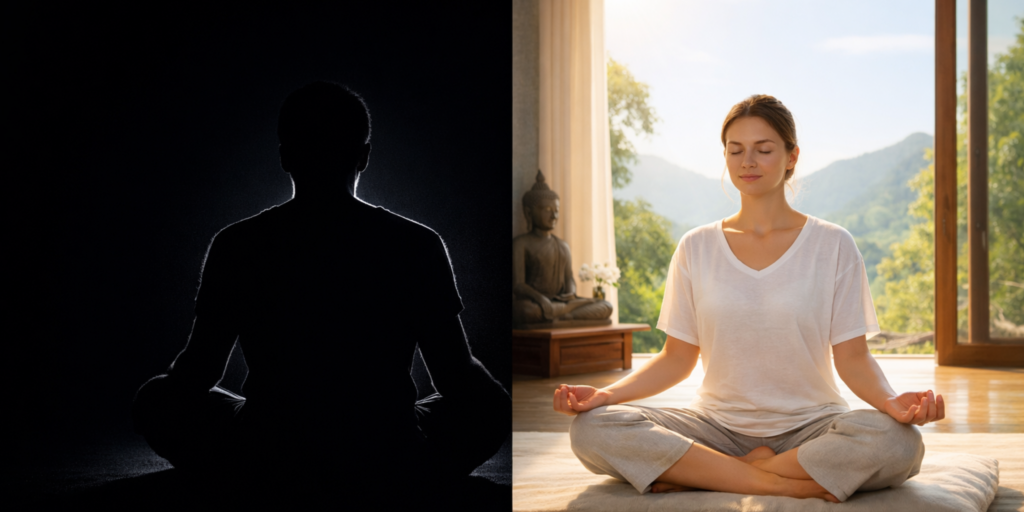
Dark room meditation retreat or silent retreat. Both promise stillness, but they work in very different ways. A dark retreat puts you in pitch black for days to shift perception and awareness. A silent retreat holds you in quiet structure with meditation, mindful activity, and guidance. Choose based on intensity, experience level, and mental health needs.
Dark room vs silent retreats: overview and comparison
Both formats reduce sensory input and social chatter so that the mind has fewer places to hide. The similarities stop there. A dark-room retreat removes light entirely and often isolates you from schedules and other people. A silent retreat keeps the lights on, the bell schedule ringing, and the teacher nearby. Each setting affects the nervous system, attention, and the kinds of insights that tend to surface.
| Feature | Dark-room meditation retreat | Silent retreat |
| Core environment | Total darkness in a sealed room, solo | Silence with light and shared spaces |
| Traditions | Tibetan Buddhism and Bön advanced practices | Vipassana, Zen, Christian monastic, secular mindfulness |
| Typical length | 3 to 7 days, sometimes weeks for advanced practitioners | 1 to 10 days for most programs, sometimes longer |
| Guidance | Check-ins and meal pass through a lightproof box | Daily instruction, interviews, and a clear schedule |
| Common effects | Altered visuals, porous sleep and dream states, time distortion | Heightened mindfulness, steadier attention, emotional clarity |
| Risks | Psychic distress if unprepared, intense visions | Physical discomfort, emotional difficulty in silence |
| Best for | Experienced meditators seeking deep internal work | Beginners through advanced practitioners |
As a rule of thumb. Darkness is intensity by subtraction. Silence is steadiness by structure. If you crave the most radical reset, darkness may call. If you want a strong container with support, silence tends to land better.
Dark room meditation retreat: definition, practice, and history
A dark-room meditation retreat places a practitioner in complete absence of light. This is an advanced practice within Tibetan Buddhism and Bön. Historical instructions describe using sealed dark rooms to evoke spontaneous visual phenomena that can progress from unstructured sparks to fully formed visionary imagery, often in the context of Dzogchen or Kalachakra systems [3]. The practice can span from hours to weeks, with long retreats historically reserved for adept practitioners and conducted under close guidance [3].
Modern versions adapt the core idea for contemporary seekers. Facilities create rooms that truly eliminate photons, provide ventilation and bathrooms, and pass meals through lightproof boxes. Supervision ranges from minimal to regular check-ins. Reports commonly include time loss, inner imagery, and the sense that dream and waking states bleed together. One contemporary account describes vivid internal visuals after several days in a fully dark room, along with pronounced shifts in sleep boundaries and perception upon reentering light [1]. These reports match long standing descriptions of phosphene like lights and visionary sequences noted in traditional texts and commentaries [3].
Why darkness shifts the inner landscape. Removing visual input seems to lower the noise floor of the nervous system so that subtle content becomes audible. Practitioners often describe improved access to dream and hypnagogic material, creativity spikes, and problem solving clarity once daytime distractions and photon driven vigilance quiet down [2]. In simple terms. when the outer lights go out, the inner projector turns on.
Silent retreat: meaning, formats, and traditions
Silent retreats suspend speech to create a stable container for practice. Formats vary by lineage and center. Many programs follow daily schedules with alternating sitting and walking meditation, optional yoga, mindful meals, and evening talks. Guidance often includes group instruction and short one on one interviews. Traditions include Vipassana programs, Zen sesshin, Christian monastic silence, and secular mindfulness formats. These programs are widely accessible and are designed to be safe for newcomers as well as seasoned meditators. This overview is editor verified.
The common thread across traditions. structure replaces guesswork. Silence reduces friction, while a bell and schedule set the day’s rhythm. Many participants report sharper attention by day three, deeper body awareness from repeated cycles of stillness and movement, and a surprising emotional range that often settles with continued practice. The container helps. When meals are set, phones are down, and chores are shared, energy not spent deciding what to do next redirects toward simple awareness.
Benefits and risks of dark room meditation
Benefits reported by teachers and practitioners include several distinct themes.
- Sleep reset and access to liminal states. Many people catch up on sleep in the first days, then notice dream and waking boundaries soften. Thought streams morph into dreams and back again, revealing layers of mind that daytime glare can drown out [2].
- Creativity and problem solving. With fewer distractions, subtle insights surface. People set a clear intention before entering and often find that novel connections or decisions crystallize in the quiet. The absence of external input seems to uncap internal associations [2].
- Altered states without substances. Preparation and integration matter in both psychedelic and dark retreat contexts. Yet in darkness, the only thing ingested is experience itself. Onset is gentle, duration can be tailored, and you can stop at any time [2].
- Visionary phenomena aligned with traditional descriptions. Traditional sources and contemporary accounts describe spontaneous inner light and visionary sequences in darkness. These experiences can be part of contemplative progress when framed and guided properly [3],[1].
Risks deserve equal clarity.
- Psychic distress if unprepared. Prolonged isolation in absolute black can destabilize those with unresolved trauma or certain psychiatric histories. Even experienced meditators can be rattled by intense vision streams and time loss [1].
- Advanced practice in its original context. Traditional Tibetan guidance restricts extended dark retreat to stable practitioners working closely with teachers. This context exists for a reason. Support, screening, and integration are not optional add ons. They are part of the practice [3].
A brief scene underscores the intensity. After several days, one participant described emerging into predawn gray and shielding their eyes, speech halting, and balance off, with mental images still flickering like afterburn. The transition can be tender. Integration needs time and care [1].
A full guide on darkness retreat benefits: 9 Amazing Darkness Retreat Benefits for Health & Wellness
Benefits and challenges of silent retreats
Silence brings steadiness. Benefits commonly reported include stronger concentration from repeated cycles of sitting and walking, clearer emotional processing, and a grounded sense of presence that lingers afterward. Group energy helps carry difficult moments. Shared silence can feel like a warm current that keeps attention afloat when the mind would otherwise bail. This synthesis is editor verified.
Challenges are real and manageable. Legs go numb. Old stories surface. The mind bargains for a coffee run. Schedules can feel strict and unfamiliar on day one. By day three, many people settle as the rhythm takes over. For those new to meditation, a silent retreat provides training wheels and a net. There is guidance, a timetable, and a community container that quietly says keep going.
You can read here more about the benefits of a darkness retreat.
Cost and duration: dark room meditation retreats vs silent retreats
Pricing and time frames vary by provider and country. As of 2025.
- Dark retreats. Stays commonly run three to seven days for general participants, with advanced practitioners extending into weeks. Pricing is often nightly and can be relatively high due to the infrastructure required for true darkness, ventilation, and individual supervision. Some providers book far in advance. These ranges are editor verified. Durations of weeks in the traditional context are noted in historical sources [3], and modern short stays have been described in media reports [1].
- Silent retreats. Programs range from single day offerings to ten day residential courses, with both tuition based and donation based models depending on lineage and center. Local centers often host weekend formats that are easier on budgets and calendars. These details are editor verified.
For any retreat. ask what is included. lodging, meals, teaching, private interviews, and aftercare. Add travel, time off work, and integration support when calculating the real cost.
For a detailed breakdown, read our Darkness Retreat Cost in 2026: Complete Pricing Guide.
Who should choose which retreat: goals, experience, and mental health
Choose by matching your goal, experience, and current stability.
- You want the deepest reset and have a steady practice. A dark room meditation retreat can be the right crucible. It helps to have daily practice experience and at least one group retreat under your belt. Seek providers with strong screening and support. Darkness works best when the nervous system is ready for it [3],[1].
- You want guidance and structure, or you are new to retreats. A silent retreat is usually the better starting point. The container supports beginners, and seasoned meditators return to hone fundamentals. Accessible formats and teacher contact make this a safer first step. Editor verified.
- You are navigating acute trauma, recent mania, psychosis, or severe anxiety. Seek professional advice before either retreat. If approved, lean toward structured silent formats with experienced teachers and clear safety protocols. Darkness retreats are not recommended without specialized guidance in these situations. This caution aligns with traditional restrictions on advanced practices [3] and contemporary reports of distress in darkness when unprepared [1].
Think in scenarios. Decision fatigue at work and low grade burnout. silence with daily guidance tends to rebuild attention and calm. Strong practice, a specific life question, and bandwidth for intensity. darkness may surface answers quickly. The right retreat meets you where you are, not where a trend says to go.
If you are unsure, read: Who Should Avoid a Darkness Retreat? Safety Guide (2026)
Locations and providers: United States, India, and near you
Dark room meditation retreats in the United States
Well known US options exist for darkness retreats. Sky Cave Dark Retreats in Oregon gained attention after an NFL quarterback spent four days there considering a career decision. Facilities offer fully dark rooms with ventilation, bathrooms, and meal pass throughs, plus check ins and clear protocols [1],[2]. Some teachers have opened smaller centers in New England with rooms built to traditional standards for short and long stays, with supervised entry and exit processes [1]. Availability is limited and bookings can require patience.
Vetting tips. Ask how the room is blacked out, how ventilation works, and how meals and check ins happen. Confirm emergency procedures, communication options, and post retreat integration support. Seek teachers with training in the relevant traditions or demonstrated experience guiding dark retreat participants [3].
Dark room meditation retreat in Europe: traditions and centers
The practice of dark room meditation retreats in Europe evolved through a modern combination which unites various contemplative methods with psychological approaches and modified spiritual traditions. European centers base their development on Tibetan dark retreat practices together with Christian mystical traditions and hermetic contemplative practices which focused on individual isolation and blocking out external stimuli to achieve spiritual insight. The European programs which focus on darkness practice teach students to develop their abilities through structured self-exploration methods and nervous system recovery techniques and emotional processing methods.
Dark room meditation retreats in Germany and the Netherlands and Spain and Italy serve as places where people can reduce their speed to find their inner self while they work on achieving equilibrium in their excessive sensory environment. The centers operate through practical therapeutic methods instead of mystical achievement which makes darkness retreats into a useful way to discover yourself while gaining emotional recovery and complete relaxation.
How to find a dark room meditation near me
Use targeted searches and due diligence.
- Search phrases. dark room meditation retreats, meditation retreat dark room, retreat for dark room meditation, darkened room meditation retreats, meditation dark room retreat, retreat with dark room meditation.
- Verify basics. real blackout construction, safety protocols, experienced guides, screening forms, and integration offerings.
- Ask about supervision. frequency of check ins, emergency procedures, and whether support is on site.
- Read community feedback. including dark room meditation Reddit threads. Look for patterns in experiences and red flags in safety reports [4].
If no dedicated darkness centers are near you, consider silent formats locally and plan a darkness retreat when travel and preparation align.
Preparation, safety, and aftercare
How to prepare for a dark room retreat
- Reduce screen exposure for a week. This calms the visual system and makes the first day less jarring. Outcome. smoother descent into darkness.
- Establish daily meditation for at least two weeks. Even 15 minutes helps. Outcome. a steadier attention baseline under stress.
- Practice short darkness sessions. Sit in a darkened room for 15 to 30 minutes. Outcome. familiarity with the mind’s first responses to low input.
- Clarify intention in one sentence. Outcome. a compass when the inner weather shifts.
- Arrange logistics and support. rides, meals for family, a gentle day after return. Outcome. more bandwidth for integration.
Many teachers emphasize intention, set, and setting. The same care applied to a silent retreat pays off too. Pack layers, earplugs, a simple notebook for after, and leave the to do list at home.
Preparation full guide: How to Prepare for a Darkness Retreat (Complete 2026 Guide)
Safety standards and screening questions
Providers should screen carefully. You should screen them too.
- Medical and mental health check. history of psychosis, bipolar mania, severe PTSD, or recent destabilization warrants extra caution in darkness [3],[1].
- Emergency access. a way to stop the retreat quickly and safely if needed. Confirm how this works before booking.
- Orientation and exit process. clear briefing on what to expect, plus stepwise reintroduction to light and conversation.
- Supervision cadence. daily check ins, meal times, and a way to communicate without breaking darkness fully.
- Integration plan. scheduled debriefs and referrals to local support if difficult material surfaces.
Integration and post-retreat support
What you do after matters as much as the days inside.
- Reenter gradually. sunglasses, minimal screens, and light duties for one or two days. Let the nervous system catch up.
- Journal or voice record. capture insights while they are fresh. Ideas often crystallize as you reword them.
- Talk to a trusted guide. schedule a follow up to place your experience in a healthy frame.
- Keep a light daily practice. ten quiet minutes morning and night to stabilize the gains.
A common saying fits. what gets integrated gets to stay. Give the experience a place to live in your daily life.
Alternatives and at-home options
Meditation day retreat near me
Daylong silent programs offer a low stakes way to test the container. Search by zip code with meditation day retreat near me and look for centers with experienced teachers and a clear schedule. Expect several sits, mindful walking, a talk, and Q and A. Costs are usually lower and time away is minimal. Editor verified.
At-home darkness practice: safe guidelines
Try a gentle version at home if a full darkness retreat is not feasible yet.
- Darken a room safely. eliminate light leaks without blocking ventilation or creating tripping hazards.
- Start small. ten to twenty minutes with a timer. Sit or lie down. No phones. No goals.
- Notice the mind’s first reaction. boredom, anxiety, visuals, sleepiness. Let them pass like weather.
- Stop if distressed. build slowly over weeks. The point is familiarity, not endurance.
This is a micro dose of darkness practice, to borrow a phrase. It helps you learn how your system responds before committing to days inside [2].
Online silent retreats and hybrid formats
Online programs and local hybrid weekends deliver much of the benefit of silence without travel. Expect guided sits, at home practice blocks, live talks, and small group interviews. The container is looser than residential formats. The tradeoff is convenience for reduced intensity. For many busy people, this is a practical middle path. Editor verified.
FAQs
What is a dark meditation retreat?
It is a spiritual retreat conducted in a completely dark space where light is entirely absent. In Tibetan Buddhism and Bön, darkness is used in advanced visionary yogas to elicit spontaneous inner light and visual sequences, traditionally practiced by experienced meditators under guidance [3].
If you’re new to immersive darkness practice, explore our What is a Darkness Retreat? The Most Complete Guide in 2026 to understand the process, benefits, and preparation involved.
How much does a darkness retreat cost?
Costs vary widely by provider and location. Pricing is often per night and reflects the specialized rooms and individual support. Short stays of three to seven days are common in modern centers. Exact figures change year to year. treat any number as an estimate. These ranges are editor verified. Media reports and teacher accounts confirm the general format and availability of stays of this length [1],[2].
Is it better to meditate in a dark room?
Better depends on your goal. Darkness reduces external input more aggressively, which can open creativity and dream like awareness and can also be destabilizing if unprepared [2],[1]. Lighted silence builds steadiness with structure and support. For most people, silence is the safer starting point. Darkness suits experienced practitioners seeking intensity. Editor verified.
Where did Aaron Rodgers do darkness retreat?
He spent four days at Sky Cave Dark Retreats in Oregon. Reports described fully dark rooms with meal pass throughs and guided procedures for entry and exit [1].
What do Reddit users say about dark room meditation?
Threads show curiosity about benefits, safety, and lineage roots. Common questions include whether it is based in Tibetan traditions, if special techniques are needed, and how to prepare. People seek first hand experiences and emphasize careful provider selection [4].
Conclusion: choosing the best retreat for you
Here is the bottom line. A silent retreat is the reliable training ground for attention, emotional clarity, and steady practice. A dark room meditation retreat is a potent crucible that can surface creativity and visionary material quickly, and that demands maturity, screening, and support. Choose the format that fits your current stability and your next step, not just your curiosity.
Next move. try a daylong silent program or a weekend retreat, build a daily practice, then decide if structured silence meets your need or if darkness is calling. If darkness calls, vet providers, prepare carefully, and line up aftercare. The right retreat at the right time is worth the effort. It has a way of changing how daylight feels when you return.
Methodology and sources. This comparison draws primarily on historical overviews of dark retreat within Tibetan Buddhism and Bön, contemporary teacher analyses of benefits and risks, a detailed modern participant account, and community questions that surface in public forums. Where specifics about silent retreat formats and pricing lacked direct sourcing, details are noted as editor verified and reflect commonly observed practices in the retreat field [3],[2],[1],[4].
References
- Colin C. You’re Going to Lose Your Mind. My Three Day Retreat in Total Darkness. The New York Times Magazine. October 21, 2025.
- Holecek A. Benefits of Dark Retreat. Unlocking Growth Potential. andrewholecek.com. Accessed 2026.
- Dark retreat. Wikipedia. https://en.wikipedia.org/wiki/Dark_retreat. Accessed 2026.
- Reddit r/Meditation. Darkness retreat questions for people with experience. https://www.reddit.com/r/Meditation/comments/1ke1gpt/darkness_retreat_questions_for_people_with/. Accessed 2026.


 Your personalized retreat result