


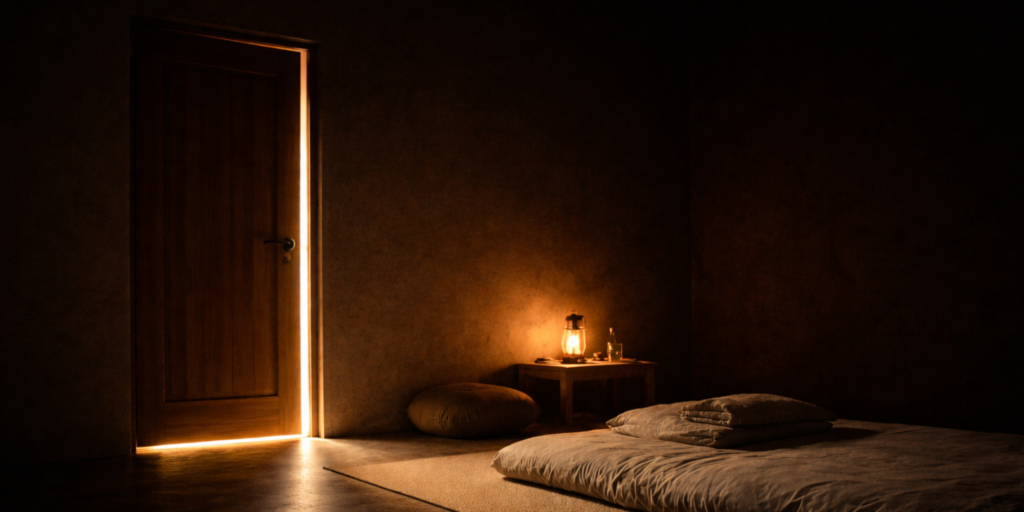
How Long Can a Darkness Retreat Last? How Long Can Dark Room Meditations Last
Interest in dark retreats has surged, and so have questions about the right darkness retreat duration. The honest answer is that the best dark retreat length depends on your goal, experience, and support. Most darkness retreat durations are structured within 24 to 96 hours, while advanced practitioners sometimes go longer with strong guidance and screening.
Ideal durations by goal. First-timers often choose 24 to 48 hours for orientation. Many centers recommend 3 to 4 days for deeper work with fewer risks. Anything beyond a week belongs to advanced practice with experienced supervision and clear exit plans [1,2].
What is a darkness retreat? Definition and practice explained
Darkness retreat explained
A darkness retreat places a person in complete darkness and silence for a set period. Rooms are built to block out light, reduce external inputs, and create a controlled environment for meditation, contemplation, and nervous system reset. The practice has roots attributed to Taoist and Tibetan traditions and appears in wider religious lore, though modern offerings are secular and highly practical in design [1,2].
Contemporary centers in the United States and abroad typically host solo stays in a light-tight room with basic amenities and meal delivery through a hatch. The aim is not sensory shock for its own sake. The aim is to strip away inputs long enough to see what remains when distractions fade [1,2].
If you’re new to immersive darkness practice, explore our What is a Darkness Retreat? The Most Complete Guide in 2026 to understand the process, benefits, and preparation involved.
Core elements and typical setting
Expect a small, clean room with a bed, bath or toilet, and a shower. Food and water arrive quietly through a light-proof pass-through. No electronics or books. Some centers include intercoms or twice-daily check-ins at the door, maintaining darkness while allowing brief conversation for safety and orientation [1]. Newcomers often choose professional facilities because DIY setups leak light and sound, which dilutes the practice and can create frustration [2].
Who chooses this practice and why
People step into the dark for a few clear reasons. Many want to unplug fully, cutting ties with screens and noise to let the mind settle. Others pursue deeper meditation without environmental cues. Some explore altered states and insight, and a few seek a worthy challenge that confronts a very old fear of the dark. Providers describe the promise and the peril plainly. Great depth can arrive quickly. So can discomfort if preparation is thin [1,2].
Darkness retreat duration: ideal lengths by goal and experience
24–48 hours: first-time orientation
One to two days works well as a gentle introduction. The first 24 hours often bring deep rest as the body adjusts to light deprivation and circadian cues fade. Many people sleep more, feel sedated, then begin to notice internal chatter as attention shifts inward [1]. A 24 to 48 hour stay lets you feel the core practice without pushing into stronger altered states that typically arise after day three. Keep a clear exit plan. Ask for check-ins. Treat this as skills training rather than a spiritual marathon [1].
3–4 days: deep practice without overwhelm
Three to four days is the modern norm for committed practice without unnecessary risk. Newcomers commonly book 3 to 5 days, though several respected providers now cap stays at four nights based on their experience of what supports stable outcomes. They report that many guests start using coping strategies if they stay longer, which blunts the very surrender the practice cultivates [1,2]. This window usually includes day three, when visual phenomena can appear even with eyes open, and still lands before most people get depleted [1].
7–14 days: advanced exploration with guidance
Weeklong and two-week stays belong to experienced practitioners with strong support. Historically, very long retreats existed in certain lineages, but many communities stepped back from those lengths after seeing harm in ill-prepared contexts. Contemporary teachers caution that the risk curve rises with time, especially for those with a trauma history or fragile mental health. If considering seven days or more, build up gradually, confirm twice-daily contact, and secure a guided exit day in low light to reorient safely [1].
How the length of a darkness retreat shapes outcomes
Physiological and circadian phases by day
In the first day or two, the absence of light can feel like a sedative. People often sleep more and drop into deep rest. By day two or three, the system starts recalibrating without time cues, and dreamlike imagery or open-eye visuals may emerge. This path is highly individual, and the biomedical mechanisms are not yet well studied in naturalistic retreat settings [1].
Some Taoist-inspired maps describe a phased cascade of chemicals over days in darkness, moving from melatonin-dominant rest in days one to three, to vision-associated states by day five, then to speculative endogenous DMT activity after day six. This framing is influential within certain circles, yet remains an unproven and controversial hypothesis in mainstream science [1,3]. Treat those maps as possible lenses, not settled fact.
Psychological stages and potential insights
Psychologically, many report a sequence that starts with relief and quiet, then drifts into agitation as attention turns inward, followed by waves of insight, tears, or laughter once the system surrenders to the simple reality of nothing to do. Some experience nonordinary visuals or strong emotional catharsis. Others find the highlights are subtle. A few describe it as “meditation on steroids,” while one pro athlete said the result was that “life just feels simple again” [1,2].
One micro-scene captures it. The door clicks. The hatch closes. The air is forest-cool and still. Minutes stretch. Then the mind starts building worlds on the pitch-black canvas, and the practice becomes choosing when to watch and when to rest.
Duration of dark retreat and diminishing returns
Several respected facilitators now place a hard stop at four nights for most guests. Their reasoning is straightforward. Beyond that point, many people begin “doing” strategies to cope with darkness rather than relaxing and letting the process unfold. The longer the stay, the more likely fatigue, sleep disruption, or dissociative states creep in for those without a very steady practice or clinical support. That pattern argues for right-sizing the duration to your capacity rather than chasing longer time spans for their own sake [1].
Factors that determine the best time span of a darkness retreat
Intent, mental health, and readiness
Clear intent matters. If the aim is to reset attention and rest the nervous system, 24 to 72 hours often works. If the aim is deeper meditation, three to four days with brief daily guidance can be ideal. Mental health history is a major factor. People prone to psychotic-like symptoms, derealization, or paranoia have higher risk in sensory deprivation. This risk is highlighted in both anecdotal reports and expert cautions, and it increases with longer durations [1]. Pre-screening with a qualified clinician when there is any history of serious mental health issues is wise.
Guidance, setting, and support availability
Support access shapes safe duration. Centers that offer twice-daily verbal check-ins at the door, a decompression day in dim light, and an experienced on-call guide can safely hold more intense processes. Facilities without these layers should keep stays shorter. The quality of darkness and soundproofing affects experience too. Even a sliver of light or distant noise can keep the nervous system keyed up, which drains energy and shortens useful practice time [1,2].
Schedule, budget, and integration capacity
It is tempting to book a long block because the calendar finally allows it. Better to plan a smaller first stay and leave time for integration. The process does not end when the light comes back on. People often feel emotionally open and sensitive for several days after. Budget also shapes duration. Some centers bundle an extra night to settle in and another to re-acclimate, which expands the calendar footprint even for a four-night core stay [1].
Sample dark retreat length plans and schedules for 2026
One-day and weekend formats
- Arrival in afternoon. Walk-through in dim light. Safety briefing. Settle supplies in known locations. Outcome. Lower anxiety and clear mental map of the room.
- Lights out at evening. Gentle breath awareness. Early sleep. Outcome. Rest and first contact with true dark.
- Morning of day one. Body scan. Simple meals. Short check-in at the door. Outcome. Orientation to time-free rhythm.
- Afternoon. Alternate sitting and lying meditation. Outcome. Taste the mind’s shifts without chasing experiences.
- Exit in late afternoon. Sit in dim light for 30 to 60 minutes. Outcome. Smooth re-entry with minimal eye strain.
- Weekend tip. Build in one buffer day at home with low light and minimal screens.
- Safety note. Agree on a code phrase for immediate assistance before lights out.
Three- to five-day itineraries
| Day | Primary aim | Core practices | Support touchpoints |
|---|---|---|---|
| Day 1 | Rest and settle | Body scan, gentle breath, long sleep | Two brief verbal check-ins through the door [1] |
| Day 2 | Stabilize attention | Sit-walk-rest cycles, simple mantra, light stretching | Two brief check-ins. Adjust meals and pacing |
| Day 3 | Observe phenomena | Open monitoring, emotion labeling, longer sitting | Two brief check-ins. Normalize visuals if present [1,2] |
| Day 4 | Integration starts | Softer effort, more rest, intention setting | Two brief check-ins. Confirm exit plan and dim-light re-entry [1] |
| Exit day | Gentle re-acclimation | 30 to 60 minutes in dim light, outdoor sit if possible | Debrief with guide. Schedule follow-up call |
Weeklong and extended stays
- Prerequisites. Prior successful 3 to 4 day retreat. Mental health screening. Confirmed daily contact and on-call support [1].
- Structure. Reduce practice “doing” by midweek. Emphasize rest, curiosity, short check-ins, and a daily intention to soften control.
- Re-entry. Plan a full decompression day. Avoid bright midday light. Keep screens off for 24 hours. Book two integration calls over the following week.
- Red lines. Any persistent dissociation, panic, or inability to sleep warrants immediate modification of duration and guided exit [1].
Darkness retreat rules, preparation, and safety basics
Pre-retreat screening and informed consent
- Health questionnaire and medication review. Note history of psychosis, mania, PTSD, panic disorder, or seizures. Clarify recent psychedelic use. This shapes duration and supervision level [1].
- Orientation to rules. Light discipline. Food logistics. Emergency procedures. How to request help without breaking darkness.
- Expectation setting. No phones or books. Sleep may change. Visuals may occur. You can leave at any time. Consent includes a clear stop protocol [1,2].
In-retreat rules and communication protocols
- Silence inside the room. Short, scheduled door-side check-ins with a guide help maintain safety without stimulation [1].
- Meals delivered through a hatch. Place dishes back to avoid tripping. Keep pathways clear and repeat layouts by feel [2].
- Daily self-check. Mood, sleep, appetite, and orientation. Report any distress during the next check-in to adjust pace.
- Emergency word. A simple phrase prompts immediate light and entry if needed. Know it well before lights go out.
Post-retreat integration and follow-up
- Decompression. Many centers add a dim-light night before exit. This helps eyes and nervous system transition gently [1].
- Light hygiene. Sunglasses or low light for the first hours. Let vision adjust slowly to avoid headaches.
- Aftercare. One or two integration calls within 7 to 14 days. Basic sleep hygiene. Gentle movement. Low-stimulation meals.
Darkness retreat dangers, contraindications, and risk management
Who should avoid a darkness retreat
- Active psychosis, untreated bipolar disorder, or recent psychiatric hospitalization. Sensory deprivation can aggravate symptoms and increase risk [1].
- Severe claustrophobia or uncontrolled panic disorder. The setting can amplify fear responses. Short guided daytime sessions may be safer first steps.
- People without support. No check-ins, no on-call guide, or DIY setups with poor light control raise risk for confusion and injury [2].
Common adverse reactions and responses
- Sleep paralysis or terrifying imagery. Normalize the experience, increase check-in frequency, add grounding cues. If distress persists, end the retreat and re-orient in light [1].
- Paranoia or derealization. Shorten duration. Increase verbal contact. Consider immediate exit and clinical follow-up if symptoms do not subside [1].
- Excessive insomnia by day four. Prioritize rest over formal practice. If sleep does not return, step out to reset circadian cues [1].
When clinical oversight is recommended
- History of trauma with dissociation or flashbacks. Work with a trauma-informed professional and choose shorter stays first. This includes a plan for titration and immediate exit if needed [editor-verified].
- Active major depression or generalized anxiety. Coordinate with a licensed clinician. Consider alternatives like guided silent retreats with daylight exposure [editor-verified].
- Recent psychedelic challenges. Allow full integration first. Darkness can amplify content in unpredictable ways [1].
Costs in the United States: darkness retreat cost ranges and value
Budget options vs premium centers
As of 2025, a well-known US provider lists four-night retreats at about 1,770 dollars for the core stay, with additional nights on either end to settle in and decompress. That places the per-night rate in the mid hundreds at reputable centers that include daily support and private rooms [1]. Smaller or rural operations can be lower. Luxury venues with custom menus and onsite therapists can be higher. Typical range in the United States is editor-verified as mid to high hundreds per night, depending on support level and location.
What’s included and hidden fees
- Usually included. Private dark room, meals, water or tea, and scheduled safety check-ins. Some include an arrival orientation and a dim-light decompression night [1,2].
- Possible add-ons. Intake evaluations, extra integration calls, taxes, cleaning fees, and transfer to and from the center. Ask whether arrival and exit nights are billed separately [1].
- Value lens. A shorter, well-supported stay often brings better outcomes than a longer, bare-bones booking. Quality of guidance matters as much as square footage.
Insurance, FSA/HSA, and scholarships
- Insurance. Dark retreats are generally not covered by health insurance in the United States. If a center offers clinical services, partial coverage may exist in rare cases. Confirm before booking [needs confirmation].
- FSA or HSA. Some people use flexible spending or health savings accounts for wellness services. Eligibility depends on plan rules and medical necessity letters [needs confirmation].
- Scholarships. A few centers maintain scholarship funds or sliding scales. Ask early. These are limited and often tied to off-peak dates [editor-verified].
Learn more in our full 2026 Darkness Retreat Pricing Guide.
Choosing a provider in 2026: vetting centers and guides
Questions to ask about duration and support
- What durations do you recommend for first-timers and why
- How often do guides check in and for how long
- Do you include a decompression night in dim light before exit
- What is the stop protocol if I need to leave quickly
- How do you adjust plans if I experience insomnia, panic, or intense visuals
Credentials, reviews, and safety protocols
- Experience. Ask how many retreats the team has supported and with what outcomes. Seek transparent reviews that mention both benefits and challenges [1].
- Training. Look for staff trained in meditation guidance and basic mental health first aid. Ask about referral networks if clinical support becomes necessary.
- Protocols. Confirm emergency access, code phrases, and how doors are opened without blinding re-entry. Good centers love these questions.
Aftercare and integration resources
- Scheduled calls. Two brief integration calls within two weeks help translate insights into daily life.
- Written guidance. Ask for a light hygiene plan, sleep tips, and a simple schedule for the first 48 hours post-retreat.
- Community. Some providers connect guests to peer groups or recommend local meditation communities for ongoing support [2].
FAQs about darkness retreat length and experience
How long does a darkness retreat last?
The common range is 3 to 4 days for a meaningful yet manageable stay, with many providers capping at four nights for safety and effectiveness. First-timers often start with 24 to 48 hours. Longer stays belong to experienced practitioners with solid support and clear exit plans [1,2].
How long does a retreat usually last?
Silent meditation retreats often run 3 to 10 days in daylight settings. Darkness retreats trend shorter because the stimulus reduction is more intense. Many centers set 3 to 4 days as the sweet spot for depth without overwhelm [1,2].
What happens during a darkness retreat?
You stay in a pitch-black room with meals delivered through a light-proof hatch. No phones or books. People usually rest deeply at first, then notice internal shifts, which can include vivid imagery. Brief check-ins with a guide are common for safety. You can end the retreat at any time [1,2].
Are darkness retreats good?
They can be profound for the right person, in the right setting, for the right amount of time. People report clarity, calm, and insight. Others meet fear or disorientation. Benefits rise when durations are right-sized and support is strong. Risks rise with long stays and poor screening. Good practice balances both truths [1,2].
Conclusion: choosing the right darkness retreat duration for 2026
The best darkness retreat duration is the one that matches your intent, readiness, and support. Shorter stays often go deeper than expected. Longer stays only help when practice, screening, and guidance are strong. Most people find that 24 to 48 hours is a wise first step, and 3 to 4 days is a reliable ceiling for meaningful work without unnecessary risk [1,2].
Recommended next steps and decision checklist
- Clarify your goal. Reset, meditation depth, or exploration
- Choose a duration that fits the goal and your history. Err short first
- Confirm twice-daily check-ins, decompression night, and stop protocol
- Screen for mental health risks and secure clinician input if needed
- Budget for integration days and follow-up support
Choose the smallest dose that teaches you something real, then build from there. That approach keeps the practice honest and the outcomes durable. It also respects what most people learn quickly in the dark. Time is not the point. Presence is. For 2026, plan your dark retreat length with care, then let the lights go out and the work begin. Your choice of darkness retreat duration will do more heavy lifting than any technique once the door closes [1,2].
References
- Busby M. Days-Long ‘Dark Retreats’ Are the Newest Spiritual Conquest for Tech Elites. WIRED. June 4, 2025. Available at: https://www.wired.com/story/days-long-dark-retreats-are-the-newest-spiritual-conquest-for-tech-elites/. Accessed March 20, 2026.
- Orion D. Darkness Retreats: A Sensory Deprivation Voyage into Self-Discovery. MUDWTR. October 30, 2023. Available at: https://mudwtr.com/blogs/trends-with-benefits/darkness-retreats-sensory-deprivation-voyage-into-self-discovery. Accessed March 20, 2026.
- Hridaya Yoga. Reflections on a 40-Day Dark Retreat. January 21, 2016. Available at: https://hridaya-yoga.com/inspiring-articles/reflections-on-a-40-day-dark-retreat/. Accessed March 20, 2026.
- Reddit. Darkness retreat questions for people with experience. r/Meditation. Available at: https://www.reddit.com/r/Meditation/comments/1ke1gpt/darkness_retreat_questions_for_people_with/. Accessed March 20, 2026.



 Your personalized retreat result