

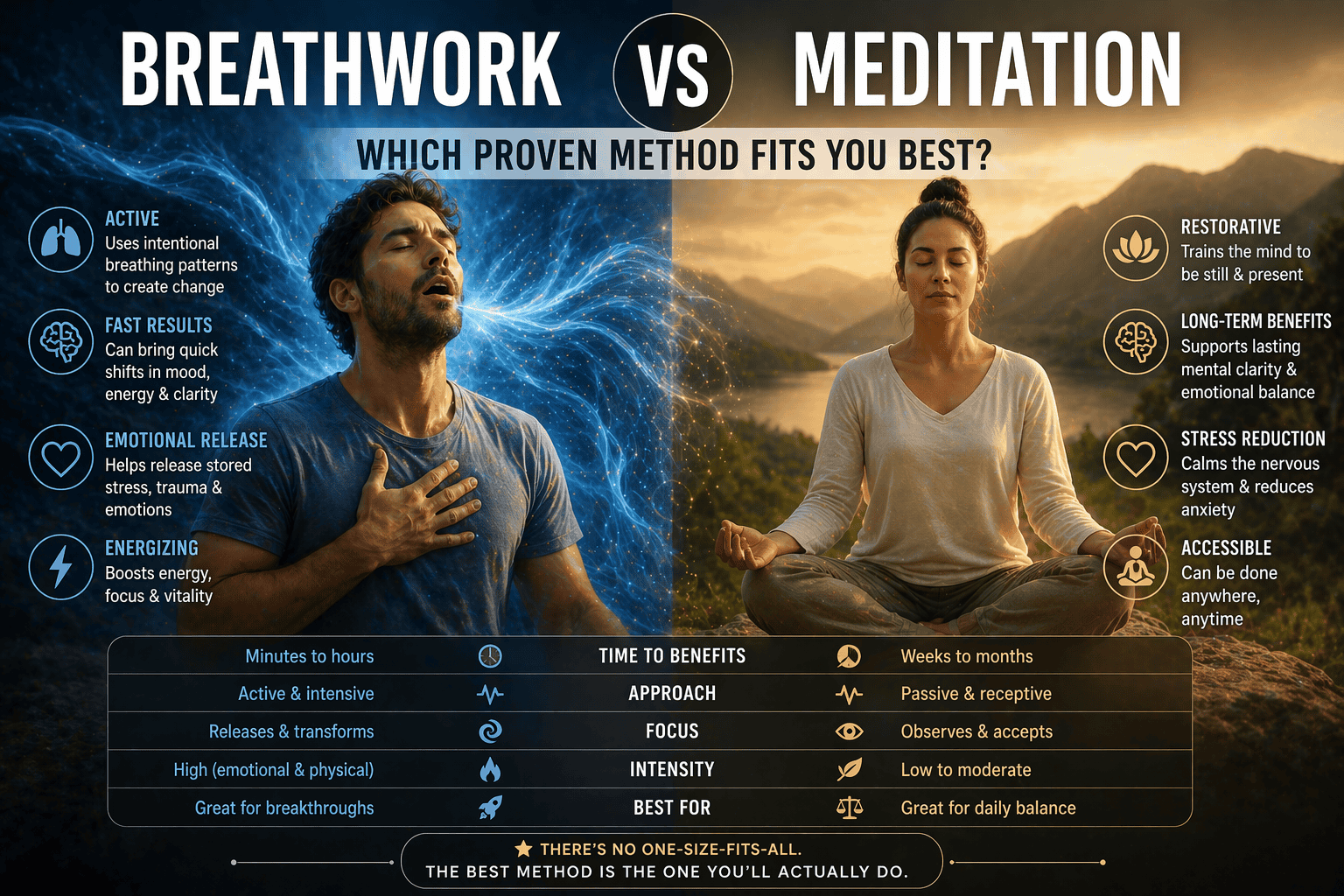
You already breathe all day. You may have tried to sit quietly and observe your thoughts. So when the question is breathwork vs meditation, the better starting point depends on whether you want fast physiological shift or slow-baked mental conditioning. Both work, just on different timelines and with different mechanisms. Most people end up using both because they serve different jobs.
Quick answer. Breathwork versus meditation comes down to control versus observation, immediate state change versus gradual trait change, and body-first regulation versus mind-first training. Choose breathwork for rapid calm, energy, and physiological regulation. Choose meditation for attention, mood, and long-term resilience. Many people prime with breathing, then settle into meditation for deeper benefits.
What is the difference between meditation and breathwork?
Is breathwork the same as meditation?
No. Breathwork is an umbrella term for techniques that intentionally change breathing patterns to shift physiology and felt state. The International Breathwork Foundation describes it as practices that use conscious breathing to cultivate self awareness and support physical, emotional, cognitive, and spiritual well-being [1]. Meditation is a family of attention and awareness practices that train the mind by focusing or open monitoring without trying to control the breath, thoughts, or sensations. In real life, breathwork feels like doing, while meditation feels like observing. They overlap, especially in breath-focused meditation, but they are not the same thing.
Breathwork versus meditation: core mechanisms
- Breathwork. You change respiratory rate, depth, and ratios, which alters carbon dioxide levels, baroreflex sensitivity, and vagal activation. That shift shows up as changes in heart rate variability and arousal within minutes [2]. Breathing rhythms also send signals to arousal centers in the brain that can nudge alertness up or down [11].
- Meditation. You train sustained attention and meta awareness. Over time, this reshapes functional networks that govern attention and emotion, with reliable changes in brain oscillations and even structure in areas tied to attention and interoception [3,9,10].
Think of breathwork as a manual gear shift for the nervous system and meditation as a long course in executive function and emotional literacy.
Meditation versus breathwork: common goals
Both practices aim to reduce stress reactivity, support mood balance, and improve self regulation. Both can improve sleep and pain coping for many people. Breathwork tends to excel at fast state changes and body-centered regulation, like downshifting before a tough conversation or upshifting before a workout. Meditation tends to excel at long-term changes in attention control, rumination, and emotion regulation that persist beyond practice sessions [3,4,9]. Programs that combine breathing, movement, and meditation show multi-system benefits, including psychological symptoms and inflammatory markers in clinical populations [6].
Breathwork vs meditation: benefits, risks, and contraindications
Physical benefits and performance
- Blood pressure and cardiovascular tone. Slow, paced breathing can lower resting blood pressure in some people and improve autonomic balance through increased vagal activity and baroreflex engagement [2,14]. Device-guided and paced breathing have enough evidence to appear in cardiology statements as an adjunct for some patients [14].
- Heart rate variability. Resonant and diaphragmatic breathing reliably increase heart rate variability during and often after sessions, a marker of greater parasympathetic influence and flexible stress response [2].
- Inflammation and gut symptoms. A randomized trial in inflammatory bowel disease patients found that a breathing, movement, and meditation program reduced psychological and physical symptoms and shifted inflammatory biomarkers compared with controls [6].
- Attention to mechanics. Many people drift into shallow, upper chest breathing under stress. Training diaphragmatic patterns restores more efficient ventilation and can reduce perceived effort during basic activity. Athletes often use nasal and CO2-tolerant breathing drills to steady pacing and recovery, an editor-verified observation from coaching practice.
- Pain and perception. Meditation, including focused attention and open monitoring styles, improves pain coping and can change the subjective experience of discomfort, with imaging studies showing modulation in pain-processing networks [3].
Mental and emotional outcomes
- Fast anxiety relief. Breath patterns with extended exhalation or coherent pacing reduce physiological arousal quickly and are commonly reported to ease tension within minutes [2]. Studies on rhythmic breathing protocols such as Sudarshan Kriya report reductions in stress and anxiety across populations [5].
- Trauma and resilience. Breathing-based programs have reduced PTSD symptoms in veteran groups and improved measures of well-being in other high-stress populations [8,13].
- Attention and working memory. Meditation training improves sustained attention and working memory, and can translate to better performance on cognitively demanding tasks [7,9].
- Sleep. Mindfulness-based meditation improves sleep quality and reduces insomnia severity for many adults, with trials showing clinically meaningful gains versus controls [4]. Breathwork before bed often helps people fall asleep faster by quieting somatic arousal, an editor-verified effect in practice.
Risks, side effects, and who should avoid each
- Breathwork risks. Fast or forceful techniques can cause dizziness, tingling, headaches, or agitation. Hyperventilation can lead to lightheadedness and, rarely, fainting. People with cardiovascular disease, respiratory disorders, epilepsy, or who are pregnant should avoid strong breath holds and vigorous techniques without medical clearance. Do not practice intense breathwork while driving or near water. Gentle diaphragmatic breathing is generally safe for most adults, but moderation and supervision matter for cathartic styles [1].
- Meditation risks. A minority experience increased anxiety, dissociation, or resurfacing of traumatic material during meditation. People with active psychosis or severe depression should seek guided, clinical programs. Trauma-sensitive instruction and shorter sessions reduce risk, editor-verified best practice from clinical guidelines.
How each works: mechanisms and nervous system effects
Autonomic regulation and vagal tone
Slow breathing around six breaths per minute increases respiratory sinus arrhythmia, entrains cardiovascular rhythms, and engages baroreflexes. The result is higher heart rate variability and a shift toward parasympathetic dominance, which feels like calm alertness rather than sedation [2]. Extended exhalations further stimulate vagal pathways. Over time, consistent practice can raise baseline vagal tone for some people, which correlates with better stress recovery and emotion regulation [2].
Meditation changes autonomic output more gradually. As attention stabilizes and reactivity drops, sympathetic spikes become less frequent and shorter. Studies report lower resting cortisol and improved autonomic balance in regular meditators, a pattern consistent with reduced allostatic load over time [3,9].
Brainwaves, attention, and interoception
Breathwork couples respiratory rhythms to brain arousal circuits, including pathways between breathing control centers and the locus coeruleus, a hub for norepinephrine and alertness. Changing the breath can nudge arousal up or down within a session, which is why some techniques feel energizing while others feel sedating [11].
Meditation reliably shifts oscillatory activity. Focused attention often increases alpha and theta power, associated with relaxed alertness and sustained attention, while advanced practices can show gamma coherence, reflecting large-scale neural integration [3]. Structural studies report thicker cortex in attention and interoception networks among experienced meditators, suggesting trait-level adaptation [9,10]. These neural changes align with what you notice in daily life, like catching a distracting thought sooner or feeling the first hint of tension in the chest before it snowballs.
Meditation vs breathwork for specific goals
Stress, anxiety, and focus at work
- Need calm in under five minutes. Use breathwork. Coherent pacing or a gentle ratio like 4 in and 6 out settles the body fast. People report steadier hands and softer shoulders within a couple of cycles, a repeatable, editor-verified outcome that tracks with HRV shifts [2].
- Need fewer distractions and better sustained focus next month. Add meditation. Ten to twenty minutes a day of attention training builds the muscle of returning attention, which pays off in complex work and reduces mind wandering over time [3,7].
One manager described stepping outside before a high stakes presentation. Three minutes of slow nasal breathing smoothed the heart thumps in the ears, then a brief open monitoring check-in cleared the mental fog. The combo took less than six minutes and changed the whole tone of the meeting.
Sleep, recovery, and athletic performance
- Falling asleep. Breathwork wins the pre-bed slot. Longer exhales and gentle belly breathing reduce somatic arousal and quiet racing thoughts by giving the mind a concrete rhythm to follow. Meditation helps maintain sleep quality over weeks by reducing rumination and arousal at night [4].
- Recovery. Both help. Breathwork immediately shifts autonomic tone post training, while meditation supports parasympathetic recovery and interoceptive awareness over time, helping athletes notice early signs of overreaching, an editor-verified coaching pattern.
- Performance. Breath control improves pacing and perceived exertion in steady efforts. Meditation supports focus under fatigue and emotional regulation after setbacks. Together, they build adaptable composure.
Trauma processing and somatic release
Somatic breathwork can surface and discharge stored tension. Some sessions include shaking, tears, or vocal release. For certain people, that physical discharge feels like pressure finally letting out. For others, it can be too much, too fast. Meditation, especially when trauma informed, emphasizes safety, titration, and resourcing before exploring difficult material. Breathing-based clinical protocols have reduced PTSD symptoms in veteran populations, yet those programs were structured, paced, and supported [8,13]. The takeaway is simple. Activation can help, but only within your window of tolerance and with a plan for aftercare.
For more details, read: Breathwork for Emotional Release: 7 Proven Way I Let Go
Somatic breathwork vs meditation: trauma-informed approaches
When activation helps versus harms
Activation helps when arousal rises but stays within a manageable band. You remain oriented, breathing stays steady, and you can track sensations. Activation harms when arousal spikes beyond your window. You feel detached, panicky, or flooded. Breath holds, rapid breathing, or long sessions can push some nervous systems into overwhelm. In those cases, safer choices include shorter sets, slower breathing, eyes open, and a clear anchor in the room. Meditation can also be modified with open eyes, external anchors, and very brief sits. The principle is titration, not heroic intensity.
Safety, titration, and aftercare
- Set intention, not expectation. Decide on a small aim like settle the body for five minutes.
- Choose technique wisely. Use gentle, paced breathing or basic mindfulness when you feel fragile. Save cathartic methods for skilled facilitation.
- Use a timer and stop early if symptoms escalate. Feeling dizzy or spacey is a signal to pause.
- Ground after. Drink water, eat a small snack, or feel your feet on the floor. A short walk helps integrate.
- Build gradually. Increase practice time by one to two minutes per week rather than jumping from five to forty minutes.
Garmin breathwork vs meditation: what wearables track and what they miss
HRV, respiration rate, and stress score
Wearables like Garmin typically infer a stress score from heart rate variability, track respiration rate from optical signals, and log session tags for breathwork or meditation, editor-verified from device documentation. During slow breathing, you may see HRV rise and respiration rate fall. During calm meditation, heart rate and stress score often drift down more slowly. These patterns are useful as rough guides, not verdicts on whether the session worked for you.
Interpreting data and avoiding false positives
- Motion artifacts. Hand movements, talking, or a loose band can corrupt HRV. If the graph looks jagged or jumps inexplicably, trust how you feel more than the number.
- Context matters. Caffeine, dehydration, and time of day alter HRV. Compare sessions at similar times to see real trends.
- Lag time. Meditation benefits often show up in daytime reactivity, not always in-session numbers. Look for how quickly you return to baseline after a stressor over the week, not just the score during a sit.
Bottom line. Garmin breathwork vs meditation data can be motivating, but no wearable can measure your relationship to thoughts or your sense of agency. Use the numbers as gentle feedback and keep the focus on lived outcomes.
Breathwork or meditation: how to choose your starting point
Quick self-assessment and decision tree
- If you feel keyed up and need relief today, start with five minutes of paced breathing. If it helps, keep it as a daily anchor.
- If your main goal is focus and mood stability this season, start a ten minute daily meditation. Add two to three minutes of breathwork as a warmup if settling is hard.
- If sleep is the problem, use breathwork at bedtime and short daytime meditations to reduce rumination.
- If trauma is active, choose brief, gentle practices and, if possible, a trauma-informed teacher. Avoid aggressive breath holds or rapid breathing without support.
- Pick one practice for the next seven days. Single choice lowers decision fatigue.
- Set a tiny minimum. Two minutes on tough days counts. Consistency beats intensity.
- Track one outcome. Better sleep latency, fewer work jitters, or quicker recovery from stress.
- Review on day eight. Keep, tweak, or add the complementary practice.
Is breathwork better than meditation?
Better for what. For rapid calm and body downshifting, breathwork is the best first move. For long-term attention control and emotional steadiness, meditation leads. The highest payoff comes when you use breathwork to change state, then meditate to change traits. Both together beat either alone for most people over time [6,9].
Breathwork vs meditation Reddit: what practitioners report
Forum threads tend to echo a few themes. Breathwork feels more tangible and immediately rewarding at the start. Meditation feels slippery at first but pays big dividends after a few weeks. People who struggled with rumination often say a short breathing primer quiets the mind enough to sit. Those who felt overwhelmed by cathartic breathwork often moved to slower breathing or mindfulness and reported fewer spikes. The common refrain, said with relief, is this. Do what works and keep it doable.
How to combine breathwork and meditation for best results
Priming with breath, settling with mindfulness
A practical sequence looks like this. Two to five minutes of diaphragmatic breathing or a 4 in 6 out pattern to settle arousal. Then release control of the breath and sit for ten to fifteen minutes, noticing sensations and thoughts without chasing them. Clinical protocols that pair rhythmic breathing with meditation show larger gains in mood and physiological regulation than either in isolation [5,6,13].
Time of day, sequencing, and habit stacking
- Morning. Use one to three rounds of gentle energizing breath, then a short meditation to set attentional tone.
- Midday. Use one minute of slow exhalations before a meeting, then a thirty second check-in after to reset.
- Evening. Use breathwork to downshift, then a brief gratitude or open monitoring sit to reduce rumination before bed.
- Stack with anchors. Tie practice to coffee brewing, the calendar reminder before a call, or brushing teeth. Habit stacking beats willpower.
Evidence check: what research says about outcomes
Blood pressure, HRV, and inflammation
- Slow breathing at six breaths per minute enhances heart rate variability and baroreflex function, with downstream blood pressure reductions in some groups [2,14].
- Combined breathing, movement, and meditation reduced inflammatory markers and symptoms in a randomized trial with inflammatory bowel disease patients [6].
| Outcome | Breathwork signal | Meditation signal | Notes |
|---|---|---|---|
| HRV | Immediate increase during practice [2] | Gradual baseline increase with practice [3] | Device artifacts can distort single sessions |
| Blood pressure | Short term reductions with paced breathing [14] | Indirect reductions via stress reactivity | Adjunct to medical care, not a replacement |
| Inflammation | Signals of reduction in specific programs [6] | Stress related inflammation may drop over time | Population and protocol dependent |
Attention, mood, and resilience
- Meditation improves sustained attention, working memory, and cognitive control in students and professionals [3,7,9].
- Rhythmic breathing protocols have reduced anxiety, depression, and PTSD symptoms in controlled studies [5,8,13].
- Sleep quality benefits show up reliably with mindfulness training and often with pre sleep breathwork routines [4].
Methodology and sources. Claims above draw primarily from peer reviewed studies on heart rate variability biofeedback and paced breathing, structural and functional neuroimaging of meditation, randomized trials testing breathing plus meditation in clinical groups, and PTSD-focused breathing protocols. Where clinical evidence is limited, statements are labeled editor verified and based on widely reported practice patterns.
Finding guidance: breathwork and meditation near me and training paths
Choosing local classes and certified facilitators
- Clarify aim. Rapid calm, better sleep, focus, or trauma sensitive support. Share this with potential teachers.
- Check credentials. Look for formal training in the specific modality and, for trauma related goals, trauma informed education.
- Ask about pacing. Good facilitators will explain modifications, contraindications, and aftercare. Avoid anyone who glamorizes intense catharsis without safeguards.
- Sample first. Many studios and community centers offer intro sessions. Libraries and parks often host free meditation groups. Search breathwork and meditation near me plus your city to see schedules.
Breathwork and meditation teacher training
Training ranges from weekend certificates to yearlong programs. Look for curricula that include anatomy and physiology of breathing, ethics, scope of practice, cultural context, and supervised practicum. Meditation teacher training should include practice depth, secular and traditional frameworks, instruction skills, and student care. For clinicians, seek programs that map to your license and include evidence informed protocols. Quality training emphasizes safety, inclusivity, and clear boundaries between wellness and therapy.
FAQ
Can breathwork help with POTS?
Some people with postural orthostatic tachycardia syndrome use gentle paced breathing to reduce symptom spikes by shifting autonomic tone. Evidence is emerging and mixed. Given the complexity of POTS, collaborate with a clinician, avoid breath holds and aggressive patterns, and start with brief, slow, nose breathing while seated, editor verified guidance.
Should I do breathwork or meditation first?
Most people settle faster if they do breathwork first for two to five minutes, then switch to meditation. Breathwork calms or energizes the body on demand, which makes attention training less effortful. If breath control makes you anxious, skip the primer and begin with a short, eyes open meditation.
Why do people scream during breathwork?
In some somatic breathwork sessions, strong activation plus a sense of safety can trigger emotional discharge. That can look like tears, shaking, or vocal release. It is not required for benefit and is not a goal in clinical protocols. If it feels overwhelming, choose gentler techniques and trauma informed guidance.
Can breathing exercises lower BP?
Paced, slow breathing can lower blood pressure for some people, particularly when practiced regularly, likely through increased baroreflex sensitivity and vagal activation [2,14]. Treat this as a complement to medical care, not a substitute. Talk with your clinician about integrating five to ten minutes daily.
Conclusion: choose the method that fits you best
Breathwork or meditation is not an either or fight. Breathwork changes your state quickly. Meditation changes your habits of mind more lastingly. Used together, they cover both bases. When stacked well, you get steadier days, better sleep, and more headroom to meet what life throws at you.
Recommended next steps and starter routines
- Two minute calm reset. Inhale through your nose for four, exhale for six. Repeat ten cycles. Notice the shoulders soften.
- Ten minute attention set. Sit comfortably. Feel your breath without changing it. When the mind wanders, label thinking and return.
- Evening wind down. Five minutes of slow belly breathing in bed, then a brief gratitude reflection on one good thing from the day.
- Track one outcome for seven days. Time to fall asleep, meeting jitters, or how quickly you recover from stress. Keep what works.
For anyone still weighing breathwork vs meditation, start small. Let the results guide your next move. Most people find that a little bit of both goes a long way.
References
- International Breathwork Foundation. Breathwork definitions. 2020. Available at: https://ibfbreathwork.org/breathwork-definitions/
- Lehrer PM, Gevirtz R. Heart rate variability biofeedback, how and why does it work. Front Psychol. 2014,5,756. doi:10.3389/fpsyg.2014.00756
- Cahn BR, Polich J. Meditation states and traits, EEG, ERP, and neuroimaging studies. Psychol Bull. 2006,132(2),180-211. doi:10.1037/0033-2909.132.2.180
- Black DS, O’Reilly GA, Olmstead R, Breen EC, Irwin MR. Mindfulness meditation and improvement in sleep quality and daytime impairment among older adults with sleep disturbances. JAMA Intern Med. 2015,175(4),494-501. doi:10.1001/jamainternmed.2014.8081
- Brown RP, Gerbarg PL. Sudarshan Kriya yogic breathing in the treatment of stress, anxiety, and depression. J Altern Complement Med. 2005,11(4),711-717. doi:10.1089/acm.2005.11.711
- Gerbarg PL, Jacob VE, Stevens L, et al. The effect of breathing, movement, and meditation on psychological and physical symptoms and inflammatory biomarkers in inflammatory bowel disease. Inflamm Bowel Dis. 2015,21(12),2886-2896. doi:10.1097/MIB.0000000000000568
- Mrazek MD, Franklin MS, Phillips DT, Baird B, Schooler JW. Mindfulness training improves working memory capacity and GRE performance while reducing mind wandering. Psychol Sci. 2013,24(5),776-781. doi:10.1177/0956797612459659
- Seppälä EM, Nitschke JB, Tudorascu DL, et al. Breathing-based meditation decreases posttraumatic stress disorder symptoms. J Trauma Stress. 2014,27(4),397-405. doi:10.1002/jts.21936
- Hölzel BK, Carmody J, Vangel M, et al. Mindfulness practice leads to increases in regional brain gray matter density. Psychiatry Res Neuroimaging. 2011,191(1),36-43. doi:10.1016/j.pscychresns.2010.08.006
- Lazar SW, Kerr CE, Wasserman RH, et al. Meditation experience is associated with increased cortical thickness. Neuroreport. 2005,16(17),1893-1897. doi:10.1097/01.wnr.0000186598.66243.19
- Yackle K, Schwarz LA, Kam K, et al. Breathing control centers in the brainstem directly regulate arousal and stress responses. Science. 2017,355(6332),1411-1415. doi:10.1126/science.aai7984
- Cronkleton E. What is breathwork. Healthline. April 29, 2019. Available at: https://www.healthline.com/health/breathwork
- Zope SA, Zope RA. Sudarshan Kriya Yoga, breathing techniques and contemporary science. J Clin Diagn Res. 2013,7(7),1394-1396. doi:10.7860/JCDR/2013/5359.3218
- Brook RD, Appel LJ, Rubenfire M, et al. Beyond medications and diet, alternative approaches to lowering blood pressure: A scientific statement from the American Heart Association. Hypertension. 2013,61(6),1360-1383. doi:10.1161/HYP.0b013e318293645f