


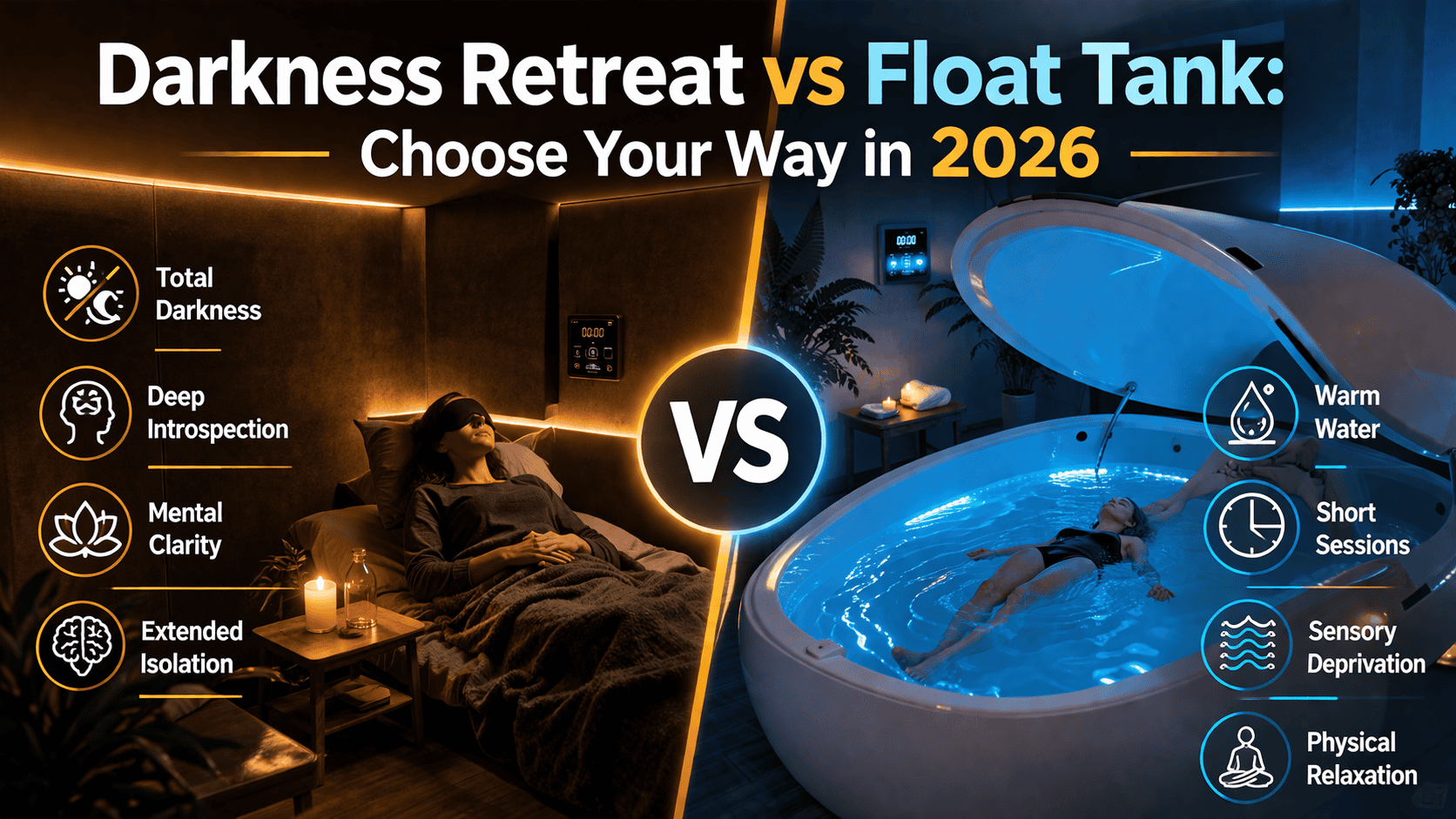
People keep comparing a darkness retreat vs float tank because both promise quiet for the nervous system, yet they work on different timelines and with different intensity. Here is the quick take. A float tank gives short, repeatable sensory reduction in water for 60 to 90 minutes. A darkness retreat is pitch black for days, sometimes weeks, and aims for deeper psychological reset. Choose the tank for accessible stress relief and the retreat for intensive inner work.
A quick scene brings it into focus. Someone steps into a float room, switches the light off, and feels the body disappear into warm, dense water. Another person closes a heavy door in a light-proof cabin and sits with total blackness for days, hearing a spoon on a meal tray and little else. Both are forms of reduced stimulus. The scale and aftermath feel very different.
Darkness Retreat vs Float Tank: How They Compare for Relaxation
Core similarities and differences
Both practices reduce sensory input to interrupt the busy stream of sight, sound, and gravity. That shared mechanism explains why many people describe deep calm, a quieter mind, and a feeling of being reset afterward. In a float tank versus darkness retreat comparison, the overlap ends at the doorway. Floating uses skin temperature water saturated with Epsom salt to create effortless buoyancy and near silence. A darkness retreat removes light entirely for extended periods and leaves a person on solid ground, often without sound, but not floating.
Duration is the biggest separator. Float sessions usually run 60 to 90 minutes and can be repeated weekly. Darkness retreat length often starts at 3 to 7 days and can extend to 10, 14, or even 40 days at specialized centers. That shift from an hour to days changes the physical demands, psychological goals, and risk profile. In practice, a float tank vs darkness retreat boils down to an accessible hour that suits most people compared to a specialized intensive that suits far fewer.
Language adds its own twist. Some people call floating “dark tank therapy” or “dark tank floating” because the experience is often done without lights. In many float rooms you can toggle gentle light and music on or off, which means you can float in complete darkness if you want to, using a simple button inside the cabin [5]. A darkness retreat, by contrast, is designed to be pitch black the entire time, down to light traps on doors and careful room builds to avoid even tiny leaks of light [6].
Float tank versus darkness retreat: session structure
| Feature | Float Tank | Darkness Retreat |
|---|---|---|
| Environment | Warm Epsom salt water, sound dampening, lights optional | Pitch black room, often sound reduced, no water immersion |
| Typical duration | 60 to 90 minutes per session | 3 to 7 days common, some longer programs |
| Control during session | Light and music controls available in many tanks [5] | No light control by design, staff support outside |
| Goal orientation | Stress relief, recovery, sleep support | Deep introspection, spiritual practice, psychological reset |
| Integration | Short reentry, back to normal day | Gradual reintroduction of light, usually structured integration |
Darkness retreat versus float tank: outcome expectations
Expect float sessions to bring rapid physical relaxation, relief from pressure points, and a quieter mental state that can feel meditative or dreamlike. Many report better sleep that night and a calmer next day. The effects tend to be short term, which is why regular sessions stack benefits over time.
Expect a darkness retreat to be a larger wave. The first day can be disorienting. Time perception loosens. By day two or three, people often report surges of imagery, emotions, or memories. On the far end, the mind can settle into unusual calm and vivid insight. That arc can include rough patches. Ethical centers screen carefully for this reason. In short, float tank compared to darkness retreat outcomes feel like a tune-up versus a full system reset, with all the complexity that brings [6].
What Is a Darkness Retreat? Definition, Environment, and Purpose
Setting, rituals, and darkness retreat length
A darkness retreat is a supervised stay in a completely light-proof space designed for continuous darkness. Rooms are built with layered light seals on doors and ventilation, blacked-out bathrooms, and safe walkways marked by touch rather than sight. Meals arrive through a pass-through without light leaks. Many centers ask participants to settle into a slow rhythm of rest, meditation, gentle movement, and simple meals.
Darkness retreat length varies by provider. Introductory programs can be 2 to 3 days. Standard stays range from 3 to 7 days. Experienced practitioners sometimes choose 10 to 14 days. Reports of 21 to 40 day retreats exist in spiritual settings. The key detail is not simply low light. The method requires pitch black conditions, which is why blindfolds or DIY setups do not meet the traditional standard [6].
Psychological aims and potential insights
The purpose is less about relaxation alone and more about what happens when the brain stops processing visual input for days. People describe intense waves of thought and emotion, then a settling of mental noise, and occasionally vivid inner imagery. Time becomes slippery. Some report creative insights or a renewed sense of purpose. These claims are largely experiential, with limited formal research, so they should be considered as emerging possibilities rather than guaranteed outcomes. That said, practitioners align on one point. “Nothing to look at, nothing to do, nowhere to go” becomes the practice itself.
Who a darkness retreat suits best
- Experienced meditators seeking a deep reset or spiritual exploration
- People with flexible schedules who can take days off for retreat and integration
- Those who have screened for mental health risks and prefer intensive inner work
People who are in acute mental health crises, have a history of psychosis, or are highly sensitive to isolation should not pursue darkness without professional guidance and thorough screening. Responsible centers are careful here, and for good reason.
For more details, check out: 3 Lurking Signs You Should Avoid a Darkness Retreat (2026)
What Is a Float Tank? Sensory Deprivation Basics and Experience
Dark tank floating and dark tank therapy explained
Float tanks were developed in the mid twentieth century and evolved into what many now call float therapy or Floatation REST, short for Reduced Environmental Stimulus Therapy. The design is simple and clever. A dense Epsom salt solution at skin temperature lets your body float effortlessly. The room dampens sound. Lights and music can be on or off. Without pressure on joints and without the usual stream of stimulus, the nervous system gets a chance to power down [1,2].
Terminology shifts can confuse newcomers. Sensory deprivation is the older term, rooted in early laboratory studies by John C. Lilly. The modern industry prefers floating and float therapy, emphasizing comfort and control rather than deprivation. The core idea is the same. Reduce outside input and let the body and mind settle [1].
What to expect in a float tank session
- Arrive, check in, and shower before the session to remove products and oils.
- Insert earplugs, step into the tank or cabin, and close the door gently.
- Lie back, let your body float, and turn lights off if comfortable. Most cabins include a light button, so you can float in complete darkness or keep a soft glow [5].
- Settle into stillness. Some choose gentle music for the first few minutes, then fade to silence.
- When the session ends, lights or soft music signal time to exit and shower off the salt.
Common sensations during and after floating
- Weightlessness and a gentle “body disappears” feeling as muscles release tension
- Thoughts slowing, with moments of daydream imagery and a time-warp sense
- Afterward, deep calm, looser shoulders, and a calmer evening
Some people ask, “Why do I feel weird after float tank sessions.” A few reasons show up often. The nervous system is recalibrating after low stimulus, which can feel like sensitivity to light and sound for an hour or two. Gentle dehydration can contribute if water intake is low. Vestibular shifts can create mild dizziness when standing up. These effects usually fade the same day. Hydration, a slow reentry, and avoiding bright screens right away help ease the transition [2].
The Science of Sensory Reduction: Stress, Brain, and Body Effects
How sensory reduction shifts the nervous system
When external input drops, the brain stops spending energy on constant monitoring. The result is a shift from an alert, beta-wave dominant state toward calmer, meditative states associated with internal focus. The default mode network, the circuit that fuels rumination and self talk, tends to quiet down. Breathing slows, muscle tone drops, and the body cues a parasympathetic response, the rest and digest mode that counters chronic stress [2].
Evidence from floatation-REST studies
The research base for Floatation REST includes early work in the 1980s and an expanding set of modern trials. Industry summaries point to cortisol reductions and relaxation responses in early REST publications [1]. More recently, clinical work with people who have anxiety shows session by session reductions in state anxiety and improvements in mood, with some studies reporting meaningful short term relief after a single float and additive benefits with repeated sessions [3,4]. Reported effects include improved sleep quality, lower stress perception, and reduced muscle pain in certain groups. The pattern is consistent. Reduced stimulus lets the nervous system find a quieter baseline, at least for a while.
What research suggests about prolonged darkness
Prolonged total darkness is used in specific contemplative traditions, yet peer reviewed research remains limited. Anecdotal reports emphasize strict light-proof conditions and extended durations far beyond an hour in water [6]. Given the scarcity of controlled data, claims about specific neurochemical effects or guaranteed outcomes should be treated as provisional and needs confirmation. What is clear is the intensity of the experience and the importance of carefully managed conditions.
Benefits Compared: Relaxation, Sleep, Anxiety, and Creativity
Float tank compared to darkness retreat for anxiety and stress
On anxiety and stress, Floatation REST shows measured reductions in state anxiety, improved calm, and decreased stress marks across several studies, including work with clinical anxiety populations [3]. That makes floating a practical option when the goal is reliable, repeatable stress relief. In a darkness retreat compared to float tank scenario, the retreat may open deeper psychological territory, yet outcomes swing wider and depend heavily on readiness and support. Stress may reduce, but the pathway can include emotionally intense phases. For many, that is the point. For others, it is too much, too fast.
Short-term relief vs deeper reset
Floating excels at short-term relief that stacks with regular practice. Muscles soften, the mind quiets, and sleep that night often improves. A darkness retreat steers toward a deeper reset, with more risk, more time, and a bigger integration window. Think of it this way. A float is the weekly massage for the mind. A darkness retreat is the multi-day vision quest without the bracing hike.
Performance, creativity, and sleep quality
Creativity and performance are trickier to measure, yet many report easier access to ideas after both practices. Reduced sensory input can unhook the mind from constant alerts, which opens space for novel connections. Sleep benefits are more straightforward. People often fall asleep faster on float nights and report fewer aches. Some retreat participants sleep in unusual cycles, then emerge with a well rested, heavy-limbed calm that lasts days. Expect individual variability here. The more intense the practice, the more varied the response [1,3].
Risks and Safety: Who Should Avoid Each Practice
Mental health considerations and screening
- Active psychosis, untreated bipolar disorder, or recent severe trauma increase risk in both practices, particularly in darkness retreats. Pre-screening and clinical guidance are non negotiable in those cases.
- Severe claustrophobia can make floating uncomfortable. Some centers use larger float rooms that reduce that sensation.
- History of panic attacks calls for gradual exposure, shorter sessions, and clear exit plans.
Physical risks, contraindications, and side effects
- Float tanks. Fresh tattoos, open wounds, untreated ear infections, and extremely low blood pressure can be problematic. Salt can irritate eyes and skin. Slips in wet areas are a practical concern. Most side effects are mild and short lived.
- Darkness retreats. Disorientation in pitch black increases fall risk. Sleep disruptions can be pronounced. Emotional lability and anxiety spikes can occur in the first days. Adequate nutrition and hydration plans are essential.
These points are editor-verified based on standard spa guidance and retreat center policies. Providers should present informed consent documents that spell out risks in plain language.
Ethical providers, supervision, and informed consent
- Float centers should offer clean, well maintained rooms, clear safety briefings, and easy in-session controls for light and sound.
- Darkness retreat providers should maintain true light-proof spaces, daily wellness check-ins without breaking darkness, emergency protocols, and access to support if a participant needs to end early.
- In both cases, transparent costs, cancellation terms, and screening questions build trust.
Cost, Access, and Time Commitment in the U.S.
Pricing and availability across regions
| Item | Typical cost | Availability | Notes |
|---|---|---|---|
| Single float session | 50 to 100 USD | Common in cities and college towns | Memberships reduce per session price, package deals offered |
| Monthly float membership | 60 to 160 USD | Most float centers | Includes 1 to 4 sessions, guest passes vary |
| Darkness retreat per day | 150 to 400 USD | Limited, regional retreat centers | Includes lodging, meals, supervision, travel extra |
As of 2025, floats are widely available in medium and large U.S. cities. Darkness retreats remain niche and may require travel. Prices vary by region and amenities. These ranges are editor-verified and intended as planning estimates.
Program length, session duration, and scheduling
- Float sessions book in 60 or 90 minute blocks, with faster turnover on weekends. Some centers offer 30 minute “intro” slots.
- Darkness retreats require multiday blocks and a deposit. Many centers run on fixed start dates to coordinate staff and kitchen schedules.
Insurance, memberships, and budgeting tips
- Insurance coverage for floating is uncommon. Health savings accounts sometimes allow it when prescribed for pain management, needs confirmation with your plan.
- Memberships are cost effective if you float at least twice per month. Watch for cancellation terms.
- For retreats, budget for travel, a day of integration after, and a cushion for rescheduling.
Darkness Retreat or Float Tank: Choosing Based on Your Goals
For beginners, busy professionals, and athletes
When time and predictability matter, a float tank or darkness retreat decision tips toward the tank. Beginners appreciate the gentle learning curve and the ability to end a session at any time. Busy professionals can book after work and sleep better that night. Athletes use floating for recovery because buoyancy removes pressure points and the salt solution eases muscle soreness, while the mind gets the break it rarely takes [2,3].
For spiritual exploration or a deep reset
When the aim is inner work, a darkness retreat or float tank choice leans the other way. Extended darkness is designed for sustained introspection. It can surface insights in a way that a single hour cannot. It also asks more. Time, preparation, and a stable mental health baseline are the basic ticket to enter. The payoff can be profound. So can the challenge.
A quick decision checklist
- Goal today. Stress relief and sleep tonight points to floating. Deep inquiry and spiritual focus points to darkness.
- Time available. One to two hours favors floating. Multiple days with integration time favors darkness.
- Nervous system sensitivity. If isolation feels edgy, start with float rooms that allow light and music. If silence feels like home, darkness may call.
- Support and screening. Choose providers who ask good questions and answer yours even better.
Preparation and Aftercare: Maximizing Results and Integration
How to prepare for a darkness retreat or float session
- Reduce caffeine and alcohol the day before to ease nervous system settling.
- Eat a light meal two to three hours before, avoid heavy or spicy foods.
- For floating, avoid shaving that day, use the restroom before, and remove contact lenses.
- For darkness, arrange responsibilities, set an intention, and confirm check in procedures with the center.
- Bring what is allowed, such as comfortable clothing. Leave phones and bright screens outside.
Post-session integration to reduce unusual sensations
- Reintroduce light and sound gradually. Sunglasses, soft lighting, and quiet help the nervous system recalibrate.
- Hydrate. Epsom salt draws fluid. Water or electrolyte drinks help after floating.
- Journal a few notes. Capture insights while they are fresh, then put the notebook down.
- Sleep. Let the body consolidate the session overnight without a late screen binge.
Red flags and when to seek help
- Persistent dizziness, prolonged disorientation, or anxiety spikes that do not resolve within a day warrant follow up with a clinician.
- Emotional waves that feel unmanageable call for support from a licensed therapist, not another session.
- Ethical providers will help coordinate care and will not pressure a return session when stability is the need.
Alternatives and Complements: Float Tank vs Meditation and More
Float tank vs meditation for relaxation
Meditation and floating often work well together. Floating reduces sensory noise by design, which shortens the climb into a quiet mind. Seated practice then becomes easier on ordinary days. For people who struggle to meditate at home, a float tank can act like windbreaks for the mind. Conversely, experienced meditators often find floating familiar and surprisingly potent.
Breathwork, sauna, and nature immersion
- Breathwork shifts physiology quickly and can pair well with post-float calm.
- Sauna and cold plunge reset attention through strong, simple signals and can serve as another path toward presence [2].
- Time in nature restores attention in gentle ways that echo sensory reduction without total isolation.
Building a sustainable relaxation routine
The best routine is the one used regularly. A sample cadence often looks like this. One float every week or two, brief daily meditation, and a nature walk on weekends. Add a retreat once or twice a year if that feels supportive. Keep the aim simple. Less noise in, more clarity out.
FAQ: Darkness Retreat vs Float Tank
What exactly happens in a darkness retreat?
You stay in a truly light-proof room for multiple days. Meals arrive through a light-sealed pass-through. Most time is spent resting, meditating, and reflecting. The brain stops processing visual input, time perception shifts, and the mind can move through agitation into quiet. The space must be pitch black, not just dim [6].
Why do I feel weird after float tank?
It is a normal reentry effect. The nervous system adapts to stillness, then meets bright light and sound again. Mild dizziness, light sensitivity, or a dreamy feeling can show up for an hour or two. Hydrate, avoid screens, and move slowly. These sensations usually pass the same day [2].




 Your personalized retreat result