


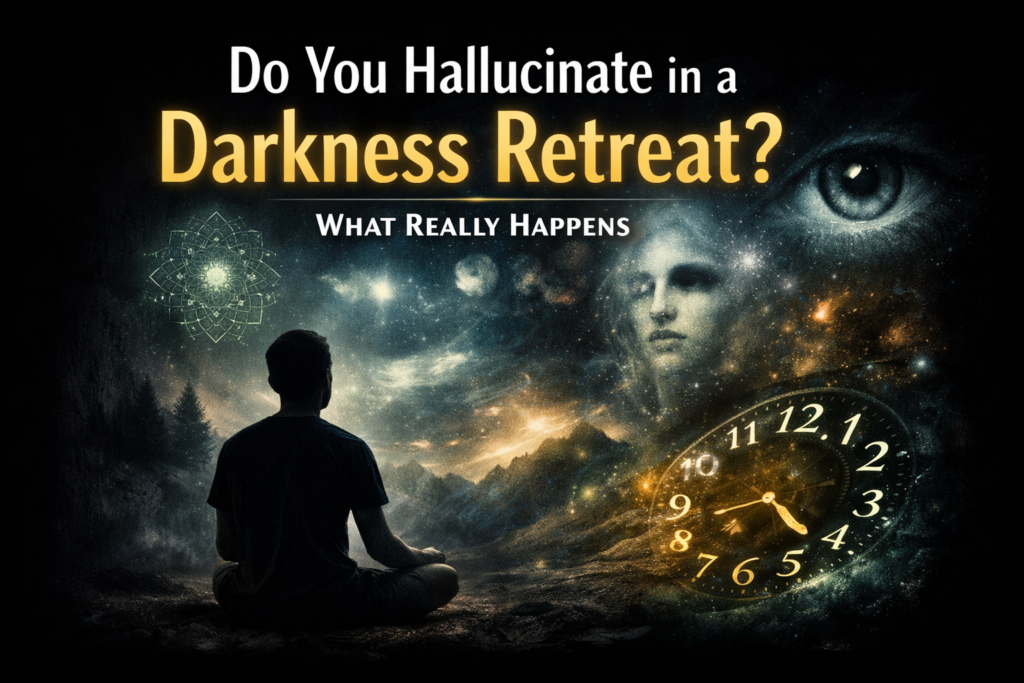
Step into a pitch black room, seal the door, then wait. At first, there is quiet and heavy sleep. Then subtle swirls. By day two or three, lights, textures, and full scenes may unfold behind closed eyes. Darkness Retreat Hallucinations are common in prolonged light deprivation and often benign, yet they can also be overwhelming if stress and sleep loss pile up. Expect visual phenomena, a foggy sense of time, and a flood of memories. Seek support if fear spirals, breathing feels constrained, or disorientation becomes unsafe [2,4].
If you’re new to immersive darkness practice, explore our What is a Darkness Retreat? The Most Complete Guide in 2026 to understand the process, benefits, and preparation involved.
What Is a Darkness Retreat? Definition, Purpose, and Origins
A darkness retreat places a person in total blackout for a fixed period, usually inside a lightproof room with a bed, bathroom, and a pass-through for meals. No screens. No books. Minimal sound. The aim is simple and radical. Remove external input so attention turns toward what is usually drowned out by stimulus, habit, and the glow of constant notifications [2,3].
Modern facilities in the United States, Germany, Guatemala, and the Czech Republic offer dedicated “caves,” with Sky Cave Retreats in southern Oregon among the best known in the U.S. As of recent reporting, stays there tend to be four nights with a day to settle and a day to reorient, and there can be a long waitlist during popular periods [2,4]. Guests describe the experience as meditation intensified by absolute darkness, with the room functioning like a sensory deprivation chamber that is easier to rest in than a float tank and far harder to distract from than everyday life [2,3,4].
Dark seclusion draws on old practices. Accounts reference Tibetan dark retreats aimed at transitional awareness, stories of contemplatives retreating to caves, and Kogi community traditions in Colombia where darkness is used to cultivate connection to a deeper layer of mind. Contemporary facilitators frame it not as punishment but as a container to meet “that which remains” when stimuli fall away [2,3,4].
In short, what is a darkness retreat. It is structured darkness seclusion designed for inner work. People pursue it for clarity, rest, and visionary experiences in darkness retreats, though the outcomes range from quiet reset to full-blown darkness retreat hallucinations.[2,3,4].
How Darkness Triggers Hallucinations: Brain, Sleep, and Sensory Deprivation
Darkness Retreat Hallucinations often arise when the visual system “idles” without input. The brain is predictive by nature. Remove light for long enough and the visual cortex starts filling gaps with internally generated patterns. Add sleep shifts, isolation, and expectation, and the stage is set for images, lights, and even immersive scenes to appear with eyes open or closed [2,3,4].
Sensory deprivation and neural plasticity
Total blackout and quiet remove a firehose of sensory data. This is not the dimness of a bedroom. It is the cave-like dark where eyes never adjust. Similar to float tanks, which reduce sensory load, darkness retreats reliably produce altered states, shifts in mood, and unusual imagery in people who are already open to present-moment awareness [2]. That pattern fits a broader observation. When sensory input drops, the brain’s predictive machinery paints in missing information, often as geometric forms, textures, or “light” moving within blackness [2,3].
Melatonin, circadian rhythm, and REM rebound
In the first one or two days, many people sleep a lot. With light gone, melatonin surges and the nervous system downshifts, which can feel like taking a sedative. Oversleep is common early. After a couple of days, sleep may fragment and REM-like imagery can spill into waking states. People report vivid dreams, hypnagogic visuals, and a warped sense of time as circadian cues flatline [1,4]. Wearable data and first-hand accounts describe long early sleeps followed later by reduced sleep duration, while visuals intensify [4].
Stress, isolation, and suggestibility mechanisms
Dark retreats can be soothing, yet they can also surface anxiety. Solitude amplifies inner dialogue. If someone arrives wired, afraid of the dark, or intent on “pushing through,” stress chemistry can spike and feed negative imagery. Reports include sleep paralysis sensations, fear of breathing constriction, and shadowy forms that feel predatory, especially in the first night or during sleep loss [4]. On the flip side, reduced dopamine cues and a lack of novelty can quiet restlessness and bring memories and life review front and center, which many find cathartic [1,2].
Visionary Experiences in Darkness Retreats: Common Themes and Types
Visionary experiences in darkness retreats span a wide spectrum. Some are faint textures in black space. Others feel like walking through a limestone cave or watching a strobe show from behind the eyelids. Many people describe colored light blobs, lattices, or holographic scenes. A smaller group notes auditory phenomena or a sense of a presence in the room, especially during light sleep or after long quiet [2,3,5].
Visual, auditory, and somatic phenomena
- Visual. Swirling blacks within black, starry speckling, colored lights, strobing, fractal geometry, caves, or full-room “projections” that look real even with eyes open in pitch dark [2,3,4].
- Auditory. Occasional tones, distant voices, or chanting are reported less often and tend to arise during liminal states. These can be startling and usually fade with rest [5].
- Somatic. Tingling, warmth, or a sense of space inflating inside the body is common during deep relaxation. Some people report feeling buoyant or vividly aware of their limbs in the bath or bed despite total dark [2,5].
Archetypal imagery vs. personal memory processing
Two streams often run together. One is archetypal or symbolic imagery. Think luminous forms, a felt presence, or scenes that echo mythic themes. The other is autobiographical processing. Several detailed accounts describe the mind sifting through relationships, conflicts, and old injuries on its own, like a conveyor belt of memories. One author described his life as millions of jellylike cubes that could be rearranged to reflect a kinder self. Another described a comprehensive replay of every relationship and injury, with attendant feelings and realizations [1,2]. Both streams can lead to insight as the nervous system digests what daily life often shoves aside [2].
Mystical experiences vs. clinical hallucinations
Mystical type experiences, such as a nondual sense that opposites coexist without conflict, can appear in the dark without drugs. Yogic practitioners and facilitators describe quiet, expansive awareness that feels more meaningful than the visual theatrics. Many people value the softening into being over the internal light show [3]. Yet there are risks. Dark isolation can unmask vulnerable states. There are anecdotes of frightening hallucinations, panic, or prolonged dissociation. Facilitators and researchers caution that some individuals exit worse off when the practice is attempted without adequate support or self-knowledge [4].
Darkness Retreat Hallucinations: Normal Signs vs. Red Flags
Hallucinations in darkness are often expected, especially after 36 to 72 hours inside a sealed space. The key is to separate normal, passing phenomena from signs of destabilization. That distinction guides whether to ride it out or call time and step into the light.
Is it normal to hallucinate in the dark?
Yes. Hallucinations during dark retreats show up frequently as benign visuals, shifting textures, and internal light that does not turn off when eyes are open. These can feel like the tail end of a psychedelic trip and often appear in tandem with changes in sleep and quiet breathing. Many guests first notice lights, strobe-like flashes, or projected scenes around day three. Some compare the imagery to ayahuasca without the soundtrack, while others find it distracting and prefer the silent rest underneath [2,3,4].
Warning signs that require support or exit
- Uncontrollable panic, persistent fear, or thoughts that feel persecutory rather than symbolic [4].
- Breathing difficulty, chest tightness, or sleep paralysis sensations that do not ease with grounding [4].
- Severe disorientation, repeated falls, or an inability to find the bathroom safely in the dark [2].
- Prolonged dissociation that lingers after rest, along with confusion about what is real [4].
- Any resurgence of psychotic-like symptoms or prior mental health crises. Exit and seek support. Editor-verified.
Facilities build in daily check-ins and an open-door policy for this reason. Some retreats now cap first stays at four nights to reduce risk and to discourage coping by constant doing. The aim is surrender and rest rather than white-knuckle endurance [4,2].
Duration, Timeline, and Stages: How Long Does a Darkness Retreat Last?
There is no single answer to darkness retreat how long. Most newcomers choose three to five days. Some practitioners have gone far longer, though modern facilitators increasingly recommend shorter stays with strong integration plans [2,3,4,5].
Typical lengths from 24 hours to 14+ days
- 24 to 48 hours. A reset for rest and a taste of silence. Visuals possible in shorter windows, though usually lighter.
- Three to five days. A common window for first-timers. This bracket captures the early deep sleep phase and the late visual phase many report [3,4].
- One to two weeks. Less common and usually reserved for prepared practitioners with support. A few centers historically hosted much longer retreats, though one U.S. center now caps initial stays at four nights based on observed risks [4].
- Forty days and beyond. Historical or advanced spiritual practice. Anecdotes note both profound experiences and cases of deterioration without strong preparation and guidance [4,5].
Day-by-day stages and likely experiential phases
- Day 1 to 2. Expect heavy sleep, grogginess, and relief. Melatonin rises. Body slows. People often describe a womb-like calm punctuated by naps and simple routines [1].
- Around 36 to 72 hours. Thought-free spaces widen, then visuals intensify. Lights, textures, and immersive scenes begin to unfold, often with a parallel review of memories [2].
- Day 3 to 5. Imagery can peak. Sleep may fragment. Some feel buoyant and clear. Others feel edgy or fearful. Daily check-ins help anchor the process [2,3,4].
- Exit and reentry. Sensitivity to light and sound can feel extreme for hours. Many report afterglow, insight, and a steadier mood for days or weeks as the nervous system recalibrates [2].
Aftereffects and re-entry timeline
Coming out is a sensory blast. Many people wear an eye mask for the first minutes in daylight. The world looks hyper detailed. Emotions can run close to the skin. In the days after, calm and clarity often persist, though the “fullness” tends to fade as normal life resumes. Some describe a long, slow trip that continues as integration work. Others simply feel rested and more patient with everyday noise [2,3,1].
Sleep in Total Darkness: Can You Sleep Too Much in a Darkness Retreat?
Sleep patterns swing widely in blackout conditions. Oversleep early is common, then short, light sleep later. The question is not whether a person can sleep too much, but whether the pattern supports safety and steadiness in the room.
Oversleeping vs. hypersomnia risks
Oversleeping during the first day or two appears normal for many guests. It reflects rapid downshifting after stimulus removal and a melatonin-rich environment. Hypersomnia is a clinical disorder with persistent daytime sleepiness and functional impairment and is not the same thing. In the dark, a practical approach works best. If long sleep leaves a person groggy but stable, let it be. If oversleep blends into dizziness or falls in the bathroom, it is time for a check-in. Editor-verified. Accounts repeatedly describe early “sleep like a log” phases that gave way to lighter sleep without harm [1,2,4].
Hallucinations after not sleeping and sleep deprivation
Sleep deprivation can intensify Darkness Retreat Hallucinations. Several reports describe dwindling sleep by days four to six as visuals crescendo. This is a known pattern. Less sleep can prime the brain for imagery and strobing that bleeds into waking. Think twilight at the end of a DMT trip. When sleep shrinks to very short windows, the risk of anxiety rises and imagery can turn unpleasant. A gentle routine, slow movement, and a willingness to pause the retreat protect the nervous system here [4,2].
Setting, Safety, and Darkness Seclusion: Do Darkness Retreats Involve Sensory Deprivation?
Yes. Darkness retreats are designed for extreme light control and near silence. The architecture and protocols matter for both safety and the depth of the work.
Room design, lightproofing, and safety features
- Lightproofing. Thick doors, protected switches, and a double-door food box allow meals without light leaks. Eyes never adjust to any glow when the switch is down [2].
- Layout. Simple rooms with bed, bath, and a defined path reduce tripping. Many guests map the room by touch with repeat routes to the bathroom or bath [2].
- Ventilation. Good airflow prevents musty buildup and keeps composting toilets from overwhelming the space. Ventilation is often powered continuously [1,5].
- Exit aids. Some centers ask guests to wear an eye mask during first light exposure on exit to ease reentry [2].
Home dark room vs. dedicated retreat facility
Home attempts are possible but difficult to make safe and truly dark. Early tinkerers blocked windows and tried multi-day dark at home, only to find that familiarity and light leaks dulled both the intensity and the safety. Professional setups remove stray light and noise and often feel safer for going inward because of daily check-ins and a clear door to the outside when needed [2,3].
Monitoring, check-ins, and emergency protocols
Daily check-ins are the anchor. Staff swap meal containers through a pass-through and talk for a few minutes. Some retreats add a second short check-in per day. Guests can always leave by opening the door. Many places request a note through the pass-through if help is needed. Some install a small outside light to signal staff, while instructing guests to shield their eyes during brief maintenance. These simple touch points help spot trouble early and keep the focus on rest rather than endurance [1,2,4].
Comparing Darkness Retreats and Psychedelics: Is There a Darkness Retreat Drug?
There is no darkness retreat drug. Yet many people say the phenomenology overlaps with psychedelics. The caveat is that the mechanism differs and the risks are unique.
Overlaps in phenomenology and set/setting
Participants often describe visuals that resemble the tail end of DMT or ayahuasca. Colored lights. Fractal geometry. A sense of presence. Long, intricate scenes that feel visionary. Some speculate about melatonin or endogenous DMT shifts in prolonged darkness. Researchers note that endogenous DMT claims are unproven and controversial, while the altered states likely arise from sensory deprivation, sleep stage shifts, and suggestion. What matters most is set and setting. The quiet container often tilts attention away from spectacle and toward steady awareness underneath [3,4].
| Darkness retreats and psychedelics at a glance | ||
| Aspect | Darkness retreat | Psychedelics |
|---|---|---|
| Primary driver | Sensory deprivation and sleep shifts | Pharmacology |
| Time course | Hours to days with phases | Minutes to hours per dose |
| Legal status | Legal setting | Varies by substance and region |
| Main risks | Isolation stress, disorientation, sleep loss | Physiologic effects, drug interactions |
| Integration | Rest, journaling, therapy helpful | Similar integration needs |
Key differences in risk, legality, and integration
Because no exogenous drug is used, legal and medical risks differ. Darkness can still destabilize people through isolation stress and sleep disruption. Some centers shorten stays for first-timers and emphasize surrender ratherSome centers shorten stays for first-timers and emphasize surrender rather than endurance, reducing the likelihood of adverse psychological effects during extended isolation . Integration support post-retreat, such as guided reflection or therapy, is increasingly recommended to help participants process intense experiences safely.
Preparation and Risk Management: Who Should Avoid Darkness Retreats
The practice of darkness retreats leads to powerful personal growth but it eliminates all mental defenses which help people maintain their usual mental stability. The absence of light and time markers and social contact makes your internal space into the main environment which you experience.
Medical centers offer their most effective treatment solutions to patients who need them the most for their healing process. The situation creates different effects on people because it produces opposing reactions. The experience of dark prolonged exposure will make your existing anxiety and trauma and depression symptoms worse instead of providing any form of relief.
People who experienced psychosis or hallucinations during non-meditation times face the same risk because darkness creates an unsafe environment which makes it difficult to distinguish between thoughts and actual experiences. The human body experiences an increase in sleep cycle disturbances because it loses its ability to follow natural light patterns which control its biological clock.
People should evaluate their compatibility with each other instead of running from their fears. The experience of darkness retreat functions as an intense psychological space which differs from traditional vacation experiences. The process requires you to start with some stability before you can reach the point where you need to seek it out. Medical professionals need to perform precise assessments before they get patients to sign their consent forms.
The process of accepting participants into a high-quality retreat requires them to show their background information during the previous stage. The program members will explain the positive aspects of the experience together with its challenging elements which include emotional waves and altered perception and mild hallucinations. You need to make your experience choices through complete understanding instead of following your natural curiosity.
The process of safety net recognition holds the same level of importance as other procedures. The system needs to offer users quick access to facilitators throughout their time in isolation while they should be able to exit the program at any time. The psychological experience undergoes a complete transformation because you have the freedom to explore instead of being stuck.
Integration and Meaning-Making: The Darkness Retreat Reveal
The retreat exists as two separate parts which together form the complete experience. The value of what you bring back will become clear when you begin to apply these things in your daily life. The human body emerges from darkness to experience the world with increased sensory awareness. The world appears in more vivid colors while my thoughts become more silent and my emotions start to rise from their usual depth. The moment lets you break free from your regular mental habits which makes it an ideal time to think deeply before normal life returns.
The main point is to record information instead of seeking immediate understanding. People use writing to protect their thoughts and feelings because they want to save their mental images and emotional states from disappearing. People who attended the retreat will understand its meaning after they spend time outside the event while they write in their journals and talk with others about their experience.
People who talk about their experience with a therapist or coach find support through this method. People need outside help to turn their mental discoveries into practical changes because this process tends to become more complicated than they expect. Creative outlets serve the same function as other methods in their operation.
People who need to explain abstract concepts can use drawing and music and movement to establish a connection between their ideas and others. People need to dedicate enough time for their transition back to regular life. People experience an overwhelming sensation when they move directly from complete darkness to bright screens and social media and active surroundings. A softer landing helps—gradually reintroducing light, giving your eyes and nervous system time to adjust, and being mindful of how much stimulation you take on in the first days.
Sleep requires a reset process to function properly. Your body will establish its own schedule after it loses access to the standard pattern which separates day from night. People who want to restore their balance need to follow a fixed sleep schedule which includes morning exposure to natural sunlight. What people often don’t expect is that the “real” retreat begins after the retreat. The raw insights serve as essential elements which form the foundation of our work. The process of integration transforms these elements into their proper significance.
FAQs About Darkness Retreat Hallucinations
Can you sleep too much in a darkness retreat?
Yes, especially in the beginning. People tend to use the dark environment for their body to recover from fatigue because they usually sleep more than normal during their first few days. People tend to experience natural changes in their sleep patterns when they develop shorter sleep durations and extended periods of being awake. The process needs to focus on helping your body recover because it does not require any further medical treatment.
What are the effects of dark retreats?
People can experience various effects from these experiences which include deep relaxation and mental clarity and emotional release and enhanced sensory perception. People experience different dream types during their sleep because some people see vivid dreams and others experience mental slowdowns which lead to better internal body awareness. The experience of users remains inconsistent because it depends on their mental state and preparation methods and the duration of their retreat.
Do darkness retreats involve sensory deprivation?
The process achieves its goal but it does not reach its complete target. The body remains able to feel and hear and move in this experience which does not require full sensory deprivation tanks. The process mainly eliminates visual stimulation from its operation. The missing element creates such a strong effect on human perception that darkness retreats have become part of the sensory deprivation experience which people practice.
How long does a darkness retreat last?
Retreat durations vary from one location to another because they do not follow any set schedule. People can experience retreats which last for two days but other retreats extend their duration until they reach seven days or more. The practice of advanced practitioners requires them to spend extended periods of darkness but this approach remains unsuitable for people who start their journey. The first experience should stay brief so you can watch how your mental and physical state reacts before you proceed with extensive exploration.



 Your personalized retreat result