


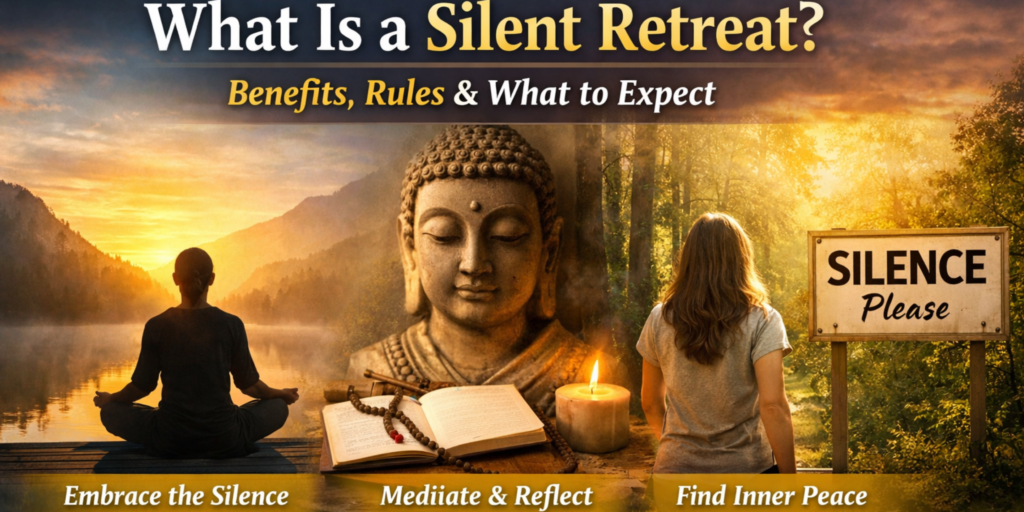
A silent retreat is not about being quiet for quiet’s sake. It is a deliberate pause from conversation, screens, and small talk so you can pay attention to what is happening within. If you have wondered “What Is a Silent Retreat,” it is a structured period of intentional silence with guided meditation, mindful routines, and basic rules that protect stillness while you rest, reflect, and reset.
Silent retreats are extended periods of intentional silence, usually in a group setting, where participants refrain from talking, phones, and casual social cues. Days follow a simple rhythm of meditation, mindful movement, walks, silent meals, rest, and short teachings. Some programs feel strict, others are flexible, yet the aim is the same. Quiet the noise, meet your mind, and come back to presence [1],[2].
Picture this. A dining hall filled with the soft clink of spoons. Steam rises from soup bowls. No one speaks, yet the room feels steady rather than awkward. Most people report that the first day feels odd, then the silence settles and a different kind of attention shows up. It is ordinary and profound at the same time [1].
What Is a Silent Retreat: Definition and Origins
What Is a Silent Retreat Called
People use a few names for these programs. You will hear silent retreat, silent meditation retreat, Vipassana retreat, mindfulness retreat, or simply retreat. Some teachers dislike the word retreat because it sounds like running away. One long-time Zen teacher suggests the word approach instead, since you are actually moving toward direct experience rather than away from life [2]. You may also see quiet retreat used for formats that keep silence but allow journaling or brief check ins with a teacher [1].
Core Practices and Principles
- Meditation. Seated practice in silence, often alternated with walking meditation. Some periods are guided, others are not [1],[2].
- Noble silence. A group agreement to pause talking and social habits like chatting, texting, and sometimes even eye contact, so attention can rest inward without interruption [1].
- Mindful movement. Gentle yoga or stretching to support bodies that are sitting more than usual [1].
- Working meditation. Simple chores like chopping vegetables or sweeping, done with the same awareness as sitting. It shows practice can infuse any activity [2].
- Meals in silence. Eating without conversation brings taste, texture, and appetite cues into focus [1],[2].
- Teacher support. Daily talks and, in some formats, brief one on one meetings to check on practice and safety [1],[2].
Underneath the schedule sits a few steady principles. Reduce external input. Notice thoughts, emotions, and sensations without fixing. Let the schedule carry you. Bring the same quality of attention to brushing teeth, putting on shoes, or making tea that you bring to formal meditation. Ordinary moments become doorways when you are not racing through them [2].
Historical Roots and Modern Adaptations
Two strong roots feed modern silent retreats. In Buddhist traditions you find Vipassana, Zen, and insight meditation where silence supports training attention and seeing the nature of mind. In Christian settings, especially Ignatian spirituality, extended silence frames prayer, scripture, and spiritual direction. The eight day format draws from the Spiritual Exercises of St Ignatius, with daily meetings with a director and Eucharist anchoring the day [2],[4].
Fast forward to today. Secular mindfulness programs adapted elements from these lineages to serve people who want the practice without a specific religious frame. Retreats that support MBSR, MBCT, and self compassion teachers now emphasize silence, meditation, and mindful awareness in daily transitions without tying it to a particular doctrine [2]. The common thread is simple. Stillness to hear what rush drowns out.
Darkness Retreats are also a modern way of experiencing silent retreat to learn more read: What is a Darkness Retreat.
What Is a Silent Retreat Like: What to Expect
Arrival, Orientation, and Settling In
Arrival day is for logistics and learning the container. You check in, find your room, meet staff, and hear the ground rules. A short orientation covers where to be, when to eat, how to get help, and what to do if something feels too intense. Many centers start silence after dinner or the evening talk. The first silent breakfast feels unusual. That soft social hum is gone. Give it a day or two. Social tension fades as the schedule takes over and your nervous system stops scanning the room for cues [1].
Daily Schedule, Meditation, and Mindful Activities
Schedules vary by tradition, yet most days move between sitting meditation, walking meditation, meals, light movement, a talk, and rest. Intensive programs may start very early and keep long hours. Mindfulness oriented formats build in more breaks and optional movement [1],[2].
| Time | Activity | Notes |
|---|---|---|
| 6:30 am | Wake and light movement | Gentle stretching or yoga to warm up [1] |
| 7:15 am | Sitting meditation | Guided or silent sit |
| 8:00 am | Breakfast in silence | Mindful eating |
| 9:00 am | Walking meditation | Indoor or outdoor path |
| 10:00 am | Sitting meditation | Alternate sit and walk periods |
| 12:00 pm | Lunch in silence | Time to rest after |
| 2:00 pm | Working meditation | Simple chores, mindful attention [2] |
| 3:00 pm | Dharma talk or teaching | Short talk from a teacher [2] |
| 4:00 pm | Walking meditation | Grounding the body |
| 5:00 pm | Sitting meditation | Evening session |
| 6:00 pm | Dinner in silence | Keep noble silence |
| 7:30 pm | Final sit or gentle movement | Wind down the day |
Expect your brain to get louder before it gets quieter. Many people assume thoughts will stop in silence. They often spike instead. That is not failure. You are finally hearing what has been there all along. When in doubt, return to the breath, the body, and the next thing on the schedule. The structure is there to carry you when momentum dips [1].
Closing, Reentry, and Post-Retreat Integration
On the final morning the group often breaks silence and speaks during a closing circle. Voices sound strange at first. People describe childlike awe at small details, surprise at emotions that moved through, and a sense of steady presence. Then real life arrives. Reentry takes care. Keep your phone off for the ride home if you can. Take one or two days to move slowly, journal if allowed during the retreat, and keep a short sit each morning. The skills built on retreat stick when you weave them into daily routines soon after you leave [1]. Reported benefits like less reactivity and clearer attention often show up in small choices, not big declarations [7].
Purpose and Benefits of a Silent Retreat
What Is the Purpose of a Silent Retreat
The purpose is simple and radical. Step far enough away from noise to see your mind and your life more clearly. People come to deepen meditation, recalibrate attention, process change, sit with grief or stress, or just rest from constant input. Silence takes the pressure off performing so you can notice what happens when you are not trying to be interesting or useful for a little while [1].
Mental and Emotional Benefits
- Nervous system rest. Less input lets the body downshift from constant alert. That unclenched feeling is often the first benefit people notice [1].
- Emotional clarity. Without distractions, feelings that were sidestepped can surface and move. The result is not always bliss. It is often relief and a workable relationship with what is true [1].
- Attention and impulse control. Retreat practice trains returning to the present. Reports and research summaries suggest improved attention and less reactivity after structured meditation periods [7].
- Brain efficiency. Summaries of small studies describe changes in activation patterns consistent with more efficient processing in non regular meditators after a week of silent practice. Exact mechanisms are still being studied [7].
There is a practical upside that rarely gets named in glossy brochures. Silence builds tolerance for healthy discomfort. Restlessness, boredom, and the urge to reach for something to fix it become training material. That is usable in hard meetings, bedtime with a toddler, or a long line at the DMV.
Spiritual Growth and Insight
Spiritual language varies by tradition, yet the core experience is recognizable. In Ignatian formats, extended prayer and daily spiritual direction invite discernment and trust in a God who delights in people, not an audit of failures. In Buddhist and mindfulness settings, the talk is about awareness and direct experience. Many teachers describe practice as reconnecting with what is already here when the noise settles. The texture changes, yet the movement is the same. Less grasping. More presence [2],[4].
Rules, Etiquette, and Boundaries of Silence
Silence, Noble Silence, and Permitted Communication
Noble silence is a shared agreement to drop talking and social signals during the program. It is not punishment. It protects the focus of every person in the room. Most retreats allow brief one on one meetings with a teacher or staff for practice questions, safety, or medical needs. Emergencies are always exceptions. Accidental words slip out. No problem. Just return to silence without making a story out of it [1].
Technology, Reading, and Journaling Policies
Phones are typically turned off and stowed. Some programs collect them at check in, others trust you to put them away. Reading and writing policies vary. Strict formats discourage or prohibit reading and journaling because both pull attention into ideas rather than direct experience. Softer formats allow journaling and short check ins with instructors. Always read the specific guidelines ahead of time [1],[2].
Mealtimes, Shared Spaces, and Mindful Conduct
Meals are silent. Many centers ask you to avoid eye contact or gestures in the hallways as well. It is less about coldness and more about reducing social pressure. Give people space. Doors close at night. Common areas stay quiet. In the meeting hall, arrive a few minutes early and settle your cushion before the bell. These small courtesies keep the group container steady [1].
Types of Silent Retreats by Tradition
What Is a Buddhist Silent Retreat
Buddhist formats range from Zen to Vipassana to insight meditation. Expect lots of sitting, walking meditation, simple meals, and a daily Dharma talk. Zen schedules are spare and emphasize stillness. Vipassana programs focus on observing sensation and mental habits with equanimity. Working meditation appears often because it proves that practice is portable and not limited to the cushion [2].
What Is a Christian Silent Retreat
Christian retreats weave silence with prayer, scripture, and in many houses, daily Eucharist. You usually meet with a spiritual director for guidance that fits your experience. Activities can include lectio divina, time before the Blessed Sacrament, or silent walks on the grounds. The emphasis is relationship and listening rather than problem solving [4].
What Is a Catholic Silent Retreat
Catholic silent retreats often follow Ignatian patterns across 3 to 8 days, adapted from the 30 day Spiritual Exercises. Participants commit to multiple prayer periods each day and meet daily with a director. Silence is universal on the grounds. The retreat supports discernment through scripture and the movements of consolation and desolation described in Ignatian teaching [4].
Silent Meditation Retreats and Vipassana Programs
What Is a Silent Meditation Retreat
Silent meditation retreats in secular or mindfulness settings keep the core practices of sitting, walking, noble silence, and daily talks. They drop overt religious framing and invite people from any background. Many are designed for teachers in MBSR, MBCT, or self compassion programs. They emphasize bringing mindfulness to transitions like dressing, making tea, and getting to the hall, not just to formal sits [2].
What Is a 10 Day Silent Retreat
Ten day formats are commonly associated with Vipassana intensives. These programs are structured and rigorous. Early wake ups, many hours of meditation, strict noble silence, and often restrictions on reading, writing, and eye contact. The intensity can be powerful and challenging, especially for first timers. It is a serious commitment rather than a casual wellness weekend [1].
How to Prepare for Your First Silent Retreat
Choosing the Right Center and Teacher
- Match the tradition to your aim. Zen and Vipassana are intensive. Mindfulness based formats are often gentler. Christian and Catholic retreats include prayer and spiritual direction [1],[2],[4].
- Check teacher credentials and safety policies. Look for clear procedures for check ins and support if you feel overwhelmed [1],[2].
- Assess the container. Review rules on phones, reading, movement, and accessibility. Decide if you want strict or flexible edges [1].
- Consider location and setting. Nature based sites can support attention through quiet paths and fresh air [1],[6].
Physical and Mental Preparation
- Add short daily sits for a week or two before retreat. Outcome. Your body and mind get used to stillness.
- Practice mini silences at home for 30 to 60 minutes. Outcome. You sample what happens when you unplug [1].
- Reduce caffeine a bit and stretch gently each morning. Outcome. Fewer jitters, less stiffness on the cushion.
- Plan support. If you live with others, set expectations about your phone being off. Outcome. Fewer urgent pings to pull you out.
- Consider mental health. If you are in acute crisis or live with severe depression, trauma, or psychosis, consult a clinician and the retreat team about fit and timing. Outcome. A safer, informed decision. Editor verified.
What to Pack and What to Leave Behind
- Pack. Comfortable layers, a cozy scarf, earplugs if you are a light sleeper, a reusable water bottle, and any cushions or a hot water bottle for comfort [1].
- Optional if allowed. A small journal and pen for big insights that feel too large to hold in mind [1].
- Leave behind. Work laptop, social media habit, and nonessential reading. Many programs ask you to skip books to protect attention [1],[2].
Challenges, Risks, and Who Should Avoid a Silent Retreat
Common Difficulties and How to Navigate Them
- Racing thoughts. Normalize it. Label thinking, return to breath or body, and lean on walking periods when energy spikes [1].
- Physical discomfort. Adjust posture, stand at the back for a few minutes, or add a cushion. Movement periods are there for a reason [1].
- Loneliness. Being alone together can feel raw. Remember the room is full of people doing the same gentle work. Let that be a quiet support [1].
- Schedule resistance. Minds love to argue with the bell. Treat resistance as part of the practice rather than a verdict on your ability [1].
Mental Health Considerations and Safety
Silence turns down outside noise, which can turn up inner volume. If you are managing PTSD, active suicidality, psychosis, or very recent trauma, a long silent retreat may not be appropriate right now. Shorter formats or one day sits with strong support can be wiser steps. Always disclose relevant history on intake forms and use teacher check ins if distress spikes. Speaking to staff for safety is permitted, even in noble silence [1]. Editor verified.
When a Shorter Retreat or Home Practice Is Better
Not everyone needs ten days in noble silence. A weekend retreat or a daylong can be the right intensity for many people. You can also create DIY mini silences at home by turning off your phone, keeping a simple schedule, and taking mindful walks. Softer edges build confidence without overwhelming your system [1].
Costs, Locations, and How to Choose a Retreat
Retreat Pricing, Scholarships, and Work-Trade
Pricing varies widely by center, length, and whether lodging and meals are included. Many centers offer sliding scale spots, scholarships, or work trade for chores like kitchen prep or cleaning. Teacher dana or donation is common in some traditions. Always ask what is included and what additional donations are customary. Editor verified.
Popular U.S. Centers and Program Formats
- Art of Living Retreat Center in the Blue Ridge Mountains. Offers silent programs with meditation, yoga, and nature immersion [6].
- UC San Diego Mindfulness Based programs. Hosts silent retreats for MBSR and related teachers and practitioners [2].
- Jesuit and Catholic retreat houses across the country. Many offer 3 to 8 day silent retreats grounded in Ignatian spirituality with daily spiritual direction [4].
Program formats tend to cluster into three types. Structured intensives with long meditation hours. Mindfulness based silence with gentle movement and teacher support. Faith based silence with prayer and sacrament. Choose based on temperament, support needs, and the kind of guidance you want [1],[2],[4].
Questions to Ask Before You Book
- What are the exact silence rules. Are phones collected. Is journaling allowed.
- How many hours of daily meditation are expected. Are sits guided or silent.
- What support is available if I struggle. Are there one on one check ins.
- What is the lodging like. Single rooms or shared. Any accessibility notes.
- What is included in the price. Are teacher donations separate.
- What tradition frames the retreat. Buddhist, Christian, secular mindfulness, or mixed.
Silent Retreat FAQs
Can you talk during a silent retreat?
During noble silence you do not talk or signal to others. Most programs allow practical communication when needed, like with staff, plus scheduled meetings with a teacher. Emergencies always override silence. If a thank you slips out, no harm done. Return to quiet without self judgment [1].
Can you read on a silent retreat?
It depends. Strict formats often ask you not to read or write so attention stays with direct experience. Softer formats may allow journaling and brief readings. Check the policy for your specific program. Many mindfulness oriented retreats discourage reading during silence and invite attention to daily activities instead [1],[2].
What happens if you stay silent for 7 days?
For many people the first two days feel loud inside, then attention steadies. Reported effects include clearer focus, less reactivity, emotional processing, and a sense of presence that carries into daily life. Summaries of small studies suggest changes linked to more efficient brain processing after a week of structured practice, though research is ongoing [1],[7].
What happens if you sit in silence for 10 minutes?
Even ten minutes of intentional quiet can help the body downshift and the mind notice what is actually happening. Thoughts likely keep moving. That is normal. The point is not to stop them. It is to see them and choose a different relationship to them for a few minutes [1].
Conclusion: Key Takeaways and Next Steps
What Is a Silent Retreat comes down to this. A clear container that trades chatter for presence. You follow a simple daily rhythm. You let the noise subside. You learn what your mind does when it is not fed constant input. The benefits tend to show up in ordinary places. A steadier breath in traffic. A softer response in a hard conversation. A quiet cup of tea that actually tastes like tea.
If you feel curious, start small. Try a daylong or a weekend. Practice a few mini silences at home. When you choose a center, match the format to your nervous system, not to someone else’s badge of honor. Read the rules, pack for comfort, and give yourself permission to be a beginner. The bell rings either way. What happens next is the point.
To go deeper, review programs at a mindfulness center, a Jesuit retreat house, or a nature based site like the Blue Ridge. Ask the safety and support questions that matter to you. Then set the phone down, walk into the hall, and sit. That is how every silent retreat starts and how most meaningful changes begin.
References
- Calm Editorial Team. Thinking of doing a silent retreat. Calm Blog. Published May 5. Accessed March 2026. https://www.calm.com/blog/silent-retreat
- UC San Diego Centers for Integrative Health. What actually is a silent retreat, and why go. Accessed March 2026. https://cih.ucsd.edu/mbpti/blog/what-actually-silent-retreat-and-why-go
- Sugar Ridge Retreat Centre. Silent Meditation Retreat benefits page. Accessed March 2026. https://www.sugarridge.ca/retreat/silent-meditation-retreat-in-ontario-3-5-or-7-nights/
- U.S. Catholic. Be quiet. What do you do on a silent retreat. Published April 23, 2012. Accessed March 2026. https://uscatholic.org/articles/201204/be-quiet-what-do-you-do-on-a-silent-retreat/
- Art of Living Retreat Center. What really happens on a silent retreat. Accessed March 2026. https://artoflivingretreatcenter.org/what-really-happens-on-a-silent-retreat/
- Healing Holidays. 6 powerful benefits of silent retreats. Accessed March 2026. https://www.healingholidays.com/blog/6-powerful-benefits-of-silent-retreats
- Calm Editorial Team. Benefits and what to expect sections within Thinking of doing a silent retreat. Calm Blog. Accessed March 2026. https://www.calm.com/blog/silent-retreat





 Your personalized retreat result