


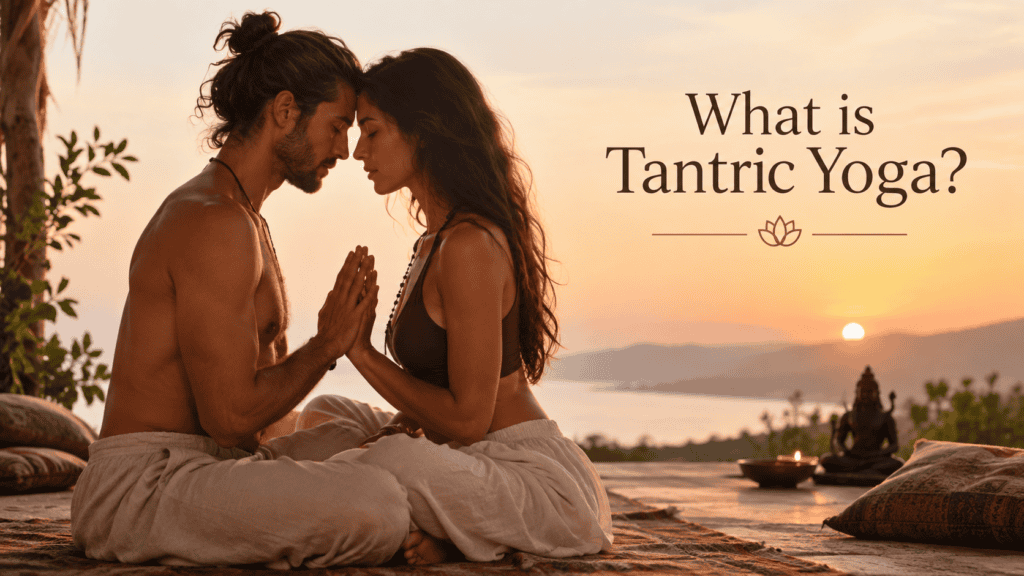
Tantric yoga is an ancient spiritual practice from India that uses yoga poses, breathwork, mantra, meditation, and visualization to awaken inner energy and support personal transformation. While often misunderstood, tantric yoga centers on weaving body, mind, and awareness through conscious presence—making daily experience itself a spiritual path rather than focusing solely on esoteric or sexual techniques.
Tantric yoga combines breath, movement, meditation, and mantra to awaken and channel inner energy, aiming for personal and spiritual growth. The practice fosters deep mind-body connection, often through slow, mindful poses and energy awareness—not necessarily sexual activity, as is often misconstrued.
Introduction to Tantric Yoga
Think of the word “tantra” and two things typically spring to mind: complicated esoteric rituals and, thanks to pop culture, a wink-wink reference to sex. But the reality on the ground in a traditional tantric yoga class looks nothing like a Hollywood fantasy. Instead, what actually happens might surprise people—the room settles into a calm silence, breath slows, and simple postures become gateways to something far subtler. Challenging? Certainly, but not for the reasons most assume.
So, what is tantric yoga? At its heart, this form of practice fuses movement, breath, concentration, and sometimes mantra to stimulate deep awareness of body and energy. Rather than just building strength or flexibility, it weaves together the sensory, the internal, and the sacred into a daily experience anyone—with serious curiosity or simple open-mindedness—can explore.1 Over the past decade, a rising tide of practitioners in the West has sought out these teachings for their restorative, mindful qualities and their reputation for transforming emotional experience, stress, and relationships.
Set aside the headlines and hype. The core of tantric yoga is the art of presence: learning to listen, feel, and witness what’s unfolding in body, mind, and heart—and, occasionally, the space between one breath and the next.
What Does Tantric Yoga Mean?
The meaning of tantric yoga, in simple terms, is the integration of physical postures, mindful breathing, meditation, and subtle energy practices to channel one’s life force (shakti) toward greater awareness and growth. This doesn’t mean abandoning everyday life in search of mystical experiences, but rather discovering the profound within the ordinary.
To “weave” is the literal root of the word tantra, so the tradition emphasizes weaving together the aspects of daily living with the quest for inner clarity and connection.2 This “weaving” also refers to balancing the masculine and feminine energies inside every person, the dance of opposites (like activity and rest, thought and stillness, receiving and giving) that shape human experience.
Most practitioners quickly notice that tantric yoga practices aren’t centered around advanced acrobatics or performance, but on deepening a relationship with the present moment. This is why even the simplest pose, done with focused breath and intention, becomes a vehicle for shifting awareness and energy.
Tantric Yoga Definition
What’s the true definition of tantric yoga? In the classical sense, it’s a spiritual system from India that combines movement, breath, visualization, mantra, and meditation to awaken and direct energy within the body.3
- Tantric yoga explained: A path that emphasizes conscious presence, integration of body and mind, and honoring the sacred in everyday life.
- Tantric yoga meaning: Awakening the energy within to cultivate presence, mindfulness, and ultimately freedom.
- What does tantric yoga mean? The practice invites you to tune in, slow down, and connect with both the simple and subtle sensations of experience.
- Explain tantric yoga: A traditional form of yoga using asana, pranayama, meditation, mantra, and energy work—not merely a set of sexual techniques.
Although many “tantra yoga definitions” circle around the idea of sacred union or energy awakening, one thread persists: the discipline of cultivating awareness—in posture, breath, touch, thought, or relationship—with the ultimate aim of spiritual and personal freedom.
What Is Tantra?
Tantra itself is a complex spiritual tradition that arose in India somewhere around the 5th to 6th centuries CE and later spread into Buddhist and Jain contexts across Asia.4 While interpretations of tantra are as numerous as the languages and cultures that have engaged with it, at its root, tantra is about using specific practices to awaken the innate potential—“shakti”—within the human body and mind. That potential is described in the texts as being both practical (health, clarity, relationships) and spiritual (liberation, realization).
In practice, tantra is less about escapism and more about working with the “material”—the body, emotions, relationships, desires—as part of the spiritual path. This sets it apart from earlier yogic and Vedic traditions that sometimes saw worldly life primarily as an obstacle to realization.5
What Does “Tantra” Mean?
Here’s where it gets interesting: “tantra” in Sanskrit means “to weave” or, more subtly, “framework,” “technique,” or “tool for expansion.”6 In the classical texts, a tantra can be a sacred scripture, a spiritual revelation, or simply a practiced method for aligning one’s actions with the principles of the divine. When people refer to “the meaning of tantric yoga,” they’re alluding to both this idea of weaving the sacred into daily experience and the practical techniques that make it possible.
There’s also the sense that tantra is about bringing together opposites—light and dark, masculine and feminine, pleasure and presence—into a harmonious whole. In many ways, this is the secret behind the staying power of tantric teachings: people resonate with the idea of integration, not exclusion.
Is Tantric Yoga the Same as Tantra?
This is one of those questions that sparks a thousand opinions, most of them confident but not always correct. Tantric yoga emerges from the broader umbrella of tantra but narrows its focus to practices and principles—movement, breath, meditation—that support the awakening and conscious direction of energy. In other words, all tantric yoga is rooted in tantra, but not all tantra is yoga. Some branches of tantra engage in rituals, ceremony, or complex philosophy that are not strictly yogic.
The popular stereotype (that tantra = sex or forbidden rituals) is largely a Western construction, and tends to obscure the austerity, depth, and subtlety of authentic tantric yoga.7 While a few tantric lineages did include specific sexual rituals, this was never the daily norm—a bit like assuming all of French cuisine is defined by escargot.8
Is Tantric Yoga a Type of Yoga?
Yes, but with a twist. Tantric yoga is one of several classical streams within the extensive tradition of Indian yoga, alongside hatha, raja, karma, and others.9 What sets it apart is its central role in introducing energy work, mantra, visualization, and the honoring of both body and mind as vehicles for transformation.
Modern yoga, especially as practiced outside India, is heavily influenced by tantric philosophy—sometimes unknowingly. Kundalini yoga, for instance, is a direct offshoot of tantric ideas about energy and the chakras. Hatha yoga’s fascination with subtle energy channels also reflects tantric influence. In a way, most contemporary yogis are already practicing “a little bit of tantra” every time they focus inward and bring conscious breath to movement.
The History of Tantric Yoga
Where Did Tantric Yoga Originate?
The origins of tantric yoga are steeped in both history and a certain poetic ambiguity. Most historical sources place its roots in India, between the 5th and 12th centuries CE, during a time of significant social and religious ferment.10 This was a period that saw traditional Vedic ritual practices giving way—sometimes gently, sometimes not—to more accessible and practical approaches to spiritual growth.
The region of Kashmir played a pivotal role, especially through the flowering of nondual Shaiva tantra, which regarded both the world and the body as sacred. Buddhist tantra, meanwhile, grew rapidly in northern India and then migrated into Tibet and East Asia.
Whenever the world seems awash in rigid rules, traditions like tantra show up with a fresh take: “Everything—yes, even laundry, relationships, and the flavor of your morning tea—can be a path to awareness, when approached skillfully.” This thought, both radical and comforting, became one of the most attractive features of tanric yoga.
The Origins of Tantra in India
Historians trace the development of tantra to a complex milieu in Indian spirituality where new forms of ritual, scriptural texts called Tantras and Agamas, and a deeply human focus on the body and experience began spreading from the 5th century onward.11 Unlike earlier Vedic traditions that tended to privilege renunciation and asceticism, tantric yoga made spiritual practice explicitly accessible to ordinary people—including women and householders.
The rise of tantra coincided with increasing urbanization and a society ready for more inclusive forms of religious life. Rituals became localized, personalized, and often celebrated the goddess or shakti principle, reflecting an embrace of the body and the feminine in spiritual practice.
Tantric Traditions in Hinduism
If the Vedas offered transcendent wisdom from on high, tantric Hinduism was more about getting spiritual dirt under your fingernails. The tradition unfolded within several schools, most notably Shaivism, Shaktism, and some branches of Vaishnavism.12
Key features included the worship of Shiva and Shakti, use of mantras and yantras (mystical diagrams), ritual honoring of the body, and an insistence that liberation could be achieved not by fleeing the mess of mortal life but by entering it, consciously and skillfully. For the first time, “householders”—people with jobs, families, joys, and heartbreak—were not barred from the spiritual elite.
Tantric Traditions in Buddhism
Buddhism, too, assimilated the methods and philosophy of tantra, especially in the Vajrayana tradition of Tibet, Mongolia, Bhutan, and parts of Nepal.13 Buddhist tantra looked beyond ritual alone, emphasizing guru-disciple transmission, subtle energy anatomy, deity visualization, and the possibility of enlightenment within a single lifetime.
Tantric Buddhism is famous for its intricate mandalas and elaborate visualizations, as well as its grounding in ethics and compassion. The image of a meditating monk surrounded by swirling syllables and rainbow-light is not just artistic license, but a reference to these ancient yogic energy practices that still pulse through contemporary Buddhist teaching.
The Development of Tantric Yoga
Tantric yoga emerged out of this fertile ground, initially recorded as a regulated system of rituals and energy techniques—mantra repetition, breathwork, physical postures, mudras (energetic hand gestures), and complex visualizations.
Over time, the focus shifted from external ritual to internalized, meditative practice. The concept of the “subtle body”—with its nadis (energy channels), chakras (energy centers), and kundalini (dormant energy at the base of the spine)—came to define the tantric yogic experience.14 The body was no longer seen as an obstacle to be escaped, but as a temple for awakening, a channel for transformation.
How Tantric Yoga Influenced Modern Yoga
Traditionalists and modern yogis alike may be surprised to learn just how many elements of today’s popular yoga flows grew out of tantric innovation. Visualizations, dynamic breathwork, chanting, and even the energetic understanding of yoga postures can be traced back to medieval tantric texts.15
The modern obsession with wellness and inner balance has a direct lineage to tantric reimagining of what spiritual life could mean—less about abstract theory, more about experience and embodiment. It’s not an accident that mindfulness, body positivity, and explorations of energy have taken center stage in the modern yoga scene.
Traditional Tantra vs Modern Tantric Yoga
Now, here’s the rub: the word “tantra” today can mean wildly different things in different circles. Classical tantric yoga encompassed rigorous ritual, mantra, discipline, and teacher-student transmission, while today’s practices vary from quiet meditative classes to boldly experimental workshops.
One crucial difference? Classical tantra was focused almost exclusively on spiritual practice and liberation, whereas modern approaches (especially in the West) often emphasize personal growth, relationships, sensuality, or even therapy. Some authenticity is lost in translation, while flexibility and accessibility are gained.16
The best modern teachers acknowledge the roots and make the lineage clear, respecting both tradition and adaptation. Practitioners benefit most when they understand not only what they’re doing, but who originally offered the tools—and for what purpose.
The Philosophy Behind Tantric Yoga
The Core Principles of Tantra
Let’s clear the air right away: at its core, tantra is not about forbidden acts or off-limits pleasure. The real heart of tantra lies in a handful of profound principles:
- Everything can be a spiritual doorway when met with conscious presence.
- The body and senses are not obstacles, but pathways to realization.
- Meditation, mantra, visualization, and ritual are valid means to awaken awareness.
- The dance of polarities—masculine and feminine, active and receptive, mind and body—is the cosmic engine behind spiritual transformation.
- Personal liberation is accessible in this very life, not some distant afterlife.
This philosophy might sound lofty, but in practice it means attention to the here and now: the sensation of air on skin during a breath practice, the feeling of tension melting in a supported posture, or the brief, honest presence in a challenging moment.
Consciousness and Energy
Tantric yoga holds that every human being possesses both consciousness (awareness, or “Shiva”) and energy (dynamic creative force, or “Shakti”). These aren’t just cosmic metaphors—they’re frameworks for understanding how thoughts, feelings, physiological processes, and even relationships work.17
Here’s the catch: most people’s awareness is dispersed, scattered across distractions and worries. A key practice in tantra is learning to anchor attention, gather energy, and notice what’s happening—without judgment. Over time, this brings a sense of “aliveness” and unity that many describe as both grounding and liberating.
Shiva and Shakti
If you’ve ever seen an image of Shiva in deep stillness or Shakti as a swirling goddess of movement, you’ve glimpsed the central metaphor of tantra. Shiva is unchanging awareness; Shakti is ever-shifting energy. The interplay of the two not only makes up the cosmos but also shapes personal experience.
In tantric yoga, the union of Shiva and Shakti is reflected in practices that blend mindfulness (stillness, witnessing) with dynamic action (movement, breath, intention). Their “marriage” is not a historical event, but a process that unfolds in every posture, every breath, every lived moment.
The Relationship Between Masculine and Feminine Energy
Contrary to literalist readings, masculine and feminine energy in tantra have less to do with gender and more to do with qualities: masculine stands for consciousness, direction, holding space; feminine implies energy, transformation, and creative flow.18
The point is to notice and balance these impulses—not to force a social identity. A person might cultivate masculine focus to steady a wandering mind, then shift into feminine receptivity to allow relaxation and insight. In couples practice, this dance becomes clearer, but it shows up in solo practice just as often.
The Concept of Shakti
Shakti is the lifeforce or creative power that animates the universe. Within tantric yoga, shakti is understood as the energy that fuels movement, breath, thought, and sensation.19 It is individualized as the dormant potential coiled at the base of the spine, known as kundalini.
Activating shakti is less about dramatic experiences and more about tuning into the present, feeling energy move, and cultivating deep self-awareness. The most profound shifts often start small: a tingling sensation in the spine, heat or coolness in the palms, or a flash of insight in meditation.
Prana and Life Force
Prana, the Sanskrit word for life force or vital energy, is a central element in both tantra and yoga more broadly. It’s not just air or oxygen, but the subtle vitality running throughout body and mind. Traditional tantric practices often combine slow, mindful breathwork (pranayama) with visualization to direct prana through energy channels, nourishing all layers of self.
For people new to this kind of practice, “energy” may sound abstract. In reality, it’s often experienced as a sensation of warmth, tingling, or flow during focused breathing or meditative stillness—sometimes, quite unexpectedly, in the middle of an ordinary day.
Chakras and Tantric Yoga
Chakras, or subtle energy centers aligned along the spine, have become a familiar concept in wellness circles, but tantra is where the idea really took hold. There are many chakra systems (not just the popular seven), but in tantric yoga, these centers are seen as gateways for transforming habitual physical, emotional, or psychological patterns.20
Classical practice involves breath, mantra, attention, and visualization placed on a specific chakra to clear stagnation or activate latent potential. While the language is ancient, the experience is modern: focused attention on these areas can bring surprising clarity, release, or inspiration.
Kundalini Energy
Kundalini, usually depicted as a coiled serpent at the base of the spine, is tantric yoga’s most famous, least understood metaphor. Kundalini is the dormant spiritual energy within each person. Practices in tantra aim not so much to “force” an awakening as to gently clear the path—through breath, posture, and consciousness—so that this energy can rise naturally.
A safe, gradual approach is the mantra in traditional circles, and for good reason: the process is unpredictable, deeply individual, and can be both liberating and destabilizing if approached recklessly.
Expanding Consciousness Through Tantra
The point of all tantric practice—whether it’s a simple breath exercise, chanting a mantra, or moving through a series of asanas—is to expand the awareness beyond its usual boundaries. Over time, practitioners learn to notice the arising and passing of thoughts, feelings, and impulses, loosening their grip and inviting a sense of spaciousness.21
For most people, these moments don’t look dramatic. Instead, they bring a quiet sense of presence, a capacity to sit with difficult feelings without being overwhelmed, and occasionally the awe that comes from recognizing the ordinary as extraordinary.
Seeing the Sacred in Everyday Life
Here’s where tantric yoga shines. The “weaving” is not just technique, but attitude—in modern terms, it’s about mindfulness, gratitude, and viewing daily tasks as genuine opportunities for spiritual growth.22
This might look like bringing full presence to washing dishes, hearing the sound of the water, or savoring a simple meal with all the senses awake. A seasoned teacher once put it plainly: “Yoga isn’t just what happens on the mat, but in the small moments between the poses.”
How Does Tantric Yoga Work?
How Tantric Yoga Differs From Traditional Yoga
Traditional yoga as practiced in gyms or studios often focuses on asana sequences for strength, flexibility, and relaxation. Tantric yoga, by contrast, roots itself in energetic anatomy, slow and mindful movement, and conscious exploration of sensation.23
Rather than a focus on “achieving” the perfect pose, tantric yoga asks: How does the posture affect breath, mood, and energy? What becomes visible or palpable when stillness is combined with internal focus? Here, the body is less a tool for performance and more a laboratory for self-discovery.
The Role of Breath
Breath is, without exaggeration, the backbone of tantric yoga. Each inhalation and exhalation is an opportunity to observe, direct, and enhance energy flow. Practices often use slow, deep breaths matched with visualization or mantra, creating an atmosphere where awareness can deepen and the nervous system settles.24
Some exercises use alternate nostril breathing, rapid fire techniques, or pauses between breaths, depending on the goal—calming, energizing, or clearing mental fog.
The Role of Meditation
Tantric yoga treats meditation not as a separate event from posture or breath, but as an element woven throughout practice. Often, a session begins with a centering or intention-setting, continues with mindful movement, and returns repeatedly to stillness and observation.
Mantra repetition, visualization, or simple open awareness are popular in both solo and partnered practices. The effect is cumulative: the mind is trained to rest in the present, old conditioning loosens, and people discover that “being” can be just as satisfying, if not more so, than “doing.”
The Role of Mantra
Chanting is not just musical entertainment in tantra—it’s a method for shifting energy and attention. Repeating a mantra, either whispered or silently, can help focus the mind, direct prana, and stimulate specific energetic centers (chakras).
Often, a teacher will assign a mantra suited to a student’s intention or energy pattern. Some popular mantras have been passed down for centuries, their syllables said to resonate with particular frequencies or qualities—peace, courage, clarity, or compassion.
The Role of Visualization
Visualization is another pillar of tantric yoga. Modern neuroscience backs up what practitioners have claimed for centuries: the mind has a profound impact on physiological state. Visualizing light, energy, or color moving through a certain area of the body can enhance sensation, awareness, and transformation.
Visualizations often focus on moving energy up the spine, clearing blockages, or filling the heart with spaciousness or unconditional love.
The Role of Mudras
Mudras are energetic gestures, usually made with the hands, that facilitate the flow of prana (life force). Some famous mudras—like Anjali Mudra (prayer hands) or Chin Mudra (thumb and index finger joined)—emphasize connection, grounding, or surrender.25
Advanced mudras can engage the whole body and may be paired with breath, gaze, or mantra for enhanced effect. They’re a staple in many traditional and modern tantric yoga practices, yet can be as simple as placing a hand on the heart and noticing what arises.
The Role of Bandhas
Bandhas are subtle energetic locks or engagements, usually applied to the pelvic floor, abdominal area, or throat. Their purpose is to contain, direct, and intensify pranic flow within the body, sometimes “sealing in” the effects of breathwork or visualization.
While powerful, bandhas should be learned with care and preferably under qualified instruction, as overzealous practice can lead to unnecessary tension or energetic imbalance.
The Role of Asana
Asana (posture) in tantric yoga is slowed down, sustained, and matched with awareness far more than in a fast-paced vinyasa class. Each pose becomes an invitation to observe how energy and breath shift from one moment to the next.
Many tantric sequences use classic hatha postures—Cobra, Bridge, Seated Forward Fold—but the intention is less about athletic achievement and more about subtle awakening, stability, and comfort. Some teachers describe the practice as “moving meditation,” where the journey is more important than the endpoint.
The Role of Energy Awareness
Energy awareness is what separates tantric yoga from mere physical exercise. Through guided breath, movement, and conscious intention, practitioners notice the ebb and flow of prana, the opening and closing of chakras, and even fluctuations in mood or emotion.26
This kind of internal sensitivity is sometimes compared to tuning an instrument: over time, the body and mind become attuned to finer and subtler “notes” of experience. The effect spills over into ordinary life, creating a consistent thread of presence and emotional regulation.
Working With Kundalini Energy
The safe activation and direction of kundalini energy is a practice to approach with humility and patience. Traditional teachings warn against hastiness, as the process can be destabilizing if not grounded in established discipline and ethical conduct.
In classic sequences, the practice involves posture, breath, bandha, mantra, and visualization, all working together to clear energetic blocks and gently coax kundalini up through the chakras. When done correctly, this does not result in fireworks—but in deep clarity, peaceful awareness, and at times a gentle sense of awe.
What Happens During a Tantric Yoga Session?
What to Expect in Your First Class
Walking into a tantric yoga class might not be what you expect. There’s often less hustle, fewer mirrors, and a quieter, more reflective mood. Teachers are more likely to invite you to close your eyes, turn inward, and respect personal boundaries.
Sessions typically begin with centering breathwork or guided meditation, followed by slow, sustained postures paired with conscious breathing. The instructor may guide mantra chanting or silent visualization. The physical intensity may be less than a power yoga class—but the internal dimension is turned up several notches.
Opening Meditation
Almost all tantric yoga classes start with a guided meditation to settle the body and mind. This could be as simple as observing the breath, setting an intention, or tuning in to sensation—like the feel of the floor under your seat, the weight of the hands in your lap, the sound of the breath.
This “opening”—sometimes lasting just a few minutes—creates the context for everything that follows: a container of awareness, a gentle invitation to step off autopilot.
Breathwork and Pranayama
Next comes focused breathwork, which might include slow abdominal breathing, alternate nostril breathing, or short pauses between breaths. The emphasis is on conscious, effortless breathing—not “performance breathing.” Even a few minutes can shift the nervous system from stress toward relaxation.
Pranayama serves not only as a warm-up for postures but as a transition to deeper states of presence.
Mantra and Sound
Some sessions include mantra chanting, either as a group or individually. This could be a single seed syllable (“OM”), a Sanskrit invocation, or a phrase chosen for its energetic resonance. The vibration of sound is said to clear mental clutter, settle the body, and open subtle channels of energy.
Not every class includes chanting, but most experienced practitioners find it shockingly effective at fostering a sense of connection and clarity.
Tantric Yoga Poses
Rather than flowing rapidly from pose to pose, tantric classes use held postures—Lotus, Cobra, Bridge, Goddess, and Seated Forward Fold among them.27 Poses are accompanied by awareness of breath, sensation, and energetic shifts; teachers often encourage props, cushions, or blocks to create comfort and stability.
It’s common to hold a posture for several minutes, breathing steadily and observing what arises.
Chakra and Energy Practices
Many teachers build in chakra awareness, inviting attention toward a particular area of the spine or energy center (heart, navel, base, throat, etc.). Visualization of light or breath moving through these centers is a hallmark of authentic tantric yoga.
Sometimes gentle self-touch, such as placing a hand over the heart or belly, can help anchor the focus and facilitate energetic shifts.
Meditation and Visualization
The practice will often return to meditation, with eyes closed, breath steady, and attention tuned to either sensation or inner imagery. This could include simple observation or more vivid visualization—a stream of light, a spinning wheel of energy, or a sense of space and expansion.
Some sessions alternate between movement and stillness several times, allowing insights and sensations to deepen gradually.
Closing Integration
Class ends with grounding: a lying or seated rest, silent gratitude practice, or gentle reflection. Teachers often suggest taking a few moments to notice the breath, scan the body for sensations, or simply sit in silence. Integration helps “seal in” the effects of the session, making the experience more than just a fleeting exercise.
How Long Is a Tantric Yoga Session?
Sessions range widely, from brief 10- to 20-minute home practices to group classes lasting 60–90 minutes. Traditional retreats may run several hours a day for multiple days. However, quality of attention trumps quantity of time—a focused 15-minute session can be just as transformative as a longer one, especially for beginners or busy people.
References
- myyogateacher.com/articles/what-is-tantra-yoga. What Is Tantra Yoga? Meaning, Poses & Practices Explained. December 2025. Accessed September 2026.
- Brett Larkin Yoga. Tantra Yoga: The Most Misunderstood Path of Yoga. https://www.brettlarkin.com/tantra-yoga/. Accessed September 2026.
- The Light Collective. What is Tantra? — The Light Collective | Yoga Studio & Training – by Sian Pascale. https://www.thelightcollective.yoga/journal/what-is-tantra. Accessed September 2026.
- Healthline. 10 FAQs About Tantric Yoga: What It Is, Benefits, How to Practice. https://www.healthline.com/health/tantric-yoga. Accessed September 2026.
- Wikipedia. Tantra. https://en.wikipedia.org/wiki/Tantra. Accessed September 2026.
- mindbodygreen. Tantric Yoga: What It Is, Origins + Ways To Practice. https://www.mindbodygreen.com/articles/traditional-tantra-yoga-everything-you-need-to-know. Accessed September 2026.



 Your personalized retreat result