

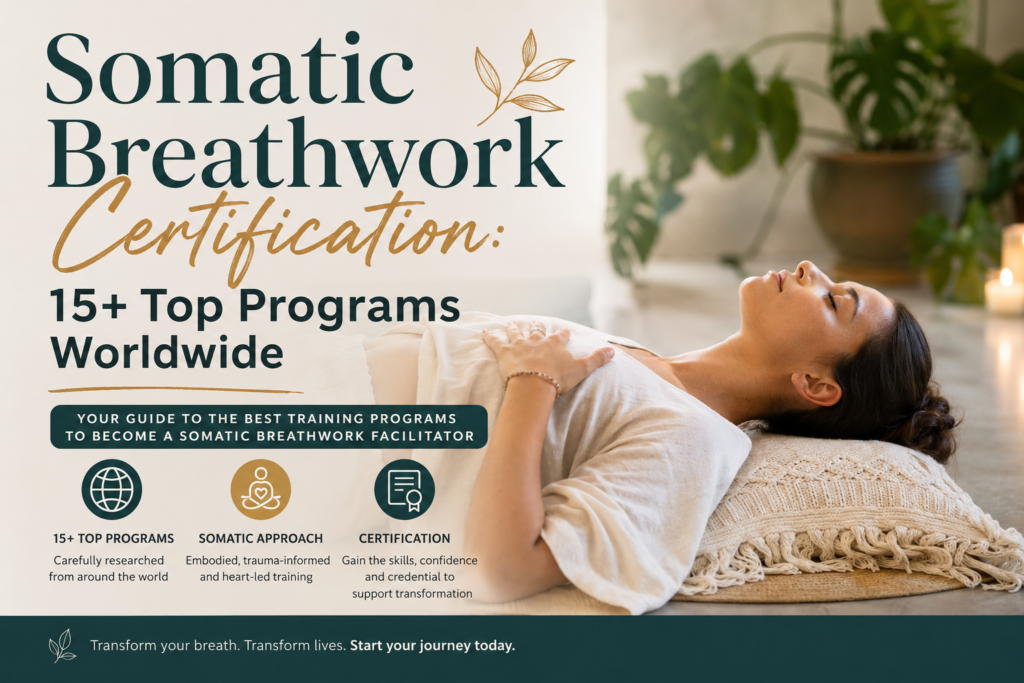
Somatic breathwork certification marks a professional path for those hoping to facilitate safe and transformative breathwork sessions focused on nervous system regulation, embodied awareness, and trauma-informed care. Finding the right somatic breathwork certification means weighing training depth, supervision, and real-world readiness—a decision shaped as much by community and mentoring as curriculum. Here’s how top somatic breathwork certification programs compare: accreditation, training hours, cost, trauma education, supervised practice, modality—these make the real difference.
A somatic breathwork certification formally trains facilitators to guide breathwork sessions that support body-based emotional release and nervous system regulation. The top programs balance trauma-informed methods, hands-on practice, and science-backed content to certify practitioners for one-on-one, group, or clinical work.
What Is Somatic Breathwork Certification?
Somatic breathwork certification is a structured credential granted after specialized training in body-centered breathwork methods. Unlike generic breathwork certificates, this type of certification emphasizes somatic approaches—meaning practitioners learn to read, work with, and support the client’s bodily sensations, nervous system shifts, and trauma responses using conscious breathing techniques. Instead of chasing altered states or athletic performance, certified somatic breathwork practitioners center on emotional release, self-regulation, and embodied healing through guided breathwork.
People pursue somatic breathwork certification for several reasons. Some are therapists or coaches adding clinically relevant skills. Others want to build new careers as breathwork facilitators, or simply deepen their own self-awareness. The essence, though, remains in learning how to safely guide others into the territory where stress, trauma, and unprocessed emotion are stored in the body—and support gentle release through breath. Over the past decade, as understanding of trauma and the mind-body connection has grown, these certifications have shifted from niche to mainstream in wellness, coaching, and even clinical settings1.
It’s common to see both the terms “somatic breathwork certification” and “certification in somatic breathwork,” but the focus is identical: structured, standards-based training in body-based breathwork facilitation, not just sitting for a quick online quiz or reading a handful of articles.
How Somatic Breathwork Certification Works
At its core, somatic breathwork certification is not just a course, but an immersive process. Programs are designed to balance theory, personal practice, and direct supervision—so practitioners don’t just recite protocols but actually learn to embody, sense, and guide real change. Typical certification includes a mix of pre-recorded content, live supervision or feedback, and hands-on practice, either online, in immersive workshops, or both.
Here’s where things get nuanced. The best certifications require trainees to:
- Understand nervous system science (especially polyvagal theory and trauma responses)
- Facilitate sessions using body-based awareness (tracking signs of regulation, activation, or shutdown in real time)
- Demonstrate actual facilitation skills with real or mock clients—often under supervision
- Complete personal process work to build their own somatic resilience
- Learn ethical boundaries, contraindications, and scope of practice
The goal is not just intellectual knowledge, but capacity to work with actual humans—who rarely follow any script. Some certifications genuinely offer this; others, not so much. So the certification “works” if it actually helps you guide safe, empowering sessions, not just hand you a PDF with your name on it.
What You Learn During Training
If you ever talk with someone who’s mid-certification, you’ll notice something: it’s not just a pile of techniques, but a transformation. A comprehensive somatic breathwork certification program typically covers:
- Science and theory: respiratory physiology, polyvagal theory, trauma science, body-mind connection
- Somatic skills: guided tracking of sensations, tension patterns, nervous system states
- Breathing techniques: slow, diaphragmatic regulation; conscious connected breathing; movement integration
- Session flow: assessment, intention setting, pacing, integration and aftercare
- Safety: trauma-informed precautions, screening, when not to proceed, and how to handle dysregulation
- Ethics, boundaries, scope of practice
- Business basics: marketing, community building, insurance needs, if offered
- Clinical or group work: how to adapt breathwork for individuals versus groups
Distinct from spiritual or performance-focused certifications, somatic programs focus on real-time body feedback, gentle pacing, and honoring each client’s unique thresholds. Some programs pair recorded modules with live calls or supervision—a model that for many, makes all the difference.
How Much Does Somatic Breathwork Certification Cost?
Cost varies widely, and if you’ve ever shopped for a program, the sticker shock is real. The range in 2025:
- Budget options: Around $600–$1,000, often self-paced, lighter on supervision.
- Mid-range: $1,000–$3,000, more support, sometimes with limited live feedback ($1,000–$3,000).
- Premium: $3,000–$5,000 for in-depth, long-form programs with supervision and mentorship.
- High-ticket: $5,000+, typically for multi-month programs, in-person intensives, or certification with business training.
Expect additional costs for books, practicum supervision, or insurance (sometimes hidden in the fine print). And while price does not guarantee quality, in this field, paying more often corresponds to getting real support and lasting community—key for anyone serious about developing real facilitation skills. “Cheap” often means less practice, little feedback, and a PDF certificate with limited legitimacy2.
How Long Does Certification Take?
Timelines range from short (a few weeks) to nearly a year, depending on program depth, format, and your own pace. As a general rule:
- Online, self-paced certificates: as little as 4–6 weeks, though rarely sufficient for true skill-building.
- Serious certifications: 3–6 months, often including 50–200 hours of combined study, practice, and live supervision.
- Hybrid or intensive: up to 12 months or more, typically with staged modules, live retreats, and ongoing practicum requirements.
The industry norm for a recognized somatic breathwork certification (as of late 2024) sits around 100–200 hours, inclusive of both theory and hands-on practice. Shorter programs can open doors for those with prior therapeutic experience, but beginners benefit from longer formats with built-in mentorship and real-time practice.
It’s tempting to go for the “quick fix,” but in somatic facilitation, real skill only comes with practice—think: learning to swim by reading about water, versus getting wet. Supervised practice changes everything.
Is Somatic Breathwork Certification Legitimate?
A question that rumbles through every practitioner forum. The short answer? It depends.
Legitimacy, in this case, hinges less on government regulation—there’s no universal licensing board for breathwork—than on three things that actually matter:
- Accreditation or recognition from respected holistic bodies (IICT, Yoga Alliance, IAOTH) or ties to mainstream institutions like universities.
- Transparent curriculum, supervision, and trauma-informed safeguards (not just “marketing buzzwords”)
- Graduate outcomes: real facilitators working safely, supported by solid ethics and professional insurance options
Some programs simply slap “somatic” on their branding, but teach little beyond generic breathwork scripts. Others are recognized worldwide for their high standards, experienced faculty, and deep mentorship. As with any bodywork or therapeutic field lacking direct state oversight, the question isn’t “Is it legal?” It’s “Is it respected and safe?” The best programs answer that clearly, with documented insurance options and honest guidance about what facilitators can (and shouldn’t) do3.
Insurance carriers and many professional associations now recognize legitimate somatic breathwork certifications for coverage, provided the program is on their approved list. That’s a pretty telling yardstick.

Best Somatic Breathwork Certifications
Soma+IQ Somatic Breathwork Certification
Best for: Blended learning with university-level recognition
Soma+IQ Somatic Practitioner Training, accredited with Arizona State University, stands out for combining neuroscience, hands-on somatic techniques, and trauma-informed coaching skills. The method focuses on identifying and releasing undigested emotion and tension, using a mix of somatic exercises, breathwork, and practical bodywork. Programs are offered online and in-person, with a strong emphasis on real-world practice—over 100 hours of online training, plus immersive retreats.
A highlight: feedback is woven into the process, not just at the end. Practitioners graduate with a clear capacity to read nervous system shifts, modulate session pacing, and facilitate not just catharsis, but grounded integration. This approach is more than just a checkbox for insurance—graduates routinely note increased resilience, better relationship skills, and a deeper sense of purpose in their work4.
Tuition is available on inquiry, but typically sits in the upper mid-tier, balancing access with experiential quality.
ReWild Breathwork Certification
Best for: Community-focused, trauma-informed, global recognition
ReWild’s practitioner pathway is built around three core programs, from functional breathwork to advanced somatic embodiment. Their most recognized certification is the 200-hour Trauma-Informed Somatic Breathwork Practitioner track. This combines in-depth science on breath and nervous system, trauma awareness, and hands-on facilitation of conscious connected breathwork. A signature: strong community and mentorship, with live calls, group mentorship, and in-person immersions in select locations.
Everything here prioritizes real human connection—think: building confidence not just through content, but through a sense of belonging. Graduates consistently report feeling “held and supported… not just by the lead trainer, but by the entire group.” It’s a common refrain. ReWild’s certifications are globally accredited, meet insurance carrier guidelines, and actively recruit diverse practitioners across more than 20 countries5.
Cost: Ranges from under $2,000 for introductory pathways to approximately $3,500–$4,000 for comprehensive tracks. Flexible payment is offered.
Breathing Tree Somatic Breathwork Training
Best for: UK-based, reputable mindfulness integration
The Breathing Tree integrates mindfulness-based stress reduction (MBSR) with clinical breathwork and somatic practice. Known for a practical, evidence-backed curriculum, its programs – especially in the UK – are respected by therapists and wellness professionals working in healthcare and corporate arenas. Focus lies in blending trauma-informed breathing, nervous system education, and the integration of movement and mindfulness for stress and trauma recovery.
Courses run in staged progression over six to twelve months and attract those who need a principled, academically robust route to certification that is respected by NHS or insurance providers in the UK. Supervision and reflection are core for graduation, and the standard of peer review is high.
Cost sits between £1,300–£1,700 ($1,323-1,688$), making it a sound investment for those prioritizing professionalism and long-term career viability6.
One Breath Institute
Best for: Holistic therapeutic integration (USA/international)
One Breath Institute leans deep into therapeutic application, drawing from somatic psychology, functional breathwork, mindful movement, and guided integration. This U.S.-based program is suitable for those wanting to blend counseling, trauma-sensitive frameworks, and neurobiology into their breathwork practice. Standout features include supervised client practice, business coaching, and accountability systems.
Graduates emerge ready not just for independent practice, but for collaboration in allied health, yoga, or clinical environments. Personal process work and mentorship are woven throughout every stage. Tuition reflects the all-inclusive, mentorship-based model, usually landing between $3,000–$4,000. The training often appeals to practitioners who want to integrate with therapy or healthcare, rather than operate as a “standalone” coach7.
SOULBODY BREATH
Best for: European sophistication, embodiment, and creative integration
SOULBODY BREATH, based in Europe but attracting students worldwide, prioritizes authentic connection, deep embodiment, and an artistic blend of movement, touch, and conscious breath. Sessions combine polyvagal-based theory, trauma-sensitive safety, and expressive approaches for supporting emotional release.
What makes this program unique is its European lens—honoring cultural nuance, working with expressive arts, and supporting practitioners to develop their own style within a grounded professional container. The faculty includes experienced therapists and somatic educators. Courses reportedly start at around €1,900 but flex depending on elective modules and retreat options. Supervision is emphasized, and graduates can practice across multiple countries due to broad accreditation.
BIYOME
Best for: Australian clinical integration and evidence-based frameworks
BIYOME (The BioMedical Institute of Yoga & Meditation) ties together clinical breathwork, trauma-sensitive practice, and robust anatomical/science training. Based in Australia, BIYOME’s program is respected for its ties to mental health, yoga therapy, and clinical allied health. Graduates are enabled to work with trauma, chronic stress, and performance optimization, supported by strong insurance options in Australia and beyond.
Programs are delivered both online and via hands-on workshops. The blend of clinical rigor with somatic awareness means graduates are equipped to navigate the line between wellbeing and therapy safely and responsibly. Tuition lands between AUD $2,500–$4,000, with scholarships occasionally available.
In the land down under, this program is often held up as the gold standard for those wanting to blend breathwork with mainstream or integrative wellness practiceseditor-verified.
Claire Belton Breathwork Training
Best for: Personalized attention and trauma release (Australia and online)
Claire Belton’s approach is all about person-centered sessions and somatic release. Courses are delivered online and face-to-face, ideal for those who value feedback and nuanced facilitation methods. The curriculum draws heavily on trauma theory, real-world facilitation skills, and includes both one-on-one and group dynamics.
Belton’s reputation is built on deep care, hands-on mentorship, and a focus on “not missing the small signs” in a client’s process. The approach is adaptable for clinicians, yoga teachers, or total beginners. Pricing sits in the AUD $2,000–$3,500 band, depending on module selection and depth.
Indian Institute of Skill Development Training
Best for: Entry-level, budget-friendly online certification (India/global)
The Certificate in Breathwork & Wellness from the Indian Institute of Skill Development Training is the accessible door into the field, offering basic training in functional breathwork and beginner somatic techniques. While it’s not as in-depth as the clinical or trauma-specialist routes, this online certificate is recognized in India and Asia and meets minimum standards for wellness practice.
The program is short (often under six weeks) and under $300 USD—targeted at yoga instructors, coaches, and those adding breathwork to an existing skill set.
Caveat: for those wanting to work with trauma, deeper certification is advisable, but it’s earned a niche as the reliable “starter” option for Southeast Asia and global digital learnerseditor-verified.
Best Online Somatic Breathwork Certifications
Best Fully Online Programs
Online somatic breathwork certification has exploded in popularity, especially since 2020’s abrupt shift to digital everything. The best online options manage to combine rigorous curriculum, robust supervision, and peer connection—key, because breathwork can’t be mastered by reading alone.
- Pause Breathwork: 6-month, fully online, includes live mentor supervision and a large peer community. Strong trauma-informed focus, but admissions are competitive and pricing is high ($4,000–$6,000).
- Embody Lab: Science-first, 60–100 hours, affordable ($687–$1,187), faculty of nine, integrates movement and breath for trauma healing. Good for supplementing an existing clinical or coaching practice8.
- Integrative Breath: 7.5 months; includes direct supervision, application-based modules, and a heavy ethical/safety orientation. Tuition $4,000+.
These programs are strong for practitioners who want practical feedback, neuroscience-backed theory, and full access for global students.
Online vs In-Person Certification
Online training wins for convenience, diversity of faculty, and global networking. It makes certification accessible for those outside major cities, and allows many to study amid work and family life. However, nothing quite equals the electric, sensory impact of in-person immersion—many recall moments of tears, laughter, or shared vulnerability that only happen face-to-face.
In-person intensives allow:
- Hands-on practice, real-time feedback, safe experimentation with touch or movement
- Group facilitation skills (which differ from one-on-one work)
- Tangible somatic learning—the “felt sense” of regulation, resonance, and group presence
The best hybrid models offer both: core content online, with optional (often required) real-world retreats or practicum workshops.
Can You Become a Facilitator Completely Online?
Yes—with caution. Many respected certifications offer complete online training, but look for programs that require you to actually facilitate sessions (with feedback), join live calls, and submit supervision evidence. The field is moving toward online legitimacy, but seasoned facilitators still value the “in-the-room” experience for nervous system attunement—something that’s just different through a screen.
Those who become great online usually invest extra time in personal process work and, where possible, fly to at least one live immersion. The community you join during training also matters—a network of honest feedback keeps you grounded long after graduation.
Somatic Breathwork Certification UK
Breathing Tree
Top pick for UK-based practitioners, Breathing Tree is the go-to for mindfulness-based trauma-informed somatic breathwork. The curriculum aligns with NHS best practices, mindfulness research, and what most clients in the UK environment expect (evidence, not just anecdote). Peer reflection and practical integration are strong points—and graduates are covered for professional insurance under UK holistic standards.
Cost for 2025 sits around £1,300–£1,700. Supervision and staged progression allow both clinicians and adjacent professionals (yoga teachers, social workers) to adapt the training to their needs.
Sessions are held online, in London, and periodically in Manchester and Brighton.
Other UK Training Options
Other reputable UK programs include certifications at leading yoga studios or somatic psychotherapy retreats. The best are accredited by recognized bodies like IICT or British Complementary Medicine Association. Always ask about insurance eligibility and real-world credibility before enrolling.
A few NHS hospitals also now host introductory breathwork programs for staff and clinicians (editor-verified), showing a real and growing trend.
Somatic Breathwork Certification USA
Soma+IQ
One of the most recognized programs in the USA, Soma+IQ blends rigorous neuroscience, trauma-informed facilitation, and hands-on somatic skills. Accredited through Arizona State University, it’s respected among clinicians and wellness coaches alike.
Both online and in-person modules are available. Supervision and practical assessment ensure graduates are ready for real-world practice. Certification meets insurance requirements in most U.S. states and is becoming a standard for holistic wellness practitioners4.
ReWild Breathwork
ReWild’s strong US presence—especially in Los Angeles and coastal cities—reflects a trend: practitioners want community, not just content. The trauma-informed curriculum, global faculty, and annual in-person retreats anchor the experience. Graduates get a recognized credential for private practice, yoga studios, or clinical collaboration.
Cost and time commitment fall in the mid-to-high tier ($2,000–$4,000).
Other US Programs
Additional U.S. options include Breath of Gold (wellness/fitness focus, accredited for continuing education), One Breath Institute (integrative/therapeutic), and Pause Breathwork (strong mentorship, high cost). Always confirm insurance eligibility and seek alumni reviews—“the word-of-mouth effect” is alive and well.
The diversity in the U.S. market has made possible everything from budget self-paced certificates to intensive, in-person practitioner tracks with seasoned clinical educators.
Somatic Breathwork Certification Australia
BIYOME
The top choice for Australians seeking somatic breathwork training that aligns with clinical and professional standards. BIYOME is well regarded among yoga therapists, allied health workers, and wellness professionals for its blend of anatomical and psychological rigour. Programs cover both online and hands-on study, with comprehensive insurance available.
Graduates often work in mental health, yoga therapy, or integrate with healthcare settings—a testament to the program’s attention to evidence and safety.
Claire Belton
Claire Belton trains small groups and individuals, emphasizing trauma release and person-centered somatic breathwork. Programs run throughout Queensland and New South Wales, with online options as well. The personal mentorship and hands-on focus are ideal for those seeking high-touch, customized certification.
Entry is competitive, with a strong focus on process work and practical feedback.
Rhythm of Breath
A newer entrant, Rhythm of Breath offers trauma-informed facilitator training with an Australian lens—group facilitation, cultural safety, and therapy-informed breathwork. Programs are mid-range in cost and blend online theory with in-person intensives in major cities. Supervision and reflective practice are prioritized.
Graduates are eligible for insurance and join a growing network of Australian breathwork professionals.
Somatic Breathwork Certification Europe
SOULBODY BREATH
One of the vanguards of European somatic breathwork, SOULBODY BREATH pulls together neuroscience, arts-based approaches, and skillful trauma education in English and local languages. The curriculum values cultural nuance—a unique strength for practitioners serving diverse communities.
Graduates note both professional and personal transformation, often referencing the “depth of embodiment” and wide network of peers even beyond Europe.
InnerCamp
InnerCamp attracts across borders, focusing on trauma-informed, conscious connected breathwork with mentoring for online and group facilitation. The course is delivered online, with options for face-to-face retreats in Spain, Portugal, and Eastern Europe. Pricing starts around €2,000; mentorship is standard.
Alumni praise the supportive supervision and practical skill-building.
Alchemy of Breath
Known for its global reach, Alchemy of Breath blends online learning, live calls, and a deep dive into somatic and spiritual breathwork. Accredited by IICT, the curriculum covers trauma, diversity, and embodied awareness, supporting practice across Europe.
Tuition ranges from £1,900 to over £3,500 depending on certification level and add-on retreats. The focus on community integration is strong.
Other European Options
Beyond the big names, smaller retreat centers and clinical programs offer niche specializations—think expressive arts, trauma resolution, or advanced clinical integration. Seek IICT or equivalent accreditation, and check for language and insurance fit for your region.
European programs are often ahead in integrating cultural competence and trauma science—a win for practitioners serving diverse populations.
Somatic Breathwork Certification Bali
ReWild Breathwork
ReWild hosts regular retreats and certification immersions in Bali, attracting an international crowd. The Bali programs reflect the same trauma-aware, science-based approach as their US and European tracks, with the added dimension of immersive cultural experiences and a strong in-person peer community.
It’s hard to describe the impact of learning in a tropical environment—participants often reference the feeling of “connection to self and others” in new and profound ways. Tuition is on par with international rates.
Other Bali-Based Training
Bali’s wellness village status means several centers run breathwork facilitator certifications, sometimes mixing somatic approaches with yoga, sound healing, or expressive arts. Key advice: check who accredits the program, ask for alumni reviews, and confirm scope-of-practice if you want to work outside Bali when done.
Programs in Bali reflect the island’s surging wellness industry—expect a focus on experiential, group-based learning.
Somatic Breathwork Certification Online
Best Online Programs
- Pause Breathwork: Known for live supervision, global access, and a thriving peer community. Tuition: $4,000–$6,000.
- Embody Lab: Affordable, flexible, and faculty-led, grounded in neuroscience and trauma studies. Tuition: $687–$1,187.
- Integrative Breath: Strong on supervision and personalized mentoring, at the high end of online pricing ($4,000+).
All three have been peer-reviewed and endorsed by established facilitators, and offer insurance-ready certification in most regions.
Online Certification Costs
Expect online certification pricing to range from $600 on the budget end up to $6,000 for premium programs with live calls and mentorship. Many reputable courses land between $1,000 and $3,000. Always check what is included—supervision, personal feedback, and lifetime access to course content can make a substantial difference.
Payment plans and scholarship options are becoming more common, a trend especially important for career changers or community facilitators taking their first step.
What Online Students Should Look For
- Supervised practice: Not just quizzes, but real feedback on facilitation skills.
- Trauma-informed protocol: A clear commitment to safety and ethical boundaries.
- Accreditation and insurance eligibility: Check with IICT, Yoga Alliance, or equivalent.
- Faculty access: Live calls, Q&A, mentorship—not just passive video content.
- Graduate network: Ongoing community support matters after you finish the course.
In the online world, “community” can sound like a cliché—until you need peers to debrief a challenging client session. The best online programs carry their cohort energy forward long past the last exam.
Somatic Breathwork Certification Cost
Under $1,000
Courses under $1,000 tend to be lighter, often self-paced and suited mainly for those supplementing an existing practice (think yoga teachers or entry-level coaches). Credibility varies, and supervision is either minimal or optional.
- Embody Lab: ~$687–$1,187, strong value for trauma-informed content, suitable as a “stack-on” certification.
- Indian Institute of Skill Development Training: <$300 for an online certificate, meets minimum entry-level requirements in Asia.
Pros: affordable, quick entry. Cons: less direct feedback, lighter on clinically relevant training.
$1,000–$3,000
The sweet spot for most practitioners. Programs here usually combine online theory with small-group supervision or mentoring. Think:
- ReWild Breathwork: $2,000–$4,000 for practitioner-level certification.
- One Breath Institute: ~$3,000, mentorship and live supervision included.
- SOULBODY BREATH: ~€1,900–€2,700, supervision and hybrid delivery.
Pros: strong community, supervision, recognized for private practice and insurance.
$3,000–$5,000
Higher-end programs at this tier focus on long-form learning, deep mentorship, and business/marketing skills. Not for the faint of heart—or wallet. Typical profiles:
- Pause Breathwork: $4,000–$6,000, extensive live training and feedback.
- Soma+IQ: price on inquiry, but sits in this range with university-level recognition and heavy immersion.
Best for practitioners who want to set up a full-time practice, integrate with therapy, or serve high-need communities.
$5,000+
Premium flagship courses, often requiring in-person immersion, advanced clinical integration, or multi-level certifications. Includes additional modules in somatic trauma therapy, expressive arts, or business building.
This tier might feel inaccessible for some budgets but for those looking to work in healthcare systems or high-level wellness centers, it can be worthwhile.
Bottom line? The price tags may seem steep—until you realize the cost of a superficial certification that leaves you without skills, insurance, or real-world confidence.
Hidden Costs
- Books, extra reading, or clinical manuals
- Insurance (annual, often $100–$300 extra per year in the US and UK)
- Professional memberships (Yoga Alliance, IICT, other bodies)
- Optional retreats or in-person intensives (sometimes not included in base tuition)
Look out for the fine print: “processing fees,” required post-certification mentorship, and subscription-based online resources aren’t always factored in upfront. The truly “hidden” cost? Time and energy for supervised practice—not all programs build this in, but it’s where real confidence forms.

How to Choose the Best Somatic Breathwork Certification
Accreditation
The difference between a certificate that means something and one that gathers digital dust. Look for accreditation from IICT, Yoga Alliance, IAOTH, or—better yet—institutions tied to universities or healthcare bodies.
Why does it matter? Insurance eligibility, international recognition, and the credibility to work in professional settings. Programs touting “internationally recognized” but without clear body names often overpromise.
Training Hours
Anything under 50 hours of real content is unlikely to equip you for breathwork facilitation, especially with higher-need or trauma-experienced clients. Top programs exceed 100 hours, and serious tracks run to 200+ hours (the ReWild Practitioner certification is a benchmark example).
Practically, more hours suggests more time to wade through uncertainty, get feedback, and adjust approach in real time.
Supervised Practice
Arguably the most important ingredient—feedback rewires actual facilitation skill. Check:
- Live practice calls (not just video submissions)
- Real-time feedback from trainers or mentors
- Required clinical case studies or practicum sessions
Certification without this is like “learning to drive by watching YouTube”—possible, but not wise.
Trauma-Informed Education
This is now non-negotiable. Every program worth attention must cover:
- Screening and contraindications
- Recognizing dysregulation and knowing when to stop or refer
- Polyvagal science applied to real clients
- Ethics and scope of practice
Look for trainers with clinical backgrounds, guest lecturers (psychologists, social workers), or links to trauma recovery networks.
In-Person Requirements
While some programs are 100% online, blended options—including retreats or workshops—offer a distinct advantage for embodied learning. If you plan to work with groups, real-world practice is invaluable.
Ask if the “in-person” component is optional or required, and factor travel costs into your budget.
Mentorship
The right mentor accelerates not just technical skill but the personal confidence to sit with distress, resistance, or emotional release. Seek programs that:
- Offer group or one-on-one mentorship, not just “email support”
- Facilitate ongoing community after graduation
- Provide reflective supervision, not sales pitches
Mentorship is best when not just transactional—look for programs where alumni stay in touch and refer to each other as “colleagues” or “family” (not pitch targets).
Insurance and Professional Membership
For anyone working with the public, insurance is a must. Confirm up front that the certification is accepted by major carriers (IICT, Yoga Alliance, IAOTH for international). In some countries (Australia, UK), certain employers require this for even part-time facilitation.
Membership in professional bodies also signals credibility, ongoing learning, and access to peer support.
Business Training
Not every facilitator wants to launch a private practice, but basic business skills—marketing, ethics, pricing, and scope-of-practice boundaries—will serve you (and your clients) long term.
Top programs offer dedicated modules (sometimes optional) for starting, marketing, and sustaining a practice, with case studies drawn from actual alumni.
Many experienced facilitators now build hybrid careers—coaching, online courses, group events, or integrating with allied health. The stronger your business foundation, the more likely you can serve your community sustainably.
Somatic Breathwork Certification vs Breathwork Facilitator Certification
What’s the Difference?
All somatic breathwork facilitators are certified breathworkers, but not all breathwork certifications are somatic. The distinction is subtle, but meaningful:
- Somatic Breathwork Certification: Emphasizes body awareness, reading/respecting nervous system signals, trauma-integration, and sensation-based facilitation. Less about altered states, more about embodied regulation and post-session integration.
- Breathwork Facilitator Certification: Generic, may focus on a specific style (e.g., Holotropic, Rebirthing, Pranayama, Wim Hof) without necessarily covering trauma or embodiment. Techniques-first, sometimes less rigorous about real-world safety.
Think of the somatic route as adding an extra layer of skill and responsibility—you’re learning not just to “lead people through breath”, but to hold space for unpredictable, sometimes vulnerable responses.
Which Certification Is More Comprehensive?
By design, somatic certifications must be more comprehensive—trauma-informed care, psychology, physiology, practical ethics, and embodied skill-building aren’t optional add-ons but central to safe facilitation. Standard breathwork facilitator courses may run as little as 20 hours of technique and allow graduates to teach group classes straight away. Somatic programs (ReWild, Soma+IQ, BIYOME, Breathing Tree) consistently deliver more content, more feedback, and a more rigorous path to insurance and employment.
Those who plan to work in clinical, therapeutic, or high-need environments benefit disproportionately from the extra investment in somatic frameworks.
Which Is Better for Beginners?
Somatic breathwork certification is suitable for beginners, but the learning curve is steeper. Those with backgrounds in yoga, bodywork, or coaching adapt quickly. Total beginners should consider programs with mentorship, staged progression, and plenty of live practice (not just theory). Some may start with a general breathwork certificate and “ladder up” to somatic training after some experience.
In short: beginners can do well, provided they seek programs that take onboarding and support seriously, rather than letting students “sink or swim.”
Is Somatic Breathwork Certification Worth It?
For Coaches
Worth it? For coaches, somatic breathwork is a client magnet. Life, health, or executive coaches add tools that support clients’ regulation, resilience, and embodied presence. In communities where trauma or chronic stress underlie client pain points, somatic methods become not just “nice to have” but essential.
Here’s the rub: clients often report the biggest transformation not from “aha moments,” but from learning how to feel safe and at home in their skin again—a skill that transcends cognitive talk.
For Yoga Teachers
Yoga teachers find somatic breathwork training is the missing link. It deepens cueing, supports trauma anxiety safely, and opens up new markets (private sessions, group immersions, workshops). Insurance options through Yoga Alliance or IICT mean they can legally expand their offering. “Yoga is about embodiment; breathwork is the next step,” as a seasoned teacher once put it.
For Therapists
Therapists bring rigorous clinical knowledge, but somatic breathwork adds embodied, regulation-first skills that often unlock faster client progress—especially for trauma, pain, or chronic dysregulation. Insurance and clinical employer acceptance depends on the program’s reputation and structure; those with IICT or university ties are best.
Therapists report fewer “stuck” cases and better outcomes when clients can access bodily safety—not just verbal processing.
For Wellness Practitioners
In wellness, competition is fierce. Somatic breathwork practitioners distinguish themselves not just with niche skills, but by being able to work safely with trauma-affected populations. The field is growing rapidly, especially as workplaces, schools, and communities seek science-backed, safe methods for stress management.
The payoff? A larger, more engaged client base and a reputation for professional care—not just motivational “highs.”
For Complete Beginners
For those starting from scratch, somatic breathwork certification can be transformative—but only if they find programs with structured onboarding, real feedback, and staged progression. Expect a steeper learning curve, but greater skill and confidence when completed. Beginners may benefit from entry-level certificates before diving into advanced somatic/clinical options.
Final Ranking: Best Somatic Breathwork Certifications
Best Overall
ReWild Breathwork. The mix of trauma-informed science, hands-on supervision, global alumni network, and flexible in-person/online study makes ReWild the most balanced, widely respected choice. Graduates consistently report both professional confidence and personal transformation.
Best Online
Embody Lab. For those needing a fully online, affordable, faculty-focused program with strong trauma curriculum, Embody Lab gets the nod. Flexible study, real-time support, and integration with coaching or clinical practice make it a top-tier choice for digital learners.
Best for Beginners
Breathing Tree (UK) or Indian Institute of Skill Development Training (Asia/global). Breathing Tree, for those wanting accreditation, supervision, and practical support; IISDT for budget digital entry.
Best for Professional Practitioners
Soma+IQ and One Breath Institute. These programs integrate trauma-informed frameworks, supervision, and real clinical pathways for established facilitators, therapists, and healthcare workers.
Best UK Program
Breathing Tree. NHS-ready, insurance eligible, strong peer support.
Best USA Program
Soma+IQ. University-linked, robust, and respected by insurance carriers.
Best Australia Program
BIYOME. Strong clinical integration, insurance ready, primary choice for allied health.
Best European Program
SOULBODY BREATH. Deep embodiment, cultural nuance, accredited for European insurance.
Best Budget Option
Indian Institute of Skill Development Training. Affordable, recognized, good as a first step.
Best Advanced Training
ReWild Breathwork Advanced Program (Embodiment, 200-hour+). Rigorous, supervised, and best for future trainers and clinical integration.
Choosing a somatic breathwork certification isn’t just about techniques—it’s about community, mentorship, and transformation that stretches far beyond the classroom. The best programs teach not only how to help others breathe, but how to tune into the deep, complicated, sometimes beautiful signals of the human body. As field standards grow and trauma awareness becomes non-negotiable, expect somatic breathwork certification to continue shaping tomorrow’s facilitators—and, by ripple effect, the communities they serve.
Next steps? Get clear on your goals, interview alumni, and commit to a program that matches not just your budget but your vision for helping others—because, as anyone who’s ever held space for breathwork will tell you, the real learning starts once the certificate is in your hand.
References
- BreathSkills. Somatic Breathwork Certification and Training (2026). https://breathskills.com/somatic-breathwork-training (accessed 2026-08-10).
- The Embody Lab. Breathwork & Movement Therapy for Trauma Healing Certificate. https://theembodylab.com/products/breathwork-movement-therapy-for-trauma-healing-certificate-program (accessed 2026-08-10).
- Breathing Tree. https://breathingtree.co.uk/ (accessed 2026-08-10).
- Soma+IQ. https://www.somaticbreathwork.com/ (accessed 2026-08-10).
- ReWild Breathwork. https://www.rewildbreathwork.com/ (accessed 2026-08-10).
- Breathing Tree Somatic Breathwork Training. https://breathingtree.co.uk/ (accessed 2026-08-10).
- One Breath Institute. https://onebreathinstitute.com/ (accessed 2026-08-10).
- The Embody Lab. https://theembodylab.com/products/breathwork-movement-therapy-for-trauma-healing-certificate-program (accessed 2026-08-10).