


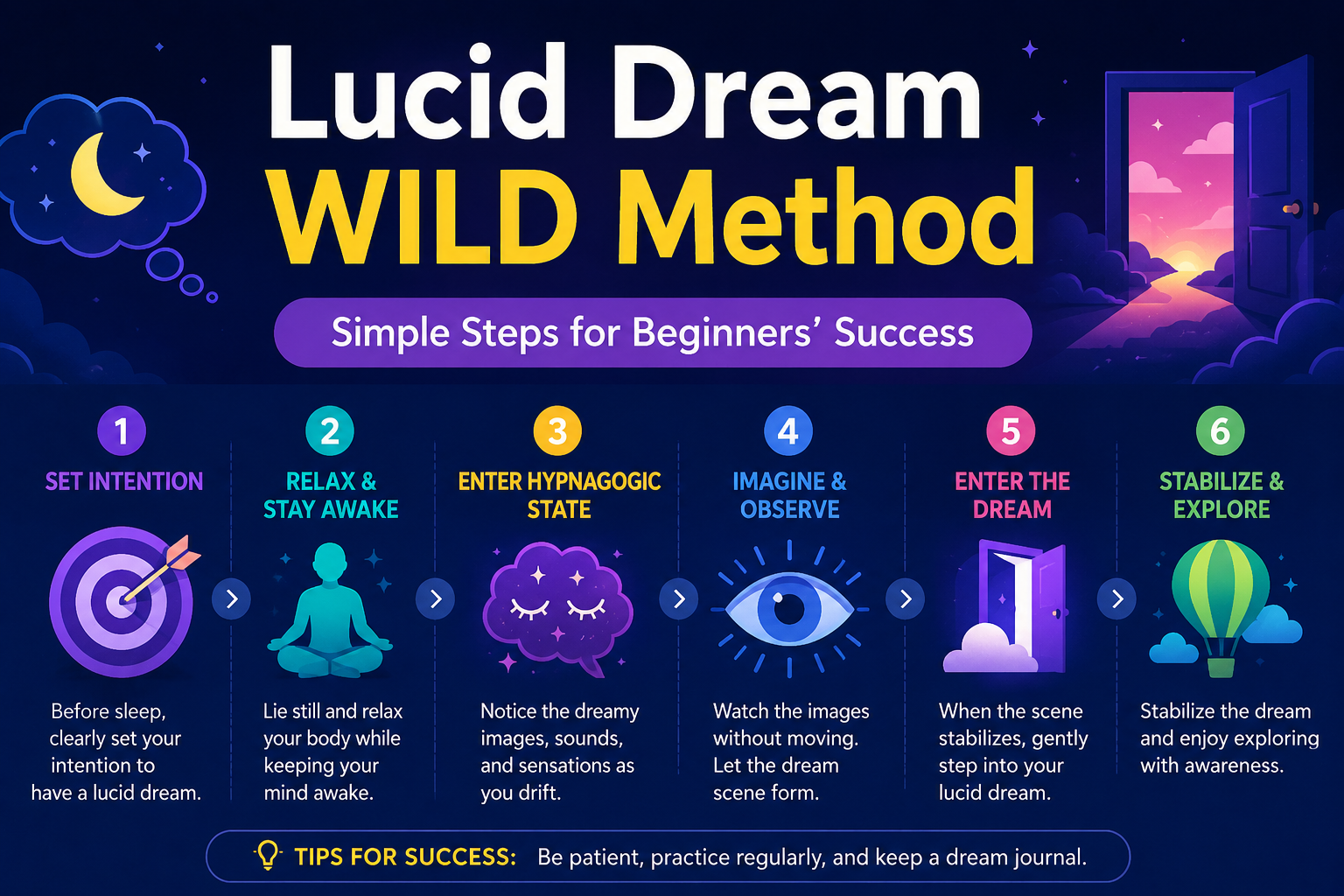
The lucid dream WILD method, or Wake-Induced Lucid Dreaming, guides you to enter a dream consciously from the waking state. Simply put, you maintain awareness while your body falls asleep, transitioning directly into a dream without losing consciousness. As you relax, observe hypnagogic imagery and sensations, remain calm if sleep paralysis occurs, and consciously “step into” your dream environment. Anyone curious about direct, intentional dream experiences can start learning this skill by following structured steps, patience, and a calm, open mindset.
What Is the Lucid Dream WILD Method?
Out of all the approaches to lucid dreaming, the WILD lucid dream method stands out as a kind of mental alchemy—one that transforms sleepy drowsiness into conscious self-awareness. Instead of waiting for lucidity to “happen” during a dream, as with many other techniques, WILD invites you to ride your consciousness right over the threshold between waking and dreaming. People are often drawn to this technique not just for the control it promises, but for the sense of mystery and direct experience it offers. This isn’t simply a step along a path—it’s a leap between worlds, with your mind as the guide and observer.
Why WILD Is Considered the “Holy Grail” of Lucid Dreaming
The phrase “holy grail” might sound dramatic for a sleep technique, but among lucid dreamers, WILD has earned this reputation for good reason. First, it gives you a front-row seat to the subtle, usually hidden workings of the sleeping mind. There’s something uniquely compelling about watching your mental landscape build itself in real time, constructing dream scenes as you maintain conscious awareness throughout. For those who chase the deepest sense of control, WILD is coveted because it allows for immediate—and often vivid—dream entry, skipping the confusion and randomness typical of other induction methods.
How WILD Differs from Other Lucid Dream Techniques
Different lucid dream methods shape the entry into lucidity in distinct ways. Most, like MILD (Mnemonic Induction of Lucid Dreams) or reality checks, rely on “catching yourself” inside an already running dream. WILD, in contrast, wants you to leave the waking world with your eyes (and mind) wide open. There’s no guessing or realization mid-dream—you’re either present through the whole transition or you aren’t. This means learning WILD can feel a bit like balancing on a tightrope: slip too far into sleep and you lose consciousness, stay too alert and you never get that dream doorway to open.
Who This Guide Is For
People new to lucid dreaming often wonder if the Lucid Dream WILD Method approach is out of reach for beginners. In fact, it’s absolutely learnable, regardless of your meditation background or dream recall skills. This guide is meant for those just dipping a toe into the world of dream techniques—and for experienced dreamers who want to finally “crack” the direct-entry code. Whether you’re drawn by curiosity, creativity, or a desire to resolve nightmares, the wild lucid dream method can become an accessible, even transformative part of your sleep ritual.
What You Will Learn
This resource gives you more than just a list of steps. You’ll uncover the science and psychology beneath the wild technique for lucid dreaming, best practices to prepare your body and mind, strategies for staying calm during sleep paralysis, and troubleshooting guides for the inevitable bumps along the road. Expect to walk away not just knowing how to do the Lucid Dream WILD Method, but also understanding why it works—and how to shape it to your needs and personality.
What Is a Lucid Dream?
Definition of Lucid Dreaming
At its core, a lucid dream is one where the dreamer becomes aware of dreaming while still inside the dream. That might sound simple, but the reality is much stranger—like waking up in a movie while the film is still running and suddenly realizing you’re both actor and director. Lucidity allows you to shape, influence, or simply observe your dreams in ways that would otherwise be impossible, blurring the lines between the ordinary and the extraordinary.
Scientific Definition
Lucid dreaming, as defined by sleep researchers, involves recognizing the dream state—while the dream continues—often accompanied by some power to influence events, manipulate the dream environment, or even shift one’s own emotional responses. In laboratory terms, this phenomenon is identified by specific patterns of brain activity and, in some studies, even voluntary eye movements signaled by dreamers to outside observers. Scientists like Dr. Stephen LaBerge have built consensus around this definition over the past decades[1].
Spiritual Perspectives on Lucid Dreaming
Well before white coats and EEGs entered the scene, spiritual traditions described lucid dreaming as a gateway to self-discovery, healing, or higher states of consciousness. Tibetan Buddhists—and many other cultures—have used conscious dreams for centuries as a kind of inner yoga, believing they reveal fundamental truths about the nature of mind and reality. Whether treated as mystical practice or psychological laboratory, lucid dreaming continues to attract those searching for meaning beyond the obvious.
Common Characteristics of Lucid Dreams
- Heightened self-awareness (“Wait, I’m dreaming!”)
- Sensory vividness, often more real than waking reality
- Freedom to change, fly, interact, or “rewrite” the environment
- Emotional clarity or exhilaration (sometimes even relief after a nightmare turns lucid)
- Memory of waking life and a sense of deliberate choice
What Happens Inside the Brain During a Lucid Dream?
If you’ve ever wondered how the brain flips the switch from sleep to conscious dreamer, you’re in good company. The neurobiology behind lucid dreaming is as fascinating as the experience itself.
REM Sleep Explained
Dreams—especially lucid ones—happen predominantly during REM (Rapid Eye Movement) sleep. In this stage, the brain becomes as electrically active as it is while awake, even as the body is temporarily paralyzed. REM is marked by wild eye movements, emotional intensity, and rapid scene changes, which fit right in with the creative unpredictability of dream worlds[2].
Brain Regions Activated During Lucidity
During a lucid dream, unique parts of the brain “light up”—especially areas associated with self-awareness, logic, and decision-making. The prefrontal cortex, which helps with critical thinking and reflection in waking life, seems to activate while the rest of the body stays deep in sleep. This unusual blend—alert brain, paralyzed body, dreaming mind—creates the perfect mix for lucidity.
Recent Research on Lucid Dreaming
Modern sleep labs have confirmed that lucid dreams aren’t just stories people tell. Using EEGs and other tools, researchers have even communicated with dreamers while they’re asleep, using prearranged eye signals to confirm lucidity. Findings suggest lucid dreamers can solve problems, control their actions, and communicate basic information—all while asleep[3]. These discoveries have fueled new interest in ways to harness the power of conscious dreaming, both for therapy and self-exploration.
Benefits of Lucid Dreaming
The appeal of lucid dreaming isn’t just about fun or fantasy. From creative breakthroughs to emotional healing, practical benefits abound for those who unlock conscious dreaming.
Creativity
Lucid dreamers frequently report bursts of original ideas and insights—sometimes solutions to tricky problems, sometimes totally new artistic inspiration. Maybe it isn’t so surprising that inventors, writers, and musicians have long praised the fertile landscape of the lucid dream.
Emotional Healing
Inside the controlled space of a lucid dream, people often confront old fears, traumas, or difficult relationships from a place of safety and choice. By reshaping the narrative or simply facing a scary image with calm awareness, emotional wounds can begin to heal in unexpected ways[4].
Nightmare Resolution
Anyone who’s ever gotten “stuck” in a nightmare knows the relief that comes when lucidity arrives. The wild lucid dream method provides direct access to this relief—empowering you to rewrite scripts, face threats, or simply change the dream channel entirely.
Spiritual Exploration
For those on a spiritual or contemplative path, lucid dreams become more than simple amusement. By using the Lucid Dream WILD Method, countless practitioners pursue self-knowledge, test the boundaries of perception, or experience moments of profound interconnectedness.
Personal Growth
Like any skill that blends challenge and reward, lucid dreaming can support personal growth. Whether you’re learning patience, boosting confidence, or developing a deep relationship with the inner self, the wild technique for lucid dreaming has transformative potential.
What Is the WILD Lucid Dream Method?
So, what exactly sets the wild lucid dream technique apart from others? Here’s where definitions, acronyms, and a bit of history matter more than you might guess.
Definition of Wake-Induced Lucid Dreaming
Wake-Induced Lucid Dreaming (WILD) refers to falling asleep with enough conscious awareness that you enter the dream state immediately, without ever “blacking out.” Instead of drifting into a dream and becoming lucid later, you’re present for the entire transition. The result is often a vivid, stable lucid dream from the first moment you realize the dream is forming[1].
What Does WILD Stand For?
The letters in WILD stand for “Wake-Induced Lucid Dream” or, alternately, “Wake-Initiated Lucid Dream.” Both refer to entering a lucid dream directly from full wakefulness, rather than “waking up” to lucidity mid-dream.
Why WILD Is Different from Other Techniques
Direct Entry Into a Dream
Rather than waiting to realize you’re dreaming later in the night, WILD allows for intentional, direct dream entry. Here, consciousness rides the gentle edge between waking reality and dream world—a bit like watching the lights dim in a theater as a new scene appears, but never losing the sense that you are both audience and actor.
Maintaining Consciousness During Sleep
Most people lose awareness as sleep sets in. WILD teaches you to keep the mind awake while the body sleeps, which can feel counterintuitive. With practice, though, this becomes a skill—much like meditation or mindful breathing. The vividness and depth of dreams entered via the Lucid Dream WILD Method often surpass those achieved with other methods, making this approach especially sought after.
Skipping Dream Recognition
Traditional lucid dreaming methods involve recognizing dream signs or doing reality checks. WILD skips this altogether, delivering you in full awareness right into the heart of the dream. There’s no “wait, is this a dream?” moment—the awareness is already there, right from the first scene.
Brief History of the WILD Technique
While the vocabulary around lucid dreaming might sound modern, the wild lucid dream method has roots stretching back centuries in both East and West.
Early Dream Yoga Traditions
Among the most ancient sources are the dream yogas of Tibetan Buddhism, which developed centuries-old systems to cultivate awareness across sleep and dreams. These techniques—themselves closely related to WILD—focused on maintaining continual mindfulness, even as the body drifted into deep rest[5].
Tibetan Dream Practices
Tibetan practices include nightly rituals, visualizations, and attentional control. Practitioners have long regarded the dream state not as an escape, but as a powerful laboratory for insight and transformation. Their descriptions of riding consciousness into dreams align, often word for word, with the modern wild lucid dream method.
Stephen LaBerge and Modern Lucid Dreaming
Fast-forward to the 1980s and beyond. Steven LaBerge, widely regarded as the modern father of lucid dreaming research, formalized many of these methods. His scientific rigor gave the wild technique for lucid dreaming mainstream credibility, connecting ancient wisdom with modern sleep science.
Evolution of WILD in Online Communities
Over the past two decades, online forums have exploded with new variations, tips, and firsthand accounts of the lucid dream wild technique[6]. Communities on Reddit, dedicated websites, and even academic circles continue to test, refine, and share fresh approaches, creating a living, breathing culture of experimentation around WILD.
How Does WILD Actually Work?
Behind all the mystical-sounding talk, the mechanics of the wild lucid dream method rest firmly on the biology of sleep. Understanding the process—stage by stage—makes it much easier to recognize progress and troubleshoot setbacks.
Understanding the Sleep Cycle
Sleep isn’t a uniform state, but a series of distinct phases, each with its own characteristics.
Stage N1 Sleep
This is the liminal zone—the borderland between being awake and asleep. You might notice fleeting images, twitching muscles, or a drifting sensation. Many wild lucid dreamers first notice “hypnagogic” imagery here—flashes of color, sound, or bits of nonsense thought. Think of this as a gentle fade-to-black as the waking world recedes in the rearview.
Stage N2 Sleep
A slightly deeper, more stable state. The body starts to slow down, heart rate dips, and consciousness slips further away unless you’re using active focus to stay aware. For Lucid Dream WILD Method lucid dreamers, N2 is where the body gets serious about rest, creating a more tangible “floating” feeling or subtle disconnect from external stimuli.
Stage N3 Deep Sleep
Here, the body plunges into restorative processes—tissue repair, energy building, immune function. Lucid dreams rarely begin at this stage, as the mind is usually too deeply asleep for dreaming consciousness to emerge.
REM Sleep
Finally, REM arrives—the stage of rapid eye movement where most vivid dreaming occurs. Muscles are paralyzed, but the brain becomes a frenzy of imaginative activity. The wild lucid dream technique aims to “hop over” into this stage while hanging on to just enough awareness.
The Consciousness Bridge
Staying Aware While the Body Falls Asleep
Here’s where things get weird, in all the best ways. The wild lucid dream method trains you to keep the mind just alert enough, even as the body “lets go.” Techniques range from breath awareness to mantras and visualization. The logic is simple: give your consciousness something to do—just enough to prevent blackout, not so much that it keeps you awake.
Why This Feels Unnatural at First
Staying conscious as the body shuts down isn’t something most people do naturally. People sometimes describe sensations like buzzing, floating, or feeling a weight press down. Beginners might get jolted awake, assuming something’s wrong, when it’s actually a sign the process is working. The trick is to relax and observe—no panic, no overthinking—just curiosity.
The Transition From Wakefulness to Dreaming
Hypnagogia
As you approach sleep, hypnagogic phenomena (imagery, sounds, odd sensations) start to ramp up. Some see swirling colors or brief scenes; others hear phantom music or words that make no sense. Staying with these sensations without grabbing onto them is a key skill for the Lucid Dream WILD Method approach.
Sleep Paralysis
One of the stranger stops on the route to a Lucid Dream WILD Method: sleep paralysis. The body temporarily “disconnects” muscle control to prevent acting out dreams. While this can feel disturbing—like your limbs are made of lead or pinned down—it’s a universal, harmless piece of REM sleep.
Dream Formation
Quickly or slowly, those fleeting images start to coalesce into a coherent dream plot. For Lucid Dream WILD Method lucid dreamers, this is often the most thrilling moment: the sense that a “veil” is lifting, or the world is being painted around you, one detail at a time.
Dream Entry
Here’s the true test: can you “step in” to the dream without snapping awake or losing awareness? Skilled practitioners find themselves smoothly carried into the dream scene, often with full control and clarity from the first second. Some even report a gentle “pull” or floating sensation as the dream forms around them.
Is the Lucid Dream WILD Method Scientifically Proven?
Research on Lucid Dreaming
The idea of becoming conscious inside a dream might once have sounded like pure fiction. But contemporary research, including work by pioneers like Stephen LaBerge, has shown that lucid dreaming—including WILD—produces measurable changes in brain activity[1][2]. In experimental conditions, lucid dreamers have signaled their awareness with prearranged eye movements, offering real-world verification.
Sleep Laboratory Studies
Researchers have recorded brainwave patterns using EEG, showing that wild technique for lucid dreaming is associated with elevated prefrontal cortex activity—essentially, parts of the brain linked to reasoning and awareness “switch on” during dreams. Lab studies have confirmed that deliberate dream entry is not just anecdotal but a reproducible phenomenon.
Brainwave Patterns During WILD
During successful WILD attempts, EEG readings typically show a blend of REM sleep (characterized by rapid eye movements and vivid dreaming) with bursts of beta and gamma brainwaves linked to conscious awareness. This mix is unusual and seen mostly in lucid states, not ordinary dreaming[2].
Current Scientific Limitations
Here’s where honest analysis is needed: as much as lucid dream wild technique is supported by lab results, plenty of details remain murky. Most studies have been small and depend on self-reporting, which is tricky when the border between conscious and unconscious is fluid. Replication is still a challenge, and some critics argue that personal narrative plays a large role in confirming success.
What Scientists Agree On
Despite the challenges, researchers widely agree that lucid dreaming—including the wild technique for lucid dreaming—is a verifiable altered state involving both REM sleep and conscious awareness. The phenomenon is now accepted as real, measurable, and of major interest for research into sleep, creativity, and the nature of consciousness itself.
Is WILD Safe?
The Short Answer
For most healthy adults, the WILD lucid dream method is as safe as regular dreaming. The Lucid Dream WILD Method doesn’t introduce any unique risks beyond those present in ordinary sleep, though it does make certain sensations—like sleep paralysis or hypnagogic hallucinations—more noticeable.
Common Fears About WILD
Sleep Paralysis
WILD is notorious for inducing conscious sleep paralysis, which can be unsettling. People often worry about being trapped, but sleep paralysis is a normal, harmless state that quickly resolves after waking or entering a dream.
Hallucinations
Wild lucid dreamers sometimes experience vivid images, voices, or touches during the transition. While these are fascinating (or sometimes spooky), they are not signs of danger or mental illness—they’re simply the brain’s creative “on-ramp” to dreaming.
Nightmares
There’s a common concern that wild technique for lucid dreaming makes nightmares more likely. Actually, research and community reports show that gaining lucidity during a nightmare is one of the best ways to lower distress and reshape negative dream content[4].
Fear of Being Stuck
A few worry, “What if I can’t wake up?” The simple answer: the dream always ends, and the body’s natural mechanisms wake you up as needed. No evidence suggests anyone can get stuck in a lucid dream or in sleep paralysis.
What Actually Happens
With the Lucid Dream WILD Method, people are simply more aware of phenomena that occur every night. Sleep paralysis, hallucinations, odd sensations—all happen routinely without incident. The key difference? Wild lucid dreamers learn to recognize and work with these instead of reacting with fear.
Who Should Use Extra Caution?
People With Severe Sleep Disorders
If you have diagnosed sleep disorders such as narcolepsy, insomnia, or severe sleep apnea, it’s wise to talk with a sleep specialist before trying any advanced dream induction methods.
PTSD Considerations
For those with PTSD or a history of trauma, dream techniques can occasionally bring distressing imagery to the surface. If nightmares or traumatic memories are intense, consider working with a therapist alongside dream practice.
Anxiety Disorders
People with generalized anxiety or panic disorders might find some transitional sensations (like sleep paralysis) trigger discomfort. Mindfulness or guided relaxation can help, but if anxiety spikes consistently, it may be best to adjust your technique.
Mental Health Concerns
Anyone with severe mental health conditions—dissociative disorders, active psychosis, or untreated schizophrenia, for example—should approach advanced lucid dreaming practices carefully, and with medical advice. For most people, though, the wild lucid dream method is no more hazardous than learning to meditate.
The Ideal Mindset for WILD Success
Why Relaxation Matters
Mastering the WILD lucid dream technique is as much about mental attitude as technical steps. People who approach practice tense, anxious, or impatiently “trying to force it” are more likely to stay stuck in frustrating limbo. Deep physical and mental relaxation sets the stage for letting go just enough to glide into the dream state without losing awareness.
Letting Go of Expectations
Paradoxically, wanting too much is the enemy of progress. The best results often arrive after dropping expectations—simply observing, accepting whatever arises during the transition. “Let go and let the dream happen” sums up the state of mind that allows WILD to work, sometimes even when you least expect it.
Avoiding Overexcitement
The first signs of success can be exhilarating: wild hypnagogic visuals, a sense of floating, or feeling the world blur around you. Ironically, getting too thrilled often pulls you right back to waking. Gentle curiosity works better than chasing lucid control—treat it like watching a sunrise, not catching a bus.
Developing Patience
WILD takes practice—rarely is it “done” on the first or even tenth attempt. The process sometimes demands patience bordering on stubbornness. Most practitioners who stick with it eventually see results, though there’s unavoidably a learning curve.
Common Psychological Obstacles
Fear
Feeling a spike of fear as your body falls asleep or during sleep paralysis is normal. Recognizing fear as a passing sensation—not a real danger—is part of building confidence.
Frustration
Not having immediate success can lead to irritation. Seasoned practitioners learn to treat each “failure” as data, not defeat. Even a night without lucid dreams teaches something valuable about focus, relaxation, or simply your own patterns.
Performance Anxiety
The more pressure you place on yourself (“This has to work tonight!”), the less likely you are to enter a lucid dream. The wild lucid dream method is best learned when viewed as a playful exploration, not a test you can pass or fail.
Impatience
Learning WILD isn’t a fast track to nightly adventures. Building this skill is more like learning an instrument than following a recipe—expect progress, setbacks, and sudden leaps forward.

The Best Time to Practice WILD
Why Bedtime Is Usually Not Ideal
Although it’s tempting to start WILD practice right at bedtime, that’s actually the most difficult timing for success. Early in the night, the body wants deep, dreamless sleep (N3), and REM cycles—the “home base” for wild lucid dreams—are still hours away. Most beginners experience nothing but frustration if they attempt WILD at sleep onset.
Understanding Wake Back To Bed (WBTB)
This is where one of lucid dreaming’s most effective “hacks” comes in: Wake Back To Bed, or WBTB.
What Is WBTB?
WBTB involves sleeping for a block of time (usually 4–6 hours), waking briefly, and then returning to bed specifically to try WILD, MILD, or related techniques. This takes advantage of the fact that later in the sleep cycle, REM periods are longer, and you’re more likely to enter a vivid dream.
Why It Dramatically Increases Success Rates
The research is clear—practicing WILD after several hours of sleep turbocharges success. The body is ready for REM, the mind is less groggy, and consciousness can “sneak” directly into the dream state before deep sleep pulls you under[6].
Best Wake-Up Times
Choosing when to wake up for WBTB matters. Too early, and you risk skipping REM entirely. Too late, and you might be too groggy to focus.
4 Hours After Sleep
This is often the sweet spot for people who go to bed around 10–11 p.m. It lands you after the first or second full sleep cycle, just as REM stages start to lengthen.
5 Hours After Sleep
If your schedule allows, five hours can be ideal—body is rested, the “REM window” is wide open, and you’re not so tired that you immediately crash back into deep sleep.
6 Hours After Sleep
For early risers or those who need more sleep, six hours can work very well. The closer to morning, the higher the chance your brain is primed for vivid dreams and your likelihood of remembering them increases.
The Science Behind WBTB
Sleep researchers have confirmed WBTB’s power. When early morning REM is “interrupted”—woken up and then resumed—dreamers report more vivid, memorable, and lucid dreams[2]. By calibrating your alarm to match personal sleep cycles, you’re stacking the odds heavily in your favor.
Step-by-Step WILD Lucid Dream Method
Here’s the nuts and bolts: a practical, no-nonsense blueprint for the wild lucid dream method, distilled from decades of experimentation by scientists and ordinary dreamers alike.
Step 1: Prepare for Sleep
Think of this as setting the stage for a successful lucid dream “performance.”
Optimize Your Bedroom
A clean, comfortable space tells your brain that rest is coming. Remove clutter—visual noise can turn into mental static as sleep approaches.
Reduce Distractions
Silence phones, shut doors, and ask family members not to disturb you during your WILD session. Every ping or light blink is a potential dream-wrecker.
Temperature Considerations
Ideally, sleep environments should be cool but not chilly—around 65–70°F works for most people. Too hot or too cold and you’ll struggle to relax into the subtle, almost invisible states that make WILD possible.
Light Management
Darkness tells your brain that it’s time for melatonin to flow. Consider blackout curtains or a sleep mask, and dim lights at least 30 minutes before your target bedtime.
Step 2: Sleep for Several Hours
This is non-negotiable. Let your body complete several natural sleep cycles before trying WILD, so you’re in the sweet spot for REM-rich dreams.
Why Initial Sleep Is Important
Skipping this step means fighting biology. Early-night sleep is dominated by deep, non-REM states—hardly a recipe for the conscious-dream handoff required by wild lucid dream method success.
Step 3: Wake Up Briefly
Set an alarm (or use natural waking, if you’re that lucky) after a block of sleep. The goal is to become just alert enough to remember your intention, but not so awake that you can’t drift back to sleep.
How Long Should You Stay Awake?
Most people do well with 5–30 minutes. The groggier you are, the longer you might need. Don’t go overboard—if you get too alert, it’s hard to fall asleep again.
Activities to Avoid
- Bright screens—electronically induced blue light suppresses melatonin
- Over-caffeinating
- Stressful conversations, physical activity, or anything that spikes adrenaline
Step 4: Return to Bed
Finding a Comfortable Position
Some people swear by lying on their back, others prefer their side. Choose whatever position feels restful, but avoid one that encourages tossing and turning. Stillness is your friend.
Step 5: Maintain Gentle Awareness
This is where the wild lucid dream technique lives or dies. The right balance—focused but relaxed—makes all the difference.
What to Focus On
Choose a simple anchor: your breath, the darkness behind your eyes, a counting pattern, or a short mantra. Let this point of focus become a soft background, not a frenzied effort.
What Not to Focus On
Don’t obsess over “Is it working? Am I dreaming yet?” This pulls your mind back to waking. Avoid checking your phone, shifting constantly, or trying to “force” sleep onset.
Step 6: Observe Hypnagogia
Visual Imagery
Swirling colors, bursts of light, quick flashes of dreamlike scenes—all are classic signs you’re getting close. Let these play across your mind without grabbing or analyzing.
Sounds
Phantom voices, music, or environmental “echoes” often show up. It’s tempting to listen for meaning, but the best approach is simply to notice and return gently to your anchor.
Sensations
Tingling in the limbs, floating, a weight pressing down, or the feeling of being “pulled”—all common. Again: notice, allow, return to gentle awareness.
Step 7: Remain Calm During Sleep Paralysis
Why Sleep Paralysis Happens
REM sleep comes with muscle paralysis to prevent us from acting out dreams. When you stay conscious while the body shuts down, you may experience this vividly, sometimes with strange audio or visual phenomena.
What To Do
- Relax and let it pass—panic only prolongs the experience
- Remember, it’s completely safe and temporary
- Use this state as a springboard for dream entry
What To Avoid
- Trying to “break out” by force—this usually fails or leads to waking
- Getting swept up in fear or disturbing thoughts
Step 8: Enter the Dream
Dream Entry Techniques
Classic techniques include: visualizing a spinning motion, “rolling” out of bed, imagining a dream scene forming around you, or simply “walking” into a vivid image as soon as it stabilizes.
Visualization Methods
Picture a scene—a beach, your favorite room, a mountain view—and gently imagine yourself stepping into it. Use all your senses: what do you see, hear, feel, or even smell?
Scene Construction
If a specific landscape or storyline starts to form, go with it. Many wild lucid dreams begin with familiar locations—your bedroom, your childhood backyard—before shifting to more fantastic settings as you gain control.
Step 9: Stabilize Lucidity
The first seconds in a lucid dream are notoriously unstable—expect flickering visuals, odd gravity, or quick “snap backs” to waking. Reinforcing the dream is essential for lasting experiences.
Hand Rubbing
Rub your hands together in the dream—this brings immediate tactile sensation and grounds awareness inside the dream body.
Spinning
Spin in place, like a child, and command “clarity” or “stability.” This technique helps stabilize the dream and prevent waking.
Sensory Grounding
Touch objects, taste food, or stomp your feet. Vivid sensory input strengthens clarity, often making the dream last longer.
Verbal Commands
Say, out loud in the dream, “Lucidity now” or “Increase clarity.” The wild lucid dream technique is highly suggestible; spoken intention works wonders.
Understanding Hypnagogia
What Is Hypnagogia?
Hypnagogia is the transitional state between wakefulness and sleep, marked by fleeting mental images, random thoughts, and odd sensations. If you’ve ever caught yourself seeing patterns of light or hearing music as you doze off, you’ve experienced hypnagogia first-hand.
Types of Hypnagogic Experiences
Visual Hypnagogia
Swirling shapes, dancing colors, or spontaneous scenes. These mental “fireworks” are a clear sign that your brain is shifting gears.
Auditory Hypnagogia
Phantom music, snatches of conversation, or environmental echoes commonly show up as the brain decouples from waking input.
Tactile Hypnagogia
Tingling, floating, falling, or feeling a gentle touch on your skin. All are common and completely harmless.
Why Hypnagogia Is Important for WILD
Recognizing hypnagogic phenomena helps you know when the boundary between waking and sleep is thinning. Wild lucid dreamers who learn to “surf” these sensations can slip into dreams with unbroken consciousness—hypnagogia is the doorway.
How to Work With Hypnagogic Imagery
- Notice images and sounds, but resist analyzing or controlling them
- Gently return to your chosen anchor (breath, counting, mantra) if you get pulled away
- As images grow more vivid, begin to imagine yourself interacting with them—step into the scene, touch an object, or simply observe
- Patience is key; trying too hard to “grab” hypnagogia often leads back to waking
Sleep Paralysis During WILD
What Is Sleep Paralysis?
Sleep paralysis is a temporary state where you’re awake and aware but unable to move or speak. It happens when the brain “paralyzes” major muscle groups during REM sleep—a perfectly natural process. In wild lucid dreaming, you experience this consciously, rather than blacking out.
Why It Happens
REM muscle atonia (the technical term) prevents the body from acting out dreams. The wild lucid dream method can “catch” you in this phase, especially when you balance on the edge of consciousness and sleep.
Common Experiences
Vibrations
A buzzing or humming sensation in the body, sometimes described like having an “internal phone vibrating.” Many view this as the nervous system shutting down for dreaming.
Pressure Sensations
Feelings of weight or a heavy “blanket” pressing down on the body are textbook sleep paralysis signatures. These are usually brief, lasting seconds to a few minutes.
Auditory Hallucinations
Sounds like footsteps, distant voices, or mechanical noises can surface in this state. These are brain-generated, often by the same mechanisms that produce dream imagery.
Shadow Figures
It’s not uncommon to see shadowy “figures” or feel an “evil presence” during sleep paralysis. Sleep researchers have traced this to misfiring perceptual circuits—not supernatural forces, just the brain’s confusion at being semi-alert and paralyzed.
Scientific Explanation
All these experiences are well-documented in sleep research. They’re essentially artifacts of REM muscle atonia and brain transition, not signs of disorder or danger. They resolve naturally as sleep cycles progress.
How to Stay Calm
- Remind yourself: “This is normal and will pass soon”
- Breathe slowly; focus on gentle awareness rather than panic
- Sometimes, shifting attention to toes or fingers helps end paralysis
Turning Sleep Paralysis Into a Lucid Dream
For the wild lucid dream method, sleep paralysis is actually a springboard. Rather than fighting the sensation, use it as a “launch pad.” Visualize rolling out of bed or stepping into a dream scene as soon as the sensation peaks—often, the dream snaps into focus immediately after.
Most Effective WILD Anchors
Breath Awareness
Counting breaths or simply noticing the in-and-out rhythm provides a calming, natural anchor.
Pros
- Supports relaxation naturally, fits well with meditation experience
- Quiet and non-disruptive for most sleepers
Cons
- Easy to drift off and lose count
- Some overthink breathing, which can disturb rhythm
Counting
Repeating numbers (“One, I’m dreaming… Two, I’m dreaming…”) gives the mind a simple, repetitive task[6].
Pros
- Provides structure and keeps mind gently engaged
- Works well for logical, analytical types
Cons
- Can become mechanical or induce frustration if “results” don’t happen
- May provoke impatience in some dreamers
Mantras
Short, personally meaningful phrases (“I will enter a dream consciously”) repeated mentally or softly out loud work like self-hypnosis.
Pros
- Helps focus intention and belief
- Easy to remember and adapt
Cons
- May keep some people too alert
- Can feel forced or artificial if not genuinely believed
Visualization
Building and sustaining mental images—a staircase, a spinning vortex, or a door you “walk” through—suits the wild technique for lucid dreaming.
Pros
- Engages imagination; can jump-start dream formation
- Versatile, works for artistic or visual thinkers
Cons
- Can keep logical thinkers awake or distract if images don’t “stick”
- Sometimes brings in too much excitement, leading to waking
Body Sensations
Focus on sensations—like the feeling of sheets, the weight of limbs, or even scanning from toes to head.
Pros
- Increases bodily relaxation and awareness
- Good for those with meditation or yoga backgrounds
Cons
- Too much bodily focus may draw attention to discomfort
- Physical distractions can make it harder to “let go” into sleep
Which Anchor Is Best?
There’s no universal answer—each wild lucid dreamer responds differently. Test multiple anchors or blend two (such as breath + counting) over several nights to find the best fit. Flexibility is the real secret; switch if progress stalls.
Beginner-Friendly Variations of WILD
Mild-WILD Hybrid
Combines memory-based intention-setting (from MILD) with conscious transition techniques (from WILD). Set your goal before bed, then practice conscious attention during sleep onset later in the night.
Counting WILD
Repeat: “One, I’m dreaming. Two, I’m dreaming…”—often combined with light breath awareness. The repetition provides mental “traction” as sleep encroaches.
Visualization WILD
Visualize a dream scene and “step into it” as it grows more vivid. Appeal to senses beyond sight: smell the ocean, feel the breeze.
Dream Scene WILD
Use recurring dream locations as a launchpad. As sleep approaches, recall a familiar setting and focus intently until it becomes real.
Anchor-Based WILD
Pick a steady, repetitive sensory cue—like a white noise machine or the feeling of your breath. Keep focused on this “anchor” while letting thoughts and images drift by.
Guided Audio WILD
Play a soft, guided meditation specifically designed for lucid dreamers. These recordings offer structured points of focus, gentle reminders, and calming reassurance.
Advanced WILD Techniques
Dream Yoga WILD
Borrowing from ancient Tibetan methods, practitioners maintain “awareness of awareness” throughout the night, blending meditation and wild lucid dream method principles. This form is for those who want their lucid dream practice deeply intertwined with spiritual discipline.
Tibetan Sleep Meditation
Techniques include reciting specialized mantras, visualizing sacred symbols, and maintaining gentle vigilance as sensations change. The wild lucid dream technique, in this context, becomes a vehicle for insight rather than control.
WILD Through Meditation
Seated or lying meditation helps prolong the “conscious edge” and trains the mind to stay aware as the body sleeps. Breath-focused or awareness-of-awareness approaches best suit the analytical or contemplative dreamer.
Yoga Nidra and WILD
Yoga Nidra (“yogic sleep”) uses body scans, breath, and deep relaxation triggers to move gradually into trance, then into dream. When practiced alongside wild lucid dream technique, it can make conscious dream entry more accessible.
Combining WILD With Breathwork
Slow, controlled breathing (4–7–8, box breathing, or simply slow inhales/exhales) paired with gentle focus helps bridge the wake-dream threshold.
Advanced Conscious Dream Entry
Once skilled, some dreamers practice entering the dream at will, skipping hypnagogia and sleep paralysis altogether. These “direct entries” emphasize intention and self-suggestion layered upon years of practice.
Why Most People Fail at WILD
Trying Too Hard
Ironically, effort often backfires. People who over-focus or anxiously scan for results usually stay awake or snap back to full alertness.
Staying Too Alert
Hyper-vigilance or mental “checking in” can keep the brain from sliding into REM. Relaxed focus—not anxious concentration—is the antidote.
Falling Asleep Unconsciously
Losing the thread of awareness is common, especially for exhausted minds. The wild lucid dream method requires a level of rest that’s “just right”—not over-tired, not under-tired.
Fear of Sleep Paralysis
Anticipating scary sensations often ensures they show up in full force, amplifying anxiety and keeping dreamers from crossing the “bridge.”
Poor Sleep Hygiene
Inconsistent sleep schedules, late-night screen use, caffeine, or a chaotic environment sabotages even perfect technique. Routine matters more than most realize.
Unrealistic Expectations
Expecting instant, movie-like dreams every night leads to disappointment. Progress is incremental, with variation between individuals.
Lack of Consistency
Skipping sessions, unreliable bedtimes, or abandoning the process too soon blocks learning. The wild lucid dream method rewards patience and steady, repeated practice.
How Long Does It Take to Learn WILD?
Typical Learning Curve
First Week
Many notice unfamiliar sensations: flashes of light, odd sounds, and brief sleep paralysis. Few report full wild lucid dreams in this window, but foundations are being laid.
First Month
Minor successes begin: partial lucidity, brief conscious dream moments, improved dream recall. Frustration is common, but so are “aha” moments and sudden breakthroughs.
First Three Months
Most consistent practitioners will experience at least one full wild lucid dream, with more regular lucidity over time. Technique refinement—changing anchors, exploring different wake-up times—shows effect.
Long-Term Mastery
With steady practice, WILD becomes a reliable tool—a skill that, like learning to juggle or ride a bike, becomes second nature. Most long-term practitioners report steady, if unpredictable, improvement in both frequency and dream vividness.
Factors Affecting Success
Sleep Quality
Restful, regular sleep is the foundation of any dream technique. Without it, wild lucid dreams are rare and fleeting.
Meditation Experience
Those with backgrounds in mindfulness or meditation often find WILD easier to learn, as both require gentle focus and letting go of intrusive thoughts.
Consistency
It bears repeating: predictable sleep patterns, a regular schedule, and nightly practice beat out rare “marathon” sessions every time.
Stress Levels
High stress stirs the mind and makes settling into sleep (not to mention lucidity) much tougher. If stress is unavoidable, try meditation, guided audio, or progressive relaxation to restore balance.
WILD vs Other Lucid Dream Techniques
WILD vs MILD
WILD demands conscious attention as sleep arrives; MILD relies on intention-setting and catching yourself inside the dream.
Advantages
- WILD: Direct entry, more vivid control, unique clarity
- MILD: Easier for beginners, less sleep disruption needed
Disadvantages
- WILD: Harder to master, requires patience and practice
- MILD: Depends on recognizing dream signs, sometimes less vivid
WILD vs SSILD
SSILD (Senses Initiated Lucid Dream) cycles through focus on different senses.
Advantages
- WILD: More control over entry, precise timing
- SSILD: Accessible, rhythm helps restless minds
Disadvantages
- WILD: Can feel rigid or intimidating for some
- SSILD: Sometimes less reliable for direct entry, more accidental awakenings
WILD vs Reality Checks
Reality checks train you to question reality during the day, hoping the habit carries over into dreams.
Advantages
- WILD: Front-row seat to transition, vivid entry
- Reality Checks: Minimal disruption, integrates with daily life
Disadvantages
- WILD: Not sustainable for all personalities or sleep schedules
- Reality Checks: Success rate dependent on habit strength, less direct control
WILD vs Dream Journaling
Dream journals train recall and pattern recognition, creating a stable base for lucid dreaming techniques.
Advantages
- WILD: Higher control, vividness, with practice
- Dream Journaling: Enhances recall, supports all other induction methods
Disadvantages
- WILD: Requires more direct skill training
- Dream Journaling: Not a induction technique by itself
Which Method Is Best?
No single technique “wins” across the board. People with strong meditation skills or curiosity for altered states are often drawn to WILD. Beginners or those wanting results with less up-front dedication often start with MILD, reality checks, or dream journaling. Blending methods—such as combining MILD and WILD with dream journaling—often produces the best outcomes.

Best Supplements for WILD Lucid Dreaming
Galantamine
Galantamine is an acetylcholinesterase inhibitor originally developed for cognitive support. Mild doses, taken after several hours of sleep, have been linked to higher rates of lucid dream initiation, especially when paired with the Lucid Dream WILD Method [2].
Benefits
- Stronger, more vivid dreams
- Higher lucidity rates in controlled research trials
Risks
- May cause nausea, vivid or disturbing dreams, or insomnia if overused
- Should not be used by people with heart conditions or on certain medications (consult a doctor)
Mugwort
A traditional herb reputed for centuries to “thin the veil” between waking and dreaming, mugwort is brewed as tea or placed under the pillow.
Traditional Use
Used in folk medicine as a sleep and dream aid, with anecdotal evidence supporting dream vividness and recall.
Potential Benefits
Some wild lucid dreamers report more frequent or intense dreams, but scientific data remains limited.
Calea Zacatechichi
Also known as “Dream Herb,” this plant has a long history in indigenous Mexican traditions.
History
Mazatec shamans reportedly used calea zacatechichi in rituals to promote dream clarity and guidance.
User Reports
Modern practitioners describe more complex, “guiding” dreams. Side effects may include stomach upset.
Melatonin
This natural sleep hormone may help regulate circadian rhythms. For some, proper timing (early evening, not immediately before bed) supports more restful sleep and better recall, indirectly aiding the wild lucid dream method.
Vitamin B6
Some studies have correlated moderate B6 supplementation with increased dream vividness and recall. Overuse can disturb sleep or cause nerve issues, so moderation is key.
Safety Considerations
- Always consult with a healthcare provider before starting any supplement, especially if taking medications or managing medical conditions
- Dosage and timing matter; more is rarely better
- Supplements are an adjunct, not a standalone solution—no pill replaces regular wild lucid dream method practice
For a full list, check out: 15+ Best Herbs for Lucid Dreaming: Deepest Guide (2026)
Can Meditation Improve WILD Success?
The Connection Between Meditation and Lucidity
Meditation trains many of the same “muscles” required for the wild lucid dream technique: sustained attention, letting thoughts drift without grasping, and maintaining calm curiosity under unusual sensations. Not surprisingly, experienced meditators tend to report easier and more frequent lucid dream entry.
Best Meditation Styles for WILD
Mindfulness Meditation
Observing thoughts and sensations without attaching meaning is the perfect warm-up for WILD. Mindfulness helps maintain awareness at the wake-sleep threshold.
Concentration Meditation
Fixing attention on a single object, word, or breath—translates directly to wild lucid dream anchors like counting or mantra repetition.
Yoga Nidra
This “sleep yoga” relaxes both body and mind, softening resistance to drifting while holding a gentle thread of awareness.
Dream Yoga
Blends mindfulness, visualization, and intention-setting to move consciously through sleep stages. Truly the wild lucid dream method’s “spiritual sibling.”
How Often Should You Meditate?
Daily is ideal, but even 2–3 sessions per week measurably influence focus and relaxation. Short, 10–15 minute sessions are enough to feel progress, especially when carried over into bedtime wild lucid dream practices.
Dream Yoga and the Lucid Dream WILD Method
Origins of Dream Yoga
Dream Yoga originates in Tibetan Buddhism, melding spiritual insight and practical dreaming techniques. The goal isn’t just self-mastery or fun—it’s self-realization through direct experience of consciousness across night and day.
Tibetan Buddhist Perspectives
Buddhist dream yoga sees dream and waking as fundamentally unified; lucid dreams become a testing ground for awareness, compassion, and ultimate truth. Teachers emphasize continued mindfulness before, during, and after dreams.
Similarities Between WILD and Dream Yoga
- Both require conscious awareness during sleep onset
- Each cultivates gentle observation over forceful control
- Dream yoga and wild lucid dream method both use visualization, mantras, and intent
Key Differences
- Dream Yoga prioritizes spiritual insight, while WILD may center on creativity, problem-solving, or entertainment
- Tibetan methods weave in ethical, philosophical, and meditative training beyond simple “lucid control”
Spiritual Applications
For those inclined, wild lucid dream method can become a spiritual practice, blending secular consciousness exploration with deep, centuries-old traditions. Results range from emotional healing to glimpses of non-dual awareness—though, as always, it pays to balance seriousness with healthy skepticism and joy.
Common WILD Experiences Explained
Vibrations
A full-body buzz, like a mild electric current, often signals the edge between waking and dream. It’s intense, surprising, and, once you know what’s happening, oddly reassuring.
Floating Sensations
Many wild lucid dreamers report feeling weightless, as if bodies are lifting off the mattress or gently swaying—similar to a carnival ride minus the adrenaline.
Falling Sensations
The classic “jerk awake” often occurs here, as muscles twitch while consciousness lingers. Instead of fighting it, letting go usually results in smooth, drift-style entry.
Loud Sounds
Door slams, knocks, or even explosions are manufactured by the dreaming brain. These can serve as “wake-up calls” or simply transition markers.
Bright Lights
Flashes or pulses of light behind closed eyelids signal the onset of deeper sleep or vivid dream imagery.
Tunnel Experiences
Some describe “zooming” through tunnels of color, geometric patterns, or blackness. These moments often lead directly to active dream scenes.
False Awakenings
Dreams where you “wake up” in your own bed, only to realize (sometimes after a reality check) that you’re still dreaming. These are fertile ground for wild lucid dreamers to regain lucidity quickly.
Out-of-Body Experiences
With practice, the Lucid Dream WILD Method for lucid dreaming can bring sensations of floating above or leaving the body. While open to interpretation—psychological or metaphysical—these are well-documented in wild lucid dream communities.
Frequently Asked Questions
Can Anyone Learn WILD?
Most healthy adults who can recall dreams can learn the wild lucid dream technique with patience and consistent practice. Some factors—like extreme sleep disorders—may make it difficult or ill-advised without professional guidance.
Can WILD Cause Sleep Paralysis?
Yes, conscious sleep paralysis often appears during wild lucid dream attempts. However, it’s temporary, harmless, and can be turned into a lucid dream “launchpad.”
How Long Does WILD Take?
Most report first successes within several weeks or a few months of regular, structured practice. Outliers are always possible—some succeed in days, others after years.
Is WILD Better Than MILD?
Neither is categorically “better”—WILD offers direct entry, but is harder to master. MILD is more accessible but relies on dream signs. The best results usually come from blending methods over time.
Can You WILD Without WBTB?
Technically, yes—some claim to achieve wild lucid dreams at bedtime or during naps. In practice, success rates are much higher after several hours of sleep (with WBTB), as REM cycles are easier to access.
Can Beginners Learn WILD?
Yes—the wild lucid dream method is accessible with structured practice and realistic expectations. Beginners often find success with simpler anchors, steady routines, and self-compassion during failure.
How Often Should You Practice?
Nightly, if your sleep schedule allows. But even 3–4 times per week helps build skill. Consistency, not intensity, creates lasting progress.
Can WILD Improve Nightmare Disorders?
WILD and other lucid dreaming techniques have been shown to help reduce nightmare frequency and distress by allowing dreamers to recognize and reshape negative content. Always consult a professional for persistent or trauma-related nightmares.
Does WILD Work During Naps?
Yes—a post-lunch or afternoon nap can be excellent for wild lucid dream practice, especially if you’re already in a dream-prone state.
Can Meditation Help WILD?
Absolutely—regular meditation improves focus, patience, and mental flexibility, all of which translate directly to WILD lucidity gains.
Final Thoughts on the WILD Lucid Dream Method
Why WILD Remains One of the Most Powerful Lucid Dream Techniques
Few practices combine the sense of mastery, vividness, and sheer awe that WILD delivers. By learning to bridge waking and dream, you gain not just better dreams, but a sharper, more adventurous mind in waking life. The wild lucid dream method’s directness, clarity, and creative potential keep it at the heart of serious lucid dreaming.
The Importance of Consistent Practice
WILD is not a trick or shortcut; it’s a cultivated skill. Consistent routines, realistic expectations, and steady, unhurried practice produce results.
Combining WILD With Dream Journaling
A dream journal isn’t window-dressing—it’s the laboratory for refining awareness, noticing patterns, and celebrating progress. Journal every morning, even on “blank” nights, to notice small wins and build recall muscle.
Building a Sustainable Lucid Dream Practice
Dream work thrives with routine, patience, and self-compassion. Seek inspiration from fellow dreamers, share insights, and don’t focus solely on results—curiosity and delight make WILD sustainable for the long haul.
Next Steps for Beginners
Ready to begin? Set up your sleep space, learn your chosen anchor, and plan your first WBTB attempt. Resilient curiosity, realistic expectations, and gentle determination make all the difference. The wild lucid dream method stands ready—just a few steps away from reshaping your nights and your waking imagination.
References
- LaBerge S. Lucid Dreaming: The Power of Being Awake & Aware in Your Dreams. Ballantine Books. 2016.
- Dresler M, et al. Neural correlates of lucid dreaming. Current Biology. 2012;22(13):1135-1139.
- Stumbrys T, Erlacher D, Johnson M, Schredl M. The Phenomenology of Lucid Dreaming: An Online Survey. The American Journal of Psychology. 2014;127(2):191-204.
- Zadra A, Pihl RO. Lucid dreaming as a treatment for recurrent nightmares. Psychotherapy and Psychosomatics. 1997;66(1):50-55.
- Rinpoche T, Fremantle F. The Tibetan Book of the Dead. Shambhala Publications. 2003.
- Lucid Dreaming/Induction Techniques – Wikibooks. https://en.wikibooks.org/wiki/Lucid_Dreaming/Induction_Techniques. Accessed June 2026.





 Your personalized retreat result