


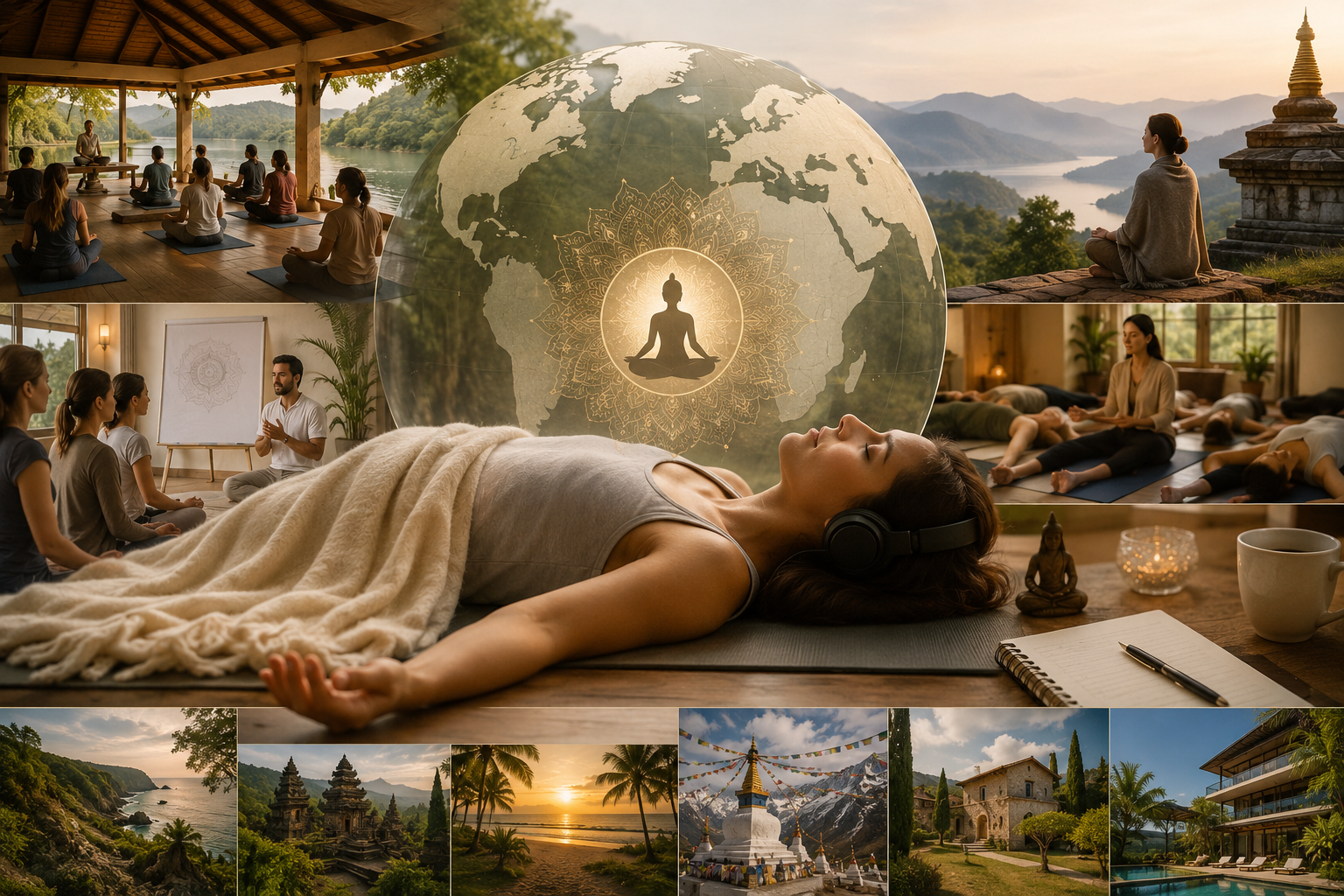
Yoga nidra teacher training in 2026 has reached new levels of depth, accessibility, and specialization. The best programs combine classical wisdom with modern neuroscience, trauma-informed teaching, and creative delivery—some online, some immersive. Whether you’re a yoga teacher, therapist, or curious practitioner, the right training can open doors to teaching, self-development, and real transformation.
Yoga nidra teacher training develops the skills needed to guide others safely through deep rest states, blending ancient yogic practices with neuroscience and trauma-awareness. In 2026, top trainings feature comprehensive curriculums, respected accreditation, and flexible delivery—empowering both teachers and wellness professionals to offer evidence-based relaxation and healing to their communities.
1.1 What Yoga Nidra Is and Why It Is Growing Rapidly
Yoga nidra, literally “yogic sleep,” is a guided meditation practice that systematically leads practitioners through physiological and psychological relaxation, culminating in a unique state between wakefulness and sleep. This isn’t just about rest; it’s about conscious transformation—accessing subconscious layers, supporting stress relief, improving sleep, and helping process trauma. The roots dig deep into classical texts and lineages (think Swami Satyananda’s seminal work), but today’s yoga nidra has grown up: expanded research, clinical usage, and a groundswell of demand in communities hungry for sustainable ways to reset mind and body.
Over the past decade, requests for yoga nidra sessions have spiked. Studios report classes booked solid, and therapists are weaving it into integrative approaches for insomnia, anxiety, and trauma resilience [1]. Not so long ago, most people conflated yoga nidra with a “nice savasana.” Now, the script has changed: yoga nidra stands out for its blend of spiritual tradition, therapeutic application, and, surprisingly, its adaptability—whether delivered in a silent ashram or streamed into a busy household. This expansion is not just a flash trend. It’s driven by something tangible: people long for rest, safety, and tools that actually work.
1.2 Why 2026 Is a Breakthrough Year for Yoga Nidra Training
2026 marks a turning point for yoga nidra teaching training. Why? Several threads have converged. There’s the surge of reliable online certifications—no longer second-rate to in-person intensives. Accreditation bodies and professional associations have stepped up quality standards, especially around trauma-informed care and neuropsychology. More programs are integrating advanced science (think: brainwave dynamics, nervous system mapping) directly into the curriculum.
Culturally, mental health conversations have pushed yoga nidra into new settings: clinics, military programs, schools, and wellness businesses across the US and Europe. This shift has forced teacher training in yoga nidra to grow beyond script-reading: today’s best educators expect you to master self-regulation, safety protocols, and creative adaptation. 2026 also sees more specialization—there’s a teacher course for nearly every profile: therapists seeking client tools, longtime yoga teachers adding a new string, counselors navigating burnout, and beginners curious about the science of rest.
What’s really striking is how this once-niche practice is now a pillar of both wellness culture and clinical intervention. It’s not a stretch to say 2026 is the most exciting (and, frankly, competitive) year yet for anyone aiming to become a certified yoga nidra instructor.
Find here: Yoga Nidra Near Me: Top 2026 Retreats & Classes Guide
1.3 Who This Guide Is For (Teachers, Practitioners, Beginners, Therapists)
Who benefits from digging into this list of the best yoga nidra teacher training in 2026? The landscape is much broader than just yoga teachers looking to add a “deep rest” segment. This guide spotlights options for:
- Experienced yoga teachers wanting a deeper, lineage-based or trauma-informed skillset
- Therapists, counselors, and coaches incorporating evidence-based relaxation and nervous system work
- Healthcare workers and community leaders adding yoga nidra for public health, sleep, anxiety, or trauma
- Wellness professionals seeking a yoga nidra teacher certification that meets Yoga Alliance or other accreditation
- Dedicated practitioners hoping to formalize their knowledge (sometimes before committing to full teacher status)
- Beginners, skeptics, or those who just want to understand the frameworks behind the practice
The “best” program looks different for each group. Realistically, the key variables include program depth, teaching methodology, accreditation, accessibility, and—no small matter—the vibe and experience of the lead trainers. This guide is built for inquisitive, motivated readers across these backgrounds, ready to move from casual interest to confident, well-informed choice.
1.4 How We Selected the Best Yoga Nidra Trainings
With so many yoga nidra teacher courses on offer, the challenge isn’t quantity—it’s quality and suitability. Training programs were selected based on several interlocking factors:
- Accreditation (Yoga Alliance, IAYT, clinical bodies, regional standards where applicable)
- Depth and currency of curriculum (lineage, science, trauma-informed, adaptable for therapy and yoga settings)
- Trainer expertise and teaching lineage (think: actual practice, not just reputational “celebrity”)
- Accessibility (online, hybrid, immersive, and options for non-teachers or beginners)
- Community and post-certification support, both mentorship and peer
- Student outcomes: feedback, alumni testimonials, impact in communities
Programs were cross-referenced against recent research, authoritative reviews, and direct reports from current and former students. The list spans “classic” traditions, top-rated global offerings, niche therapist programs, newer online providers, and standouts in both the US and abroad. This isn’t a generic hand-picked list; it’s a snapshot of what actually works for students—across diverse goals and backgrounds—in 2026.
2.1 Lineage-Based vs Modern Therapeutic Approaches
One of the first crossroads in yoga nidra teacher training centers on tradition versus modernity. Lineage-based courses (think Bihar School of Yoga, Amrit Method) immerse trainees in the methods passed down through gurus and ancient texts. These programs may privilege the spiritual process, prescribe strict practice sequences, and expect commitment to yogic philosophy and discipline. For many, this brings an unmatched sense of depth and historical context. You can almost sense the air turn dense with meaning inside a traditional ashram or during a structured satsang.
By contrast, modern therapeutic approaches to yoga nidra training often start with clinical research, evidence-based applications (e.g., for trauma or anxiety), and flexibility for secular populations. These courses may feature interactive neuroscience modules, trauma-sensitive language, and readily customizable scripts. Hybrid programs now blend both: offering the “bones” of classical structure, while layering on current brain science and mental health insights. The key is noticing not just what’s taught, but how—does the program reflect a living tradition, or does it apply yoga nidra as a technology for modern problems?
2.2 Trauma-Informed Certification Standards
Trauma-informed yoga nidra teaching training isn’t optional anymore—it’s the professional minimum, especially if you’re working in therapeutic or community settings. Top programs in 2026 weave trauma-awareness throughout: from intake protocols and scope-of-practice to language sensitivity and somatic grounding. This isn’t mere trend-chasing; it’s a deep response to what people are actually bringing to the mat: chronic stress, unprocessed history, and a desperate need for psychological safety.
Look for accreditations like IAYT (International Association of Yoga Therapists), programs with trauma specialists on faculty, or those offering specific “trauma-sensitive” modules. The questions to ask: Does the curriculum address the nervous system, titration, and boundaries? Are there protocols for when things get difficult during deep states? As one seasoned instructor put it recently, “Teaching yoga nidra without trauma-awareness is like driving with your eyes half-closed.” That might sound blunt, but it’s the reality facing facilitators in 2026.
2.3 Hours of Training and Certification Levels
Certification hours can range dramatically—some yoga nidra instructor training is 20–25 hours (bare minimum to teach), while others run 50 or even 100+. What matters less is the sheer number, and more is what’s packed into those hours: Are you doing direct practice and receiving feedback? Is teaching methodology (sequencing, script-writing, adapting to students) a core focus? Is there integration with broader yoga or therapy training, or is it a stand-alone?
Many of the leading yoga nidra teacher certification programs track Yoga Alliance CEU requirements for continuing education (often 25–40 hours). Advanced levels—sometimes called “Facilitator,” “Advanced Teacher” or “Level 2/3” training—demand prior experience and deeper personal practice. Some lineages (such as iRest) require multi-stage pathways with mentoring and supervision, which greatly boosts competency and confidence. Be wary of any certification that promises mastery solely by watching videos and answering a few quizzes. These are skills honed through experience, not just memorization.
2.4 Online vs In-Person Immersion Quality Differences
Here’s where things get interesting—and a little contentious. Several years ago, online yoga nidra training was seen as “less authentic.” Fast-forward to 2026 and the script is flipped: some of the world’s leading teachers (formerly only accessible via remote ashrams or global retreats) are running live digital courses that rival traditional in-person programs in quality and depth.
Online offerings bring flexibility, affordability, and broader access, especially for those outside major urban hubs or unable to travel. But there are trade-offs: some skills—like reading group energy, navigating somatic release, and holding presence—are easier learned face-to-face. Residential immersives often add layers of group support, silence, and shared ritual that online can’t fully replicate. For many, the strongest pathway blends both: asynchronous learning, live digital practice, paired with an intensive in-person component when possible. “Being guided in real time with a skilled teacher changes everything,” one recent graduate shared; “but honestly, daily digital check-ins kept me accountable when the retreat was over.” Hybrid is no longer an experiment—it’s just good sense.
2.5 Teacher Experience and Accreditation Bodies
The reputation and demonstrated skill of your lead instructor is, quite simply, the single biggest predictor of a transformational teacher training in yoga nidra. Credentials matter: look for E-RYT 500, C-IAYT, or lineage transmission with documented teaching experience—in both group and therapeutic contexts. Formal accreditation by organizations like Yoga Alliance, IAYT, or key European/clinical boards signals professionalism; check that your chosen certification qualifies for continuing education credit in your field.
But the real differentiator? Teachers who are actively engaged, accessible for feedback, and transparent about their methods and boundaries. Avoid programs that hide behind logos or clever marketing but offer little direct access to master teachers. The right instructor not only grounds curriculum in lived wisdom, but also models the very presence and integration yoga nidra seeks to foster in its teachers. If you can’t connect with the lead teacher before committing, pause and reconsider. Students learn best from people who actually embody what they teach.
3.1 Overview of iRest System
iRest Yoga Nidra, developed by Dr. Richard Miller and the Integrative Restoration Institute, is one of the most widely recognized yoga nidra teacher training systems in clinical, military, and wellness settings. Its curriculum is rooted in nondual yogic philosophy but tailored for contemporary needs. Rather than strictly following classic scripts, iRest emphasizes adaptability, personal experience, and science-backed techniques for emotional regulation and deep rest.
What really makes iRest distinct is its structured, multi-level pathway for teacher development. Each step explores the mechanics of conscious sleep, neurological integration, and guided self-inquiry. It’s favored by professionals who need both rigor and therapeutic applicability—think psychologists, counselors, physical therapists, as well as experienced yoga teachers. The reputation for transformation is well-earned: many students report a profound shift not just in teaching skills, but in their own relationship to rest, stress, trauma, and emotion.
3.2 Certification Path (Level 1–2–3)
The iRest certification system lays out a clear, progressive path:
- Level 1: Foundational training (around 30 hours) covering the core principles, basic practices, and trauma-informed skills. Students gain scripts, live practice, and direct feedback.
- Level 2: Deepening practice and teaching methodology; mentorship, advanced neuroscience, and clinical applications. Typically requires successful completion of Level 1 and a portfolio review.
- Level 3: Advanced teacher designation. Intensive, hands-on group facilitation, clinical supervision, and specialty focuses (e.g., working with PTSD, addiction, medical populations).
Each level is supported by live retreats (virtual or in-person), extensive study resources, and a requirement for ongoing supervised teaching. Certification from iRest is not just a rubber stamp—it’s a respected credential opening doors to both yoga and clinical communities internationally [2].
3.3 Military & Clinical Applications of iRest
iRest has been at the forefront of incorporating yoga nidra into military and mental health institutions. The method is used extensively with veterans, active-duty military, and trauma survivors thanks to its adaptable, trauma-sensitive framework. Numerous clinical trials and real-world studies have shown iRest’s effectiveness for reducing symptoms of anxiety, insomnia, depression, and PTSD.
The protocol’s clear structure is well-suited to hospitals, VA centers, clinics, and mental health practices—enabling therapists, counselors, and community volunteers to deliver yoga nidra safely to those with complex needs. What resonates most is the system’s combination of evidence-based language, modular scripting, and flexibility to be fully secular or richly spiritual, depending on client or group context. If one needs to interface with the medical world, iRest yoga nidra teacher training is still the gold standard.
3.4 Who This Training Is Best For
iRest yoga nidra teacher training stands out for therapists, psychologists, yoga therapists, and experienced teachers who need to serve diverse populations—including those in high-stress, clinical, or vulnerable circumstances. Anyone planning to work with trauma, veterans, hospitals, or those seeking a research-backed, accredited credential finds iRest particularly valuable.
That said, the structure and depth also benefit longtime practitioners who want a roadmap for integrating yoga nidra beyond wellness or spiritual circles. It’s less suited for those avoiding an evidence-based or highly structured approach, or who prefer pure classical/traditional pedagogy.
3.5 Pros and Cons of iRest Training
| Pros | Cons |
|---|---|
| Gold-standard in clinical and trauma-informed circlesWell-structured, multi-level pathwayRespected credential, globally recognizedStrong faculty, mentorship, and supportFlexible delivery: in-person or online | More costly and time-intensiveAcademic rigor not suited for those seeking casual “script-based” learningCertification is multi-stage, requiring commitment over months/yearsCan feel clinical or less spiritual than ashram-based programs |
4.1 Amrit Method and Yogic Foundations
Amrit Yoga Institute’s yoga nidra training traces its roots to the direct tradition handed down from Swami Kripalu, with Yogi Amrit Desai at the helm. The Amrit Method blends the classical koshic (five-layer) model with energetic and somatic awareness, focusing strongly on integrating all layers of the self—physical, energetic, emotional, intellectual, and spiritual. Many who train here describe an immersive, heart-centered approach that balances precision with genuine warmth.
Central to the Amrit Method is the belief that yoga nidra is not just “passive rest,” but an alchemical process for healing and conscious evolution. The course interweaves pranayama, contemplative self-inquiry, visualizations, mantra, and the science of body-mind relaxation. Expect lots of experiential practice; faculty consistently bring teaching to life through lived demonstration and mentorship.
4.2 Structure of the Certification Program
The yoga nidra teacher certification with Amrit typically spans 30–40 hours across immersive retreats or hybrid formats. Content includes deep dives into koshas, intention-setting (sankalpa), group facilitation, trauma-informed basics, and hands-on practice teaching. Unlike some script-driven courses, teachers here are encouraged to adapt protocols based on the unique group or client scenario—an approach that’s both empowering and a little daunting for nervous first-timers.
Certification is recognized for Yoga Alliance continuing education hours. Those seeking extended mentorship or to become “trainers of trainers” can progress to advanced mentorship levels. What feels evident from both course structure and alumni feedback: Amrit’s focus on inner transformation ripples out—teachers leave with as much personal shift as professional skill.
4.3 Retreat Environment and Immersion Style
In-person Amrit Yoga Institute retreats, based at their Florida campus, are immersive in the truest sense: multi-day residential intensives that blend satsang (community teaching), group sharing, yoga nidra practice, morning movement, and guided self-reflection. Days begin with silence, gentle movement, and meditation, progressing into deep rest sessions, teaching feedback circles, and philosophical discussions.
Participants share that the retreat environment—the silence, nature, and supportive group—triggers unexpected clarity and healing, even for veteran teachers. For those unable to travel, hybrid or virtual versions now capture much of that magic, offering a window into the traditional ethos from anywhere in the world.
4.4 Spiritual vs Therapeutic Focus
While Amrit Yoga Nidra is solidly grounded in lineage, its pedagogy skillfully walks the line between spiritual growth and contemporary wellness. The curriculum gives plenty of space for spiritual inquiry (including mantra, energetic models, meditative nonduality), but never loses sight of the tangible: techniques to address stress, anxiety, trauma, and sleep disturbance. Perhaps that’s why alumni include ashram devotees, yoga therapists, clinicians, and curious seekers alike. There’s an implicit message: yoga nidra can be both soul work and science, without contradiction.
4.5 Ideal Student Profile
Amrit Yoga Institute’s teacher course suits those who crave depth, value tradition, and seek a community-centered, experiential environment. It’s a favorite for yoga teachers expanding their toolkit, wellness professionals who want spiritual “roots” alongside trauma-informed rigor, and serious seekers ready for immersion. Those who prefer purely secular, script-based methodology, or need only “quick CEUs” may find the layered, inquiry-heavy pedagogy less satisfying.
5.1 Origins of Yoga Nidra in Satyananda Lineage
The Bihar School of Yoga—founded by Swami Satyananda Saraswati—stands as “the classical source” for modern yoga nidra. It’s the original method that made “yogic sleep” a global phenomenon, defining systematic protocols for deep relaxation and subtle awareness rooted in tantric and yogic scripture. Many Western and global teacher trainings derive their approaches (and scripts) from this lineage, whether they admit it or not.
The classical Satyananda method directs practitioners step-by-step through rotation of consciousness, breath awareness, visualization, and sankalpa—layered to induce pratyahara (withdrawal of the senses) and subtle states between waking, dreaming, and deep sleep. The language is precise, the ritual is real, and the sense of history is palpable. For those wanting to touch the heart of yoga nidra practice, this approach is unmatched for its authenticity and discipline.
5.2 Traditional Teaching Structure
Teacher training in this lineage is rigorous, often immersive, and steeped in discipline. Expect intensive study of yogic texts, daily practice, group teaching under supervision, and feedback from lifelong practitioners. Unlike some modular online programs, Bihar School of Yoga’s regimen requires in-person presence (at least for full certification), strict daily schedules, and commitment to deeper inquiry. The methodical, layered instruction builds competence—from entry-level “guides” to advanced instructors holding sangha in ashram settings.
The structure can feel intense—sequences, philosophy, ethics, and group teaching all mix in long ashram days. Yet students often describe a paradoxical sense of ease: the more structured the environment, the more clearly rest and transformation unfold.
5.3 Ashram-Based Training Experience
Training at the Bihar ashram in India offers a complete immersion: dawn-to-dusk spiritual discipline, communal living, karma yoga, and regular group satsang. Westerners and international students find the culture inspiring, occasionally demanding, but unfailingly transformative. Ashram-based yoga nidra teaching training is less about “passing a test” and more about culturing presence, discipline, and respect for the tradition.
Many alumni say the impact lingers years after—one recalled the “scent of incense, sun-heated stone floors, and the weight of silence,” as an enduring memory. The program is not fast or easy, but what’s gained is a sense of lineage rarely found elsewhere. For those who can make the trip—or access satellite ashrams in the US and abroad—this method is the definitive classical experience.
5.4 Depth of Practice and Discipline Required
A word of honesty—yoga nidra teacher training at Bihar or affiliated satellite ashrams isn’t for dabblers. Students are expected to maintain daily practice, abide by ashram routines (including periods of silence and strict schedules), and embrace a lifestyle of conscious discipline during the course. The payoff is real depth, but it’s not always comfortable; many encounter their edges (sometimes fiercely) before settling into genuine insight. This rigor is what gives “Satyananda yoga nidra” its reputation for lasting change.
5.5 Why This Is Considered the Classical Source
Why do so many refer to the Bihar School of Yoga as the classical source? It’s not just name recognition. This tradition literally defined the architecture of modern yoga nidra: script structure, koshas, sankalpa, visualization, and measured rotation of consciousness. Nearly every reputable contemporary training owes a debt to Satyananda’s early work. It’s the reference point for both purists and those who build creative adaptations today [3]. Choosing this training is, in a real sense, choosing to study at the wellspring—and that kind of authenticity is impossible to fake.
6.1 Psychology-Based Yoga Nidra Method
The Yoga Nidra Network, guided by Uma Dinsmore-Tuli, Kamini Desai, and a faculty of internationally recognized teachers, is the home of “Total Yoga Nidra”—a creative, psychology-based approach that honors classical tradition while weaving in western psychology, feminism, and deep rest consciousness. What sets this network apart is its flexibility and inclusivity—there’s little dogmatism, and plenty of room for creative adaptation.
“Total Yoga Nidra” operates as both a method and a movement: trainees are encouraged to explore script structures, body-based insight, cyclical wisdom (particularly for women and non-binary practitioners), trauma-awareness, and intuitive teaching. This stands out in a field sometimes dominated by formulaic scripts or rigid tradition. Past students often remark, “Yoga Nidra Network was where the practice came alive for me—it felt like a living language, not just a recitation.”
6.2 Sleep Science and Subconscious Reprogramming Approach
Rooted in sleep science and subconscious reprogramming, Yoga Nidra Network’s curriculum maps the physiology of rest, neuroplasticity, and subconscious healing directly onto classical kosha models. Students learn to design protocols that work for anxiety, sleep disturbance, trauma, or spiritual growth. The integration of lucid dreaming techniques, intentions (sankalpa), and guided visualization makes this method attractive to therapists, coaches, yoga teachers, and wellness innovators.
6.3 Certification Levels and Curriculum
Training is structured in progressive levels:
- Total Yoga Nidra Teacher and Facilitator Training: A 30–50 hour intensive (offered in-person, hybrid, and fully online), including history, teaching methodology, trauma-awareness, and creative script-writing.
- Yoni Shakti: Rematriation and Well Woman Yoga Therapy: Focused on feminine embodiment, cyclical wisdom, and women’s health applications.
- Therapeutic Yoga Teacher for Pregnancy/Birth/Postnatal Recovery: A specialty for perinatal professionals integrating total yoga nidra and somatic healing.
All courses are recognized as Approved Professional Development by the International Association of Yoga Therapists (IAYT) and count for Yoga Alliance CEUs. The curriculum offers dense practical modules—expect to practice, reflect, and teach, not just memorize scripts.
6.4 Online Accessibility and Global Reach
While the founding team is based in the UK and Europe, the Yoga Nidra Network now runs fully online and hybrid trainings accessible worldwide. Courses are punctuated by live sessions, mentorship circles, and rich community forums—alumni hail from the US, Canada, Europe, Asia, and beyond. Recorded modules allow for self-pace, while live feedback ensures “you’re not just learning in a vacuum.”
For those juggling work or family, the online model makes deep study feasible. One recent graduate summed it up: “Being able to learn at home, yet still be part of a European circle of teachers sharing real experience, made a difference in my learning.”
6.5 Strengths of This System
- Inclusivity: Embraces all backgrounds, spiritual orientations, and body types
- Trauma-informed from the ground up
- Deep integration of sleep science, psychology, and cyclical wisdom
- Offers creative freedom—graduates craft their own unique teaching style
- Approved for IAYT and Yoga Alliance CEUs
7.1 Trauma-Informed Feminine Approach
Uma Dinsmore-Tuli’s yoga nidra teacher training brings a distinctly feminine, trauma-aware, and body-positive approach to the table—a true “rematriation” of yoga for modern times. Her work, centered around the “Yoni Shakti” method, addresses the needs and cycles of women and non-binary bodies, offering protocols for deep rest, womb healing, perinatal wellbeing, and recovery from burnout or trauma. Uma’s programs challenge the patriarchal structures found in traditional yoga, nurturing cyclical wisdom and honoring personal agency at every step.
This approach doesn’t just diversify yoga nidra teaching; it reshapes it. Many students find this the first safe space to learn, rest, and teach outside rigid scripts or gendered assumptions. It’s not surprising that many alumni report, “I felt seen, supported, and empowered to bring yoga nidra to all kinds of people.”
7.2 Womb Yoga & Deep Rest Practices
Womb Yoga, pioneered by Uma Dinsmore-Tuli, anchors courses in cyclical, body-focused practice, integrating yoga nidra, gentle movement, breathwork, and intention. These practices are specifically crafted for menstrual health, fertility, perinatal transitions, menopause, and womb trauma (including birth loss and gynecological surgery recovery). The teaching style is gentle yet rigorous—students are taught to adapt yoga nidra for every body, every age, and every life stage.
This inclusive scope is rare, even in broader yoga circles, and has attracted therapists, doulas, health practitioners, and women’s health advocates seeking yoga nidra teacher certification for specialized populations.
7.3 Therapeutic Applications for Healing Trauma
A core tenet of Uma’s method is that deep rest is an act of reclamation, especially for those carrying trauma in the body. The training weaves in contemporary trauma research, somatic psychology, and mindfulness to help teachers facilitate psycho-emotional safety, titration, and gentle release. This is not “one-size-fits-all relaxation”—it’s a dynamic, practical, and innovative response to the invisible wounds prevalent in modern life.
Graduates leave with not just techniques, but also protocols for holding safe space, recognizing trauma triggers, and fostering nervous system resilience. For anyone planning to work in trauma recovery, women’s health, or inclusive yoga therapy, this training is an industry leader.
7.4 Who This Training Is Designed For
- Yoga teachers, doulas, therapists, and bodyworkers focused on women and non-binary clients
- Mental health professionals integrating trauma-sensitive practices
- Anyone seeking a cyclical, embodied, and feminist approach to rest and healing
- Practitioners in recovery, perinatal stages, menopause, or navigating chronic stress/burnout
The atmosphere here is about empowerment and healing, rather than just “relaxation.” Those looking for more than script-reading or basic theory will find this a breath of fresh air.
7.5 Unique Methodological Differences
Key differences in Uma’s approach:
- Total absence of dogmatism—emphasis is on creativity, consent, and embodied learning
- Cyclical (rather than linear) teaching models—rest and practice adapt to body rhythms
- “Un-training” as much as “training”—students are invited to challenge conventional thinking
- Extensive trauma-sensitive pedagogy woven throughout
The result? A yoga nidra teacher program that is flexible, research-informed, and genuinely empowering—ideal for anyone ready to teach with both rigor and radical kindness.
8.1 Kripalu Lineage and Teaching Philosophy
Kripalu Center’s yoga nidra teacher training has long been respected in the US and worldwide for its emphasis on compassionate inquiry, experiential teaching, and integration of yogic wisdom with mindfulness and well-being. The Kripalu lineage draws from Swami Kripalu’s teachings, with a deep respect for the classical kosha model and the “witness consciousness” at the practice’s heart.
Here, yoga nidra is not just about induced relaxation or script-following; it’s a dynamic, inquiry-driven process of meeting oneself just as one is. The teaching philosophy centers on transformation through gentle awareness, making space for self-reflection, and cultivating presence—qualities as valuable for daily life as for professional yoga nidra guidance [4].
8.2 Integration of Mindfulness and Yoga Nidra
Unlike more rigid script-based programs, Kripalu yoga nidra blends mindfulness meditation, breath awareness, emotional processing, and intuitive rest. The curriculum situates yoga nidra within a “continuum” that includes mindful movement, dialogue, and group integration. This fusion tends to attract practitioners and teachers who crave both discipline and creative fluidity—those comfortable with living questions rather than fixed answers.
8.3 Residential Retreat Training Structure
Most Kripalu trainings are delivered as five-day on-campus intensives, merging deep rest practice with hands-on group coaching, daily yoga, and immersion in the retreat environment. Students alternate between silent mornings, lively nurse-circle discussions, and structured teaching feedback. There’s a real sense of supportive community, often reported as “transformative beyond expectations.”
Kripalu’s tranquil countryside setting (western Massachusetts, USA) provides the sense of sanctuary that, for many, is a rare luxury—a place where one can “actually feel the nervous system unwind.” That said, hybrid and virtual options are now available for those unable to travel, keeping quality high and peer learning strong.
8.4 Emotional Processing and Self-Inquiry Work
A hallmark of Kripalu’s yoga nidra teaching program is the integration of emotional processing and guided inquiry into the curriculum. Rather than just practicing rest or learning to read scripts, students are coached to recognize emotional “weather,” hold safe group space, and adapt cues to help students meet rather than bypass difficult feelings. This emotional depth can be confronting, but most students emerge more resilient, compassionate, and skilled as facilitators.
Modules on self-inquiry, witness consciousness, and cultivating empathy put Kripalu’s teacher program in a league of its own for those prepared for inner work.
8.5 Benefits of Kripalu-Based Training
- Hybrid of classical lineage and contemporary mindfulness
- Residential retreat deepens embodiment and peer support
- Accredited for Yoga Alliance CEUs
- Thorough coaching in emotional intelligence and self-inquiry
- Strong focus on personal transformation, not just teaching method
9.1 Overview of Arhanta Yoga System
The Arhanta Yoga system, based in Europe (Netherlands and India), offers a yoga nidra teacher course rooted in the traditional Himalayan yoga lineage, yet shaped for the needs of modern students. Their approach is highly structured, balancing step-by-step skill development with practical experience and robust online learning infrastructure.
The curriculum draws on the proven structure found in the classic Indian ashrams but updates it for Western accessibility and sensibilities. You’ll find close mentorship, clear progression criteria, and an emphasis on daily practice and self-discipline. Arhanta’s reputation has expanded rapidly, thanks to reliable standards and a multi-national alumni network.
9.2 Intensive European Retreat Format
Arhanta offers both online self-paced certification and immersive on-site retreats in Europe (primarily the Netherlands, Germany, and occasionally Spain/Italy). The retreat format is intensive—typically a five to seven-day in-person immersion that includes teaching circles, group practice, and live feedback. Students work together in a close-knit community, often forming lasting networks with fellow graduates.
Alumni consistently report that stepping out of their daily routines to focus exclusively on yoga nidra creates space for profound learning and growth.
9.3 Curriculum and Teaching Methodology
The core curriculum covers classical yoga nidra sequence (setup, rotation, breath, visualization, sankalpa), trauma-sensitive teaching, group dynamics, script adaptation, and student assessment. Teaching methodology is emphasized—practice teaching is required, with real-time peer and faculty feedback. Students are encouraged to personalize their scripts while upholding traditional integrity.
Arhanta’s pedagogy is “no-fluff” yet non-dogmatic. The balance between rigorous standards and accessible, actionable learning makes it a strong fit for European and international students seeking clarity, community, and real-world skill development.
9.4 Certification Recognition
Arhanta Yoga Nidra Teacher Certification is recognized across the EU, US, and global yoga teaching networks (including Yoga Alliance CEUs and professional yoga therapist bodies). Graduates are licensed to offer yoga nidra in studios, clinical settings, or as part of broader yoga therapy practice.
9.5 Ideal Students for This Training
- European (or EU-based) yoga teachers and wellness professionals wanting a hybrid of classical and modern training
- Practitioners seeking structured, step-by-step learning and practical feedback
- International students looking for a respected, non-dogmatic system
- Anyone who benefits from immersive, in-person learning combined with the option for continued online support
10.1 Ancient Himalayan Meditation Roots
There’s no denying the mystique and authority of the Himalayan tradition in yoga nidra. Programs rooted here—typically found at Indian ashrams, select US/Europe retreat centers, and with select global teachers—emphasize the unbroken “guru-disciple” transmission of deep rest, pratyahara, and subtle body awareness practices. Unlike westernized, script-driven courses, these are about direct experience, disciplined self-inquiry, and spiritual evolution.
One attendee remarked, “The silence felt quiet, but the learning was thunderous.” Expect to meet practices and teachers who see yoga nidra as a preparation for higher states of meditation, not just for physical relaxation.
10.2 Guru-Disciple Transmission Style
Central to these trainings is the lived presence of a master teacher (often called Guruji, Swamiji, or with a lineage-specific honorific) who imparts teachings through oral transmission, example, and direct feedback. The relationship is part mentorship, part challenge: students are held accountable for daily practice, self-discipline, and inner transformation. This can be both inspiring and, for some, a stark departure from western classroom cultures.
The guru-disciple model also means learning happens not just through lectures but through immersion, community living, and “watching how presence unfolds in the teacher.”
10.3 Depth Practices and Inner Awareness Training
Yoga nidra in the Himalayan tradition goes far beyond body scan and breath awareness. Trainees are guided into layers of subtle awareness—visualization, mantra, prana flow, and “witness consciousness” that border on deep meditation (samadhi). The discipline required is substantial: silence, daily repetition, and ongoing self-inquiry form the backbone of the process. This is ideal for those seeking spiritual growth and profound, energetic shifts.
Advanced programs include instruction on guiding students into deeper yogic states (such as turiya), framed within a context of ethical living and selfless service.
10.4 Retreat Environment and Silence Practices
Settings range from remote Himalayan ashrams to peaceful European centers—but always with an emphasis on single-pointed focus. Silent practice is common, with extended digital detox, early mornings, and a gentle but unwavering expectation that students “let go of the world” to learn presence-first.
For many, the environment is transformative; for others, the rigor can be confronting. This is not a drop-in workshop—it’s an initiation in the truest sense.
10.5 Who This Path Is For
- Experienced yogis seeking lineage transmission above quick credentials
- Spiritual seekers needing immersive, disciplined environments
- Teachers, scholars, and traditionalists wishing to honor ancient roots
- Anyone ready for personal transformation through sustained self-inquiry and discipline
It’s best to approach with readiness, respect, and a deep commitment. Yoga nidra here is not a product but a living, breathing practice.
11.1 Popular Retreat Centers in the UK
The UK has developed a robust yoga nidra training scene—one rich with retreat centers that balance tradition and accessibility. Standouts include Triyoga (London), Mandala Yoga Ashram, and popular yoga therapy schools running immersive weekends and short intensives. The scene bubbles with creative, trauma-aware instructors and a cohort of European teachers skilled at blending classical roots with modern mental health science.
Expect plenty of lush countryside, brisk air, and cozy group learning atmospheres. Community and conversation form as much a part of the experience as rest itself—the “tea break” discussion becoming a surprising hotbed for insight.

11.2 Short Intensive Certification Formats
Short-form certification (2–5-day intensives or weekend courses) is a hallmark of UK yoga nidra teacher training. Programs are designed to equip yoga teachers, therapists, and wellness professionals with practical skills fast—combining concentrated group practice, creative script-writing, trauma-informed language, and peer feedback. It’s the “no-nonsense, direct to application” approach emblematic of British yoga education.
While these shorter courses may not match the depth of a month-long ashram retreat, they are lifelines for working professionals who need skills now, not next year.
11.3 Integration with Modern Therapy Approaches
A defining feature of the UK training landscape is its active dialogue with modern therapy—mindfulness, psychotherapy, cognitive science. Many providers cross-reference yoga nidra scripts with evidence-based protocols, nervous system regulation, and trauma-sensitive delivery. Several yoga therapy institutions lead the way in integrating yoga nidra into professional standards for yoga therapists and mental health workers.
11.4 Accessibility for European Students
Easy transport links, affordable pricing (relative to the US and India), and a supportive, multicultural community draw students from across Europe. Many courses are hybrid, blending flexible online theory with in-person practice modules over weekends or “retreat-lets.” The result is a dynamic, cross-cultural learning environment that keeps yoga nidra evolving for modern needs.
11.5 Strength of UK Training Scene
- Offers flexible, accessible entry points for every experience level
- Strong trauma-informed and clinical focus
- Expert faculty and lively cross-European alumni community
- Short, intensive formats suit busy lifestyles
- Blends tradition with therapy, rooted in practical application
12.1 Nature-Based Retreat Environments
Across Germany, Spain, and the Netherlands, yoga nidra training has found a natural home in nature-based retreats—settings that combine deep rest with landscape immersion: think forest surrounds, mountain vistas, or sun-soaked rural centers. These environments do more than frame the learning. As many participants describe, something shifts when the “background noise” drops away and only trees, birdsong, and quiet bodies remain.
Nature-based retreats frequently blend daily yoga, mindful walking, group sharing, and lectures, creating layers of rest and learning inaccessible in standard city studios.
12.2 Silent Retreat Integration Models
Silence is increasingly built into European yoga nidra facilitator training. This isn’t just about discipline; it’s about letting rest ripple deeper, bypassing surface distraction. Several respected programs run “half-silent” days, integrating noble silence with key lecture or practice periods. The result is a dual-track growth: deepening personal rest, while sharpening teaching presence and clarity.
Alumni often note that once digital distractions, city noise, and social chatter fade away, their own intuition as teachers starts to sharpen—a benefit that lingers long after.
12.3 Trauma-Informed European Approaches
Therapeutic integrity is a must-have in today’s European trainings. Ever since trauma-informed practice became the benchmark in the US and UK, leading European schools have incorporated modules on somatic safety, psychological first aid, and inclusive language. These frameworks aren’t just about serving “at-risk” clients; they shape every classroom, making space for neurodiversity, cultural difference, and safe exploration of rest.
Students learn not just what to teach, but how to teach—skills urgently needed across Europe’s heterogeneous communities.
12.4 Popular Retreat Structures
- 5–7 day immersive retreat/certificate programs
- Weekend intensives paired with virtual follow-up support
- Hybrid retreats (in-person plus digital home practice modules)
- Peer teaching circles, mentorship, and “graduation” projects
Flexibility is key: most students are mid-career, juggling work, family, and travel. The best programs are built to fit real lives, not just hypothetical schedules.
12.5 Why Europe Is Growing in Yoga Nidra Training
The European scene stands out for its innovation, therapeutic depth, and cross-cultural richness. Several trends drive this momentum:
- Growing awareness of stress, anxiety, and burnout across all sectors
- Increased funding and openness to yoga therapy in health systems
- Demand from clinicians, educators, and wellbeing professionals for accessible, research-backed certification
- A tradition of “learning by retreat”—stepping out of routine to gain real insight
If the past five years have proven anything, it’s that Europe has become a global incubator for sophisticated, community-friendly yoga nidra teacher training.
13.1 Rise of Digital Yoga Nidra Education
The digital revolution in yoga nidra instruction wasn’t just a pandemic stop-gap—it’s now the primary learning track for thousands. In 2026, some of the best yoga nidra teacher certification can be completed fully online, with growing quality, interactivity, and industry recognition. Gone are the days when an online certificate was a weak substitute for in-person immersion; today’s top platforms blend live sessions, peer support, and required practice teaching.
Online options are especially vital for working professionals, parents, and international students with limited travel flexibility. “Without Zoom, I’d never have made it past wishful thinking,” one recent US-based graduate quipped before adding, “but don’t think these programs are just screen time—they’re designed to keep you awake, not knock you out.”
13.2 Best Global Online Platforms
- My Vinyasa Practice: Yoga Alliance accredited, 40-hour self-paced program, trauma-informed, comprehensive, supported by expert educators (Michelle Young, Tara Cleven, Maire McGlasson)
- Yoga Medicine: 20-hour advanced LIVE online training, evidence-informed, blending classical teachings with cutting-edge neuroscience (instructors: Caroline Wybar, Dr. Katja Bartsch)
- Yoga For You: 25-hour at-your-pace training focused on script-writing, neuroscience, and nervous system regulation (instructor: Kelly Smith, Mindful in Minutes podcast)
- Aura Wellness Center: Affordable 30-hour online course, suitable for teachers, therapists, and non-teachers, with broad support and multiple script-writing modules
- Total Yoga Nidra Online (Yoga Nidra Network): 50-hour inclusive curriculum, trauma-aware, highly interactive with live support options
- Ally Boothroyd Online Yoga Nidra Teacher Training: Known for an accessible, soulful approach—especially for meditation and yin yoga practitioners
13.3 Self-Paced vs Live Training Models
Online certification comes in two basic flavors:
- Self-paced: Students access video/audio lectures, reading, and assignments on their own timetable; live check-ins or mentorship offered in some programs
- Live online: Scheduled Zoom calls, real-time Q&A, interactive group practice, sometimes with “office hours” or required direct feedback
Both bring advantages—self-paced suits independent learners and global time zones, while live training builds accountability and “on-the-fly” teaching skills.
13.4 Certification Validity and Recognition
Almost all respected online yoga nidra teacher courses now align with Yoga Alliance CEU or IAYT standards. Certificates are recognized by studios, wellness organizations, and therapy networks—sometimes with manual review or added documentation. Do your homework: check whether a given certificate holds value for your intended work (studio, clinical, school, or therapy setting), and whether your professional body accepts “non-contact” CEU credit.
Some programs (for example, My Vinyasa Practice, Aura Wellness Center, Yoga Medicine) issue digital credentials immediately upon meeting exam and practice requirements.
13.5 Limitations of Online Learning
- Less “in-person” group energy—hard to learn nonverbal cues and group dynamics fully
- Requires strong self-motivation and digital discipline
- Practice teaching with actual humans (not just a camera) remains irreplaceable
- Some accreditation bodies still give preference to in-person CEUs
Best advice? Use online as a foundation and supplement with local teaching, mentorship, or live workshops when possible. In 2026, the smartest yoga nidra instructors skillfully blend both worlds.
14.1 Psychology + Nervous System Approach
Trauma-informed yoga nidra facilitator training, once the “boutique” option, is now baked into best practices. These specialized programs train facilitators to work with clients who carry unprocessed stress, anxiety, or trauma—teaching not just “rest,” but the practical skills of nervous system regulation, somatic awareness, and psychological safety.
The curriculum moves far beyond scripts or “relaxation.” Students learn about the window of tolerance, trauma triggers, brain-body pathways, and how to handle strong emotions compassionately. Programs by Yoga Nidra Network, Yoga Medicine, and iRest are leaders here.
14.2 Somatic Healing Integration
The new wave of teacher training programs emphasizes somatic healing—tracking body sensations, titrating activation, and using breath and voice to foster gentle, safe release. Facilitators are taught to respond, not react, to students’ needs in the moment. This approach prioritizes presence and adaptability over rigid scripts—a skill clinicians, therapists, and trauma survivors report as essential.
14.3 Use in Therapy and Coaching Fields
Growing numbers of coaches, counselors, and therapists now complete yoga nidra instructor training to add practical tools for anxiety, sleep issues, and trauma symptoms. Evidence suggests that trauma-aware yoga nidra, when delivered skillfully, can support treatment for PTSD, depression, and chronic stress—especially as part of a holistic or integrative care plan.
Several insurance and mental health organizations now recognize trauma-informed yoga nidra as an adjunct modality—though credentialing and scope of practice vary regionally.
14.4 Safety Protocols in Teaching Trauma Clients
- Intake and assessment before guided sessions
- Consent, agency, and right to pause at any moment
- Neutral, invitational language avoiding prescriptive or directive cues
- Training in recognizing signs of dysregulation, dissociation, or overwhelm
- Immediate support protocols for strong emotional responses
The best facilitators combine technical skill with human empathy, offering true trust and containment rather than just a “script for distress.”
14.5 Who Should Choose This Path
- Therapists, counselors, psychologists, and trauma-focused yoga teachers
- Health, community, or crisis professionals needing safe relaxation tools
- Anyone with a personal or professional history of trauma seeking best practices
- Coaches and wellness practitioners integrating mind-body care
If your work brings you into contact with vulnerability, trauma, or chronic stress, skipping trauma-informed certification is no longer an option—it’s the professional baseline.
15.1 Deep Meditation and Conscious Sleep States
For experienced graduates and committed seekers, advanced yoga nidra practitioner intensives offer what standard teacher courses rarely reach: guided entry into altered consciousness, conscious sleep, and even fundamental nonduality (advaita). Here, teaching is not just about “relaxation” but about accessing and maintaining subtler states of mind—pratyahara, dharana, and even glimpses of samadhi.
Participants are led by senior teachers—often direct lineage holders—with decades of experiential knowledge. The curriculum includes systematic meditation, advanced pranayama, mantra, and protocols for weaving deep rest into daily living.
15.2 Advanced Samadhi-Oriented Practices
Some intensives, especially in the Himalayan and Satyananda systems, point directly at samadhi-oriented practice. Here, trainees work with states beyond dreaming and deep sleep—often called turiya (the “fourth” state in yogic philosophy). These retreats may involve periods of silence, nightly yoga nidra, and advanced self-inquiry. The intention is not certification, but transformation.
Alumni speak of altered perceptions, increased intuition, and deep peace—not as passing states, but as lived traits. This is advanced territory and not to be entered lightly.
15.3 Long Retreat Immersions (10–30 Days)
Longer retreats (often 10–30 days) provide a rare chance for total immersion: trainees unplug from routine, technology, and outside distraction, and undertake daily practice, teaching, and reflection. These programs are rare in the West but remain common at ashrams and a handful of select US/European centers.
- Daily schedule: early morning meditation, multi-hour nidra, seva (service)
- Group integration and mentorship with senior teachers
- Ongoing feedback and “integration circles” for processing deep shifts
For those ready for depth or on the verge of life change, these immersions can catalyze lasting transformation.
15.4 Silent Training Components
Silence—both external and internal—is a core component of advanced intensives. Extended noble silence allows practitioners to descend into subtle mind states, access inner guidance, and refine their teaching presence. Faculty will often “teach less, demonstrate more,” expecting participants to hold themselves in disciplined accountability. It’s an environment where breakthroughs and resistance travel in tandem.
15.5 Master-Level Skill Development
Master-level training moves beyond the well-worn script to nuanced, adaptive delivery. Teachers-in-training learn to read energy, hold containers for group silence, and support practitioners through strong emotion or even “spiritual emergencies.” This skillset—more art than science—is why master-level yoga nidra teachers are so sought after in yoga therapy and community circles. The best can guide not just a session, but genuine transformation.
16.1 5–7 Day Immersion Formats
Not everyone has bandwidth (or budget) for a month-long ashram stay. That’s why 5–7 day yoga nidra teacher training immersions have become so popular in the US, UK, and Europe. These short intensives pack focused learning, group community, and practice-teaching into manageable containers—often in retreat centers or wellness resorts.
Days blend early movement, multiple nidra sessions, script analysis, feedback, and sometimes optional silence. For many, the shift in environment and focus makes integration of learning much easier than in “drip-fed” weekend formats.
16.2 Weekend Certification Options
Ultra-short (2–3 day) yoga nidra instructor certifications are now widely available, especially for existing yoga teachers, counselors, or wellness professionals who need “plug-and-play” skills. These weekends are “all-in,” expect late evenings, early mornings, and high accountability for solo and group teaching. They’re best for those with prior background, as process is compressed and self-direction required.
Weekend options range from in-studio to destination resort intensives—some even offering continuing education credits.
16.3 Best Use Cases for Short Trainings
- Yoga teachers who want immediate “add-on” skills
- Therapists needing a rapid upskill for clinical/therapy integration
- Professionals with limited time, looking for CEUs
- Alumni of longer courses seeking refreshers or specialty modules
16.4 Pros and Limitations
| Pros | Limitations |
|---|---|
| Efficient, focused learning on a tight scheduleCost-effective, accessible locationsQuick path to certification and CE credit | Less depth than long-term programsLimited integration/support post-trainingBest for those with solid foundation in yoga/therapy |
16.5 Who Should Start Here
- Working professionals seeking skill upgrade
- Yoga teachers, wellness professionals already certified in basic yoga
- Those with practice experience but little formal training
- Anyone who learns best in fast-paced, hands-on settings
For in-depth personal transformation, a longer retreat or hybrid course may be better. For rapid professional upskilling, short intensives get the job done.
17.1 Adding Yoga Nidra to Existing Yoga Certification
Many yoga teachers find that adding a yoga nidra teacher course to their 200-hour (or higher) yoga certification not only expands their teaching toolkit, but also satisfies the “missing link” between vinyasa and rest. Studios increasingly prioritize teachers with nidra certification—one studio manager noted, “It’s our number one requirement for restorative classes.”
Yoga Alliance and IAYT-recognized yoga nidra instructor training allows teachers to market, bill, and teach stand-alone or integrated nidra sessions. The main advantages: more diverse offerings, higher student retention, and access to new client groups (e.g. trauma, sleep support, anxiety).
17.2 Integration into Therapy Practice
Counselors, therapists, and mental health workers are now training in yoga nidra not just for their own self-care, but as a frontline tool for client resilience and nervous system regulation. Yoga nidra’s evidence base and acceptance by clinical bodies have expanded: integrative therapists use it for stress reduction, sleep disorders, trauma, and even chronic pain.
Many therapy practices now market yoga nidra as a core wellness service—building both community goodwill and clinical outcomes. Yoga nidra isn’t just “add-on relaxation,” it’s a bridge into deeper healing.
17.3 Teaching Methodology Development
Effective yoga nidra teaching methodology blends science, tradition, and communication skill. Teacher courses now dedicate modules to script personalization, inclusive language, emotional containment, and group facilitation.
Alumni report that “learning to adapt the script in real time, and being able to read group energy, was what finally set my teaching apart.” Methodology skill is what transforms a capable facilitator into a much-in-demand teacher.
17.4 Client Application in Real Settings
Real-world client application is the final test of any teacher training. The best programs require solo and group teaching practice, often using peer/mentor feedback and recorded submissions. Teachers report bringing in yoga nidra to chronic pain management, anxiety, children’s education, addiction recovery, and trauma work.
Who benefits most? Clients feel safe, rested, and seen—and teachers gain both skill and confidence as group leaders.
17.5 Professional Expansion Opportunities
- Lead classes in studios, wellness centers, therapy offices, or community groups
- Offer one-on-one or small group nidra coaching
- Specialize in trauma, sleep, anxiety, women’s health, or perinatal care
- Develop corporate, hospital, or school programs
- Ace continuing education requirements for licensure and professional marketing
“Adding yoga nidra to your professional toolkit is like switching your meals from packaged food to home-cooked—suddenly, everything gets deeper and more nourishing,” as one veteran yoga therapist put it.
18.1 Low-Cost Online Certifications
As of 2026, entry-level online yoga nidra teacher certifications can be found for as little as $100–$250 (editor-verified). These typically include 20–30 hours of video/audio content, digital manuals, practice assignments, and basic mentor feedback. Aura Wellness Center and Yoga For You are good examples.
“Affordable doesn’t have to mean shallow—look for support, live check-ins, and active alumni circles,” says one recent graduate. Self-paced online options let students learn without travel or accommodation costs—and payment plans are increasingly the norm.
18.2 Mid-Range European Retreat Trainings
In-person European retreat trainings (Germany, Netherlands, Spain, UK) tend to fall in the $400–$800 range for 30–40 hour immersions, including meals and lodging (2026 pricing). These intensives offer deep practice, mentoring, and real-world group training at accessible costs—especially compared to US residential programs.
Hybrid/partial residential formats allow students to balance immersion with affordability, blending in-person modules with online/follow-up sessions.
18.3 High-End Immersion Programs
The most comprehensive and prestigious yoga nidra teacher courses—think iRest, Himalayan ashram residency, full Kripalu immersions—carry fees between $1000–$3,500+ (not counting travel). These programs routinely run 5–21+ days, with luxury retreat centers or international travel. Some programs (Bihar School of Yoga) require donation-based or sliding scale, especially for longer ashram stays.
While the cost can be significant, the depth, peer networking, and post-course career or teaching boost often justify the spend for committed professionals.
18.4 What Affects Pricing (Duration, Lineage, Location)
- Duration: Longer or multi-level programs cost more.
- Lineage: Famous lineages, named teachers, or clinical protocols push up fees.
- Location: Ashrams in India are cheaper, while US luxury retreats or European countryside settings increase costs.
- Coaching/Mentoring: Ongoing support, live Q&A, or “after-care” packages affect pricing.
- Certification Levels: Higher-level or multi-stage certifications cost more—and sometimes require re-certification fees.
Always factor in time off work, travel, supplies, and exam/certification processing fees—often overlooked in sticker price comparisons.
18.5 Is It Worth the Investment?
The answer, according to most alumni and program directors: For inspired and prepared students, yes. The combination of personal transformation, new revenue streams, clinical application, and continuing education credit makes a properly chosen yoga nidra teacher training program a practical and meaningful investment. That said, research your fit, needs, and desired teaching context first. An expensive, prestigious program means little if it doesn’t fit your community or your teaching style.
19.1 Personal Intention and Career Goals
Start with “your why.” Do you want to deepen your own practice, gain professional CEUs, serve trauma clients, or specialize in sleep, anxiety, or women’s health? The answer shapes everything—method, modality, and instructor style.
One therapist put it like this, “Choosing a yoga nidra training is less like picking a college, more like finding a mentor who can teach you to cook with your own ingredients.”
19.2 Depth vs Accessibility Trade-Off
Be honest about how much time, money, and travel you can commit. Ashram immersions offer deep lineage study, but require time and discipline. Short online programs fit modern lives, but may need supplementing with in-person mentorship or practice circles. The key: don’t bite off more than you can chew—choose for growth, not for “resume trophy collecting.”
19.3 Certification vs Personal Practice Focus
Some programs are geared for certification and studio/therapy work, others for personal healing and experience. If you need CEUs, verify credentials with Yoga Alliance or your country’s yoga/therapy registration body before enrolling. If you’re seeking transformation or recovery, look for personal support, integration, and post-course community rather than just a certificate.
19.4 Teacher Connection and Style Fit
The teacher’s approach may matter more than brand recognition or course materials. Review faculty bios, watch sample teachings, check alumni testimonials, and—if possible—attend a class or intro workshop before enrolling. Remember, a teacher whose style “lands” for you will help you grow; a mismatch can stifle even the best intentions.
19.5 Common Mistakes to Avoid
- Chasing prestige or convenience over real learning
- Skipping trauma-informed training (no matter how “spiritual” you feel)
- Ignoring personal needs or life context in the name of intensity
- Not reviewing post-certification support and alumni community
- Choosing based on cost alone rather than actual fit (both too cheap and too expensive can hide surprises)
Take your time, ask real questions, and remember—every teacher training is as much about who you become as what you’ll teach.
20.1 Global Expansion of Yoga Nidra
Yoga nidra, once the secret of yogic lineages and whisper-down-the-lane teacher circles, now stands center stage—imprinted in wellness, clinical care, education, and community health worldwide. New hubs develop each year, with online platforms and in-person retreats both expanding offerings and raising teaching standards. The future is local and global—traditional lineages balancing innovation, Western science sparking new inclusivity. This is a practice both ancient and needed, alive in community rooms, clinics, urban yoga studios, and solitary bedrooms from the Rockies to Rotterdam.
20.2 Integration with Mental Health Fields
Mental health professionals are rapidly integrating yoga nidra into treatment plans—sleep clinics, trauma counseling, school wellness, and integrative health settings. This dialogue between tradition and clinical practice gives yoga nidra teacher training its unique credibility in 2026—offering a return to inner safety, resilience, and transformation for both students and teachers. Programs that cling to spiritual innovation while respecting clinical rigor are leading the way.
20.3 Rise of Trauma-Informed Meditation Training
Trauma awareness is not a bonus, but the baseline for anyone guiding others into vulnerable states of rest. The best teacher courses upskill on the nervous system, psychological safety, and consent—a respectful, compassionate approach for our era. As trauma-informed yoga nidra becomes the gold standard, more voices find space to rest and recover—wider representation, greater impact, lasting change.
20.4 Final Guidance for Choosing Your Path
Selecting a yoga nidra teacher training in 2026 means reflecting on personal and professional goals, values, and community needs. Start by clarifying your intention, then let that guide you toward the training that will support your own evolution. Whether you seek in-person ashram discipline, flexible online certification, trauma-informed methodology, or creative, inclusive pedagogy, the right path is the one you’ll walk with consistency, curiosity, and compassion.
Above all, remember: the skill to guide others into deep rest is a form of sacred service. Teaching yoga nidra isn’t just about scripts or settings—it’s about presence, wisdom, and the ability to hold space for the healing that every community now recognizes as non-negotiable. In 2026 and beyond, those who commit to quality training will help define a new era in yoga and collective well-being.
For those ready to share rest—and the ripple of recovery it brings—the time for deepened training is not some far-off ideal; it’s ongoing, effective, and here.
References
- Satyananda Saraswati, Swami. Yoga Nidra. Bihar School of Yoga, 2009.
- Integrative Restoration Institute. “iRest Yoga Nidra: Clinical Trials and Research.” Accessed 2026.
- Bihar School of Yoga. “Yoga Nidra Teacher Training Curriculum and Lineage.” Internal documentation, 2025.
- Kripalu Center for Yoga & Health. “Yoga Nidra Teacher Training Syllabus.” Accessed 2026.



 Your personalized retreat result